


Views: 278 Author: Hongyuan Silicone Publish Time: 2026-10-13 Origin: Site


Content Menu
● Square Ice Cube Trays vs Round Ice Molds: Quick Comparison
● How Ice Shape Affects Beverage Cooling
>> Surface Area Controls the Opportunity for Heat Transfer
>> Cooling and Dilution Are Connected
● An Equal-Volume Comparison: What the Geometry Actually Shows
>> Why Equal Width Is Not a Fair Test
● What Practical Beverage Tests Reveal
● Square Ice Cube Trays: Strengths and Limitations
>> Faster Chilling for Everyday Drinks
● Round Ice Molds: Strengths and Limitations
>> A Good Fit for Slow-Sipping Drinks
>> Filling and Release Require Attention
>> Glass Compatibility Matters
● Which Ice Format Works Best for Different Beverages?
● A Practical Five-Step Cooling Test for Buyers
>> 1. Match Ice Mass and Starting Conditions
>> 2. Separate Shape Testing from Product Testing
>> 3. Record Temperature Over Time
>> 4. Measure Melting Consistently
● Silicone Ice Tray Quality: What Commercial Buyers Should Check
>> Evaluate the Complete Product
>> Keep Compliance Categories Separate
● OEM and ODM Support from Yangjiang Hongyuan Trading Co., Ltd.
>> Start with the Intended Drinking Experience
>> Do round ice molds cool drinks better than square ice cube trays?
>> Do ice spheres prevent whiskey dilution?
>> Are large square cubes suitable for whiskey?
>> Does a silicone mold make clear ice?
>> What should buyers prioritize when choosing silicone ice molds?
Square ice cube trays vs round ice molds: which should you choose for better beverage cooling? Square cubes generally favor faster initial chilling when ice mass and serving conditions are comparable. Round ice molds produce spheres with less surface area at the same volume, which can slow heat transfer and melting. However, size, ice quantity, starting temperature, and serving habits can matter more than shape alone.
At Yangjiang Hongyuan Trading Co., Ltd., we approach this comparison from a silicone kitchenware manufacturer's perspective: the best product must suit both the drink and the person preparing it. A useful silicone ice tray should combine appropriate ice dimensions, convenient filling, reliable release, and practical storage.
This guide compares cooling performance, dilution, usability, and purchasing considerations to help consumers and commercial buyers select the right format.

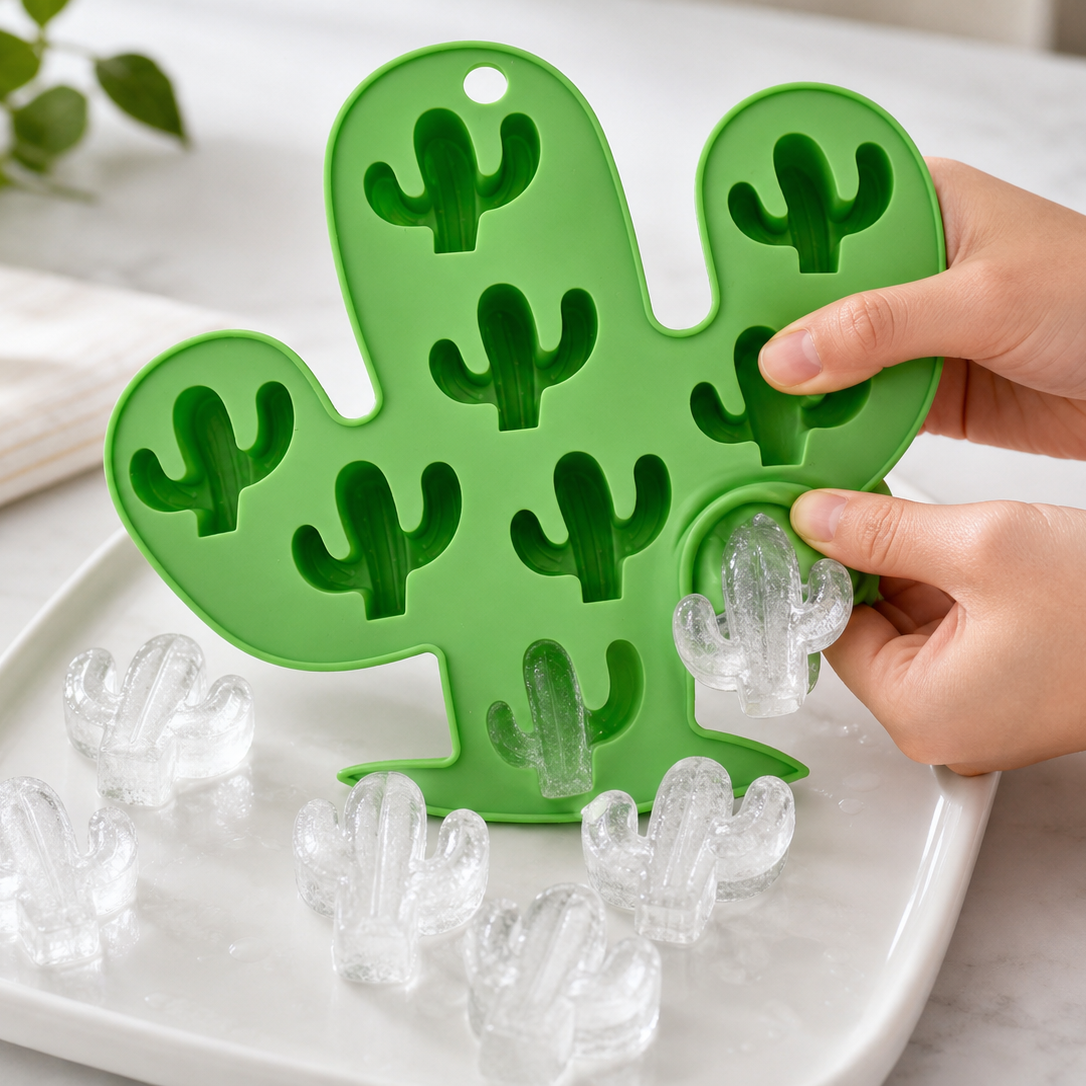
Here, "round ice molds" means molds that produce spherical ice balls—not cylindrical or rounded-edge cubes.
| Comparison factor | Square ice cube trays | Round ice molds |
|---|---|---|
| Initial cooling | Generally faster at equal ice mass and comparable conditions | May cool more slowly because of lower surface area |
| Melting behavior | More exposed surface at equal volume | Less exposed surface at equal volume |
| Dilution | Can introduce meltwater faster during initial cooling | Can slow dilution, but cannot eliminate it |
| Typical drinks | Iced coffee, soft drinks, cocktails, everyday beverages | Whiskey, spirit-forward cocktails, slow-sipping drinks |
| Filling | Open cavities are often straightforward | Two-part designs require alignment and careful filling |
| Storage | Rectangular tray layouts can use shelf space efficiently | Efficiency depends on mold size and housing design |
| Presentation | Familiar and versatile | Distinctive, especially in suitable rocks glasses |
| Commercial positioning | Everyday kitchen accessory | Premium barware or gifting accessory |
Verdict: Choose square ice cube trays when fast chilling and everyday convenience are priorities. Choose round ice molds when presentation and a slower drinking experience matter—but compare actual ice size before assuming spheres perform better.
Ice cools a beverage by absorbing heat. Some energy warms ice toward its melting point; substantial additional energy is absorbed as ice melts.
The contact surface between ice and liquid influences how quickly heat can transfer. Under comparable conditions, more surface area generally supports faster heat exchange.
A sphere has the smallest surface area of any shape enclosing the same volume. That gives spherical ice a geometric advantage for limiting exposed surface, but not an automatic advantage for rapid chilling.
Square cubes provide more surface area at equal volume. Their initial cooling can therefore be faster, although actual performance also depends on liquid movement, temperature differences, and immersion.
The common promise that an ice sphere "cools without watering down your drink" is misleading.
Melting contributes substantially to beverage cooling. If ice melts, water enters the drink. Changing its shape does not remove that relationship.
Large ice can moderate the pace of cooling and dilution. However, comparing drinks after five minutes may produce a different result from comparing them once both reach the same temperature.
For buyers, this distinction matters: slower melting is not necessarily better if the beverage remains warmer than desired.
Shape comparisons become more useful when the ice quantities match.
Consider a perfect cube with sides measuring 40 mm:
- Volume: 64 cubic centimeters.
- Surface area: 96 square centimeters.
A sphere containing the same volume would have a diameter of approximately 49.6 mm and a surface area of approximately 77.4 square centimeters.
That sphere has about 19% less surface area than the cube.
This is a geometric calculation—not a measured claim that the sphere melts 19% more slowly. Real drinks introduce convection, floating ice, glass contact, and changing shapes as melting proceeds.
A 50 mm cube and a 50 mm sphere do not contain equal amounts of ice.
Their respective volumes are approximately:
- 50 mm cube: 125 cubic centimeters.
- 50 mm sphere: 65.4 cubic centimeters.
The cube contains almost twice the volume. Any cooling comparison would therefore mix the effects of shape and quantity.
When sourcing square ice cube trays or round ice molds, request cavity capacity as well as dimensions. Comparing milliliters per cavity gives a more meaningful starting point than comparing width alone.
Published bar experiments show why simple shape-based claims deserve caution.
Bartender Jeffrey Morgenthaler compared different ice formats using equal whiskey portions and broadly similar ice temperatures. In his particular twenty-minute test, the dilution difference between large-format clear ice and smaller cubes was only about 4 ml.
That observation does not prove all ice shapes perform identically. It demonstrates that noticeable differences in appearance do not necessarily produce dramatic differences in the glass.
Another published experiment compared equal masses of spherical ice and cubes in bourbon. The cubes cooled the drink faster and reached a lower temperature, while the sphere melted more slowly during the test.
Both examples support a practical conclusion: evaluate temperature and dilution together. Neither experiment establishes a universal performance percentage for every tray, beverage, or serving environment.
Square ice cube trays are a sensible starting point for beverages that need to become cold promptly.
Examples include:
- Iced coffee prepared from cooled coffee.
- Soft drinks and sparkling beverages.
- Mixed drinks served immediately.
- Water and juice for everyday use.
Several smaller cubes provide more total surface area than one solid piece containing the same ice volume. That can accelerate cooling, although it can also accelerate melting.
Large square cubes offer another option. They combine a familiar shape with a lower surface-area-to-volume ratio than smaller cubes, making them relevant to whiskey and cocktail service too.
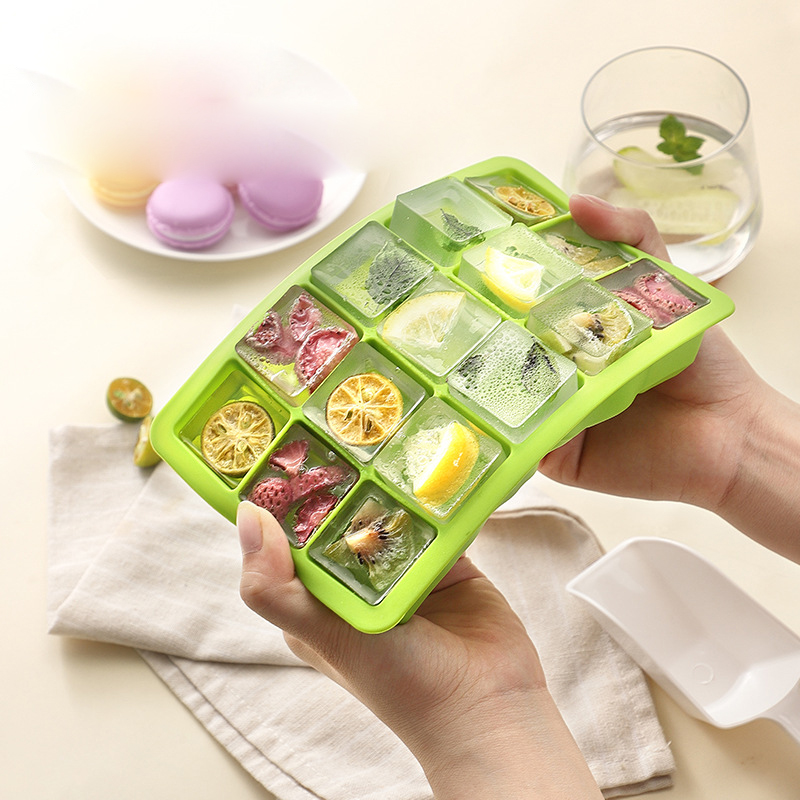
Open square cavities are generally easy to inspect while filling. Users can see the water level and identify overfilled compartments.
Flexible silicone can assist release by allowing the cavity walls to deform. Nevertheless, convenience depends on the finished design—not simply the material name.
For product development, evaluate:
- Cavity wall thickness.
- Base flexibility.
- Rim support.
- Lid fit.
- Filled-tray stability.
A tray that releases ice easily but bends excessively during transport may create a frustrating user experience.
Small cubes may melt faster than consumers expect in warm drinks. Unsupported trays can spill when carried, while unsuitable lids may make stacking inconvenient.
These are design problems rather than unavoidable weaknesses of square ice.
Commercial buyers should test a filled sample, not assess only an empty tray or product photograph.
Large spherical ice is appealing for whiskey, aged spirits, and cocktails served in rocks glasses.
Its lower surface area at equal volume can slow heat transfer and melting under comparable conditions. Its visual appeal also gives brands a clear premium-barware positioning opportunity.
However, a large square cube can serve a similar purpose. The comparison should be between specific ice formats rather than between "ordinary cubes" and "premium spheres."
Many round ice molds use two connected halves with a filling opening.
That design introduces additional checkpoints:
- Do the halves align securely?
- Is the fill level clear?
- Can trapped air escape?
- Does water leak during transfer?
- Can users separate the mold without difficulty?
Water expands when freezing. Follow the mold's intended fill level rather than forcing extra water into a sealed cavity.
Depending on construction, overfilling or poor alignment can produce seams, overflow, or incomplete spheres.
A sphere must fit comfortably inside the intended glass.
A visually impressive ice ball can be impractical if it sits above the liquid, obstructs drinking, or cannot pass through the glass opening.
For retailers and hospitality buyers, test molds with actual serving glasses. Product dimensions alone do not reveal how the finished ice behaves during use.
| Beverage or serving situation | Practical starting choice | Main consideration |
|---|---|---|
| Iced coffee | Square cubes | Convenient filling and prompt chilling |
| Soft drinks | Square cubes | Everyday use and flexible portions |
| Whiskey served slowly | Large sphere or large cube | Size and total ice mass matter alongside shape |
| Spirit-forward cocktails | Large sphere or large cube | Balance presentation, temperature, and dilution |
| High-volume drink service | Square trays, subject to workflow testing | Filling, release speed, and storage capacity |
| Premium gift sets | Round molds or a combined set | Presentation and ease of use |
For iced coffee, neither format prevents dilution. Coffee ice cubes are an alternative when added water is undesirable, although they also change drink strength and flavor as they melt.
For cocktails, some dilution is intentional. The goal is a suitable drinking balance—not necessarily the smallest possible amount of meltwater.
Instead of accepting broad "slow-melting" claims, compare production samples with a repeatable test.
Weigh the ice rather than assuming equal dimensions mean equal quantities.
Use the same freezer conditions, beverage volume, starting beverage temperature, and glass type.
An equal-mass test helps isolate shape.
A separate "normal serving" test shows how each product performs when consumers use its intended number of cubes or spheres.
Both are useful, but they answer different questions.
Measure beverage temperature at consistent intervals, such as one, three, five, ten, and twenty minutes.
Keep stirring behavior consistent. Stirring one drink while leaving another untouched makes the comparison unreliable.
Use a repeatable procedure for recovering and weighing remaining ice, including consistent draining time.
Recognize measurement limitations: liquid clinging to ice can affect results.
Run several trials and report averages alongside the observed range.
Record ambient conditions and any cracked or incomplete ice pieces. Describe the findings as results from that setup—not as guarantees for all beverages.
This protocol gives buyers a stronger basis for packaging claims and product selection.
A well-designed silicone ice tray should balance flexibility with stability.
Inspect mold seams, lid alignment, surface finish, filling instructions, and packaging clarity. Test cleaning and repeated freeze-and-release cycles under the intended conditions of use.
Claims such as dishwasher-safe or temperature-resistant should follow verified specifications for the particular product.
Quality management, social auditing, and food-contact compliance serve different purposes.
- ISO 9001 concerns an organization's quality management system.
- amfori BSCI is a social auditing initiative, not a product certification.
- FDA-related food-contact compliance depends on applicable substances, uses, and conditions.
- LFGB-related assessment should identify the relevant German requirements and testing basis.
- REACH-related documentation should identify the applicable chemical obligations and assessment scope.
Avoid treating this collection as a universal guarantee covering every product and destination.
Request current documentation that matches the product, silicone formulation, manufacturing site, and intended market.
Yangjiang Hongyuan Trading Co., Ltd. manufactures silicone ice trays and other silicone kitchenware for supermarkets, wholesalers, brands, and online retailers.
According to the company information supplied for this article, operations include a 4,500-square-meter main factory and a 2,000-square-meter branch factory, with stated capability to deliver one million products within sixty days.
The company serves customers across the European Union, United States, United Kingdom, Australia, and South America, offering OEM and ODM services.
For a purchasing project, confirm the production schedule against the approved design, tooling requirements, order quantity, inspection plan, and delivery terms.
The supplied company profile also identifies ISO 9001, BSCI, LFGB, FDA, and REACH credentials or compliance documentation. Buyers should review their exact scope and validity before making market-specific claims.
A useful development brief should specify:
1. Target beverage and glass dimensions.
2. Desired ice size and cavity capacity.
3. Tray or mold configuration.
4. Filling, stacking, and release requirements.
5. Destination-market documentation.
6. Packaging, branding, quantity, and delivery expectations.
Contact Yangjiang Hongyuan Trading Co., Ltd. with these requirements to request an OEM or ODM discussion and sample evaluation. Compare square and spherical formats before committing to your final product specification.
Not automatically. Spheres have less surface area at equal volume and may melt more slowly. Cubes generally favor faster initial chilling under comparable conditions.
No. Spheres still melt and add water. Their shape can moderate melting, but temperature, size, and serving conditions affect the outcome.
Yes. Large cubes can provide a practical alternative to spheres. Compare equal ice quantities and actual glass fit.
Not by itself. Shape and silicone material do not guarantee clarity. Clear-ice production requires control of the freezing process, rather than simply choosing a round cavity.
Prioritize usable cavity capacity, filling stability, release performance, glass compatibility, and product-specific compliance documentation. Appearance should complement—not replace—functional testing.
1. [Jeffrey Morgenthaler — "Ice: How Much Does Shape and Clarity Really Matter?"]
Practitioner experiment supporting the discussion of dilution differences and the limitations of broad ice-performance claims. [jeffreymorgenthaler]
2. [Doing Science To Stuff — "On the Shape of Ice: Spheres vs Cubes"]
Equal-mass bourbon experiment supporting the distinction between cooling speed and melting rate. This is an illustrative experiment, not a standardized product certification test. [blog.doingsciencetostuff]
3. [NIST — "Heat of Fusion of Ice: A Revision"]
Technical reference supporting the explanation that melting ice absorbs heat. [nvlpubs.nist]
4. [ISO — ISO 9001:2015, Quality Management Systems—Requirements]
Official explanation of ISO 9001 and its quality-management scope. [iso]
5. [amfori — amfori BSCI]
Official clarification that BSCI is not a certification scheme. [amfori]
6. [FDA — Inventory of Food Contact Substances Listed in 21 CFR]
Official guidance explaining that authorization depends on substance identity, intended use, and conditions of use. [hfpappexternal.fda]
7. [German Federal Institute for Risk Assessment — Recommendations on Food Contact Materials]
Official explanation of recommendations relevant to silicone and other food-contact materials, including their relationship to legal requirements. [bfr.bund]


