


Views: 212 Author: Hongyuan Silicone Publish Time: 2026-10-24 Origin: Site


Content Menu
● Whiskey Ice Sphere Molds vs Large Square Ice Cube Molds: The Quick Comparison
● Why Ice Spheres Usually Melt More Slowly
>> Surface Area Controls Part of the Heat-Transfer Process
>> Cooling and Dilution Are Connected
● The Dimension Trap: Two Inches Does Not Mean Equal Ice
● What Else Changes How Quickly Whiskey Ice Melts?
>> Stirring and Liquid Movement
● Which Shape Works Better for Whiskey and Cocktails?
>> Ice Spheres for a Rounded Presentation
>> Large Cubes for a Geometric Presentation
● Silicone Mold Design: Where Practical Quality Becomes Visible
>> Sphere Mold Alignment and Venting
>> Cube Tray Support and Release
>> Cleaning and Care Instructions
● A Practical Test Protocol for Comparing Both Molds
>> Step 1: Define the Comparison
>> Step 2: Standardize the Conditions
>> Step 3: Record More Than Disappearance Time
>> Step 4: Repeat and Report the Limits
● A Buyer's Scorecard Beyond Melt Speed
● Manufacturing and Compliance: Ask for Specific Evidence
● Choose Your Next Silicone Ice Mold with Measurable Specifications
>> Do Whiskey Ice Spheres Always Melt More Slowly Than Large Cubes?
>> How Much Less Surface Area Does an Ice Sphere Have?
>> Is a Two-Inch Ice Sphere Equal to a Two-Inch Cube?
>> Can Silicone Ice Molds Guarantee Clear Ice?
>> Can Either Shape Chill Whiskey Without Dilution?
>> What Should Private-Label Buyers Request Before Ordering?
Whiskey ice sphere molds generally produce slower-melting ice than large square ice cube molds when the finished pieces have equal volume and start under comparable conditions. The reason is geometry: a sphere exposes less surface area for the same amount of ice. However, a larger cube can outlast a smaller sphere, so shape alone does not determine the winner.
For whiskey drinkers, this comparison is about cooling, dilution, and presentation. For retailers and private-label brands, it also involves filling convenience, freezer space, product consistency, and manufacturing quality.
Our manufacturing perspective at Yangjiang Hongyuan Trading Co., Ltd. starts with one principle: compare the finished ice, not simply the mold's advertised dimensions. Here is how to choose the right format without relying on exaggerated melt-time claims.
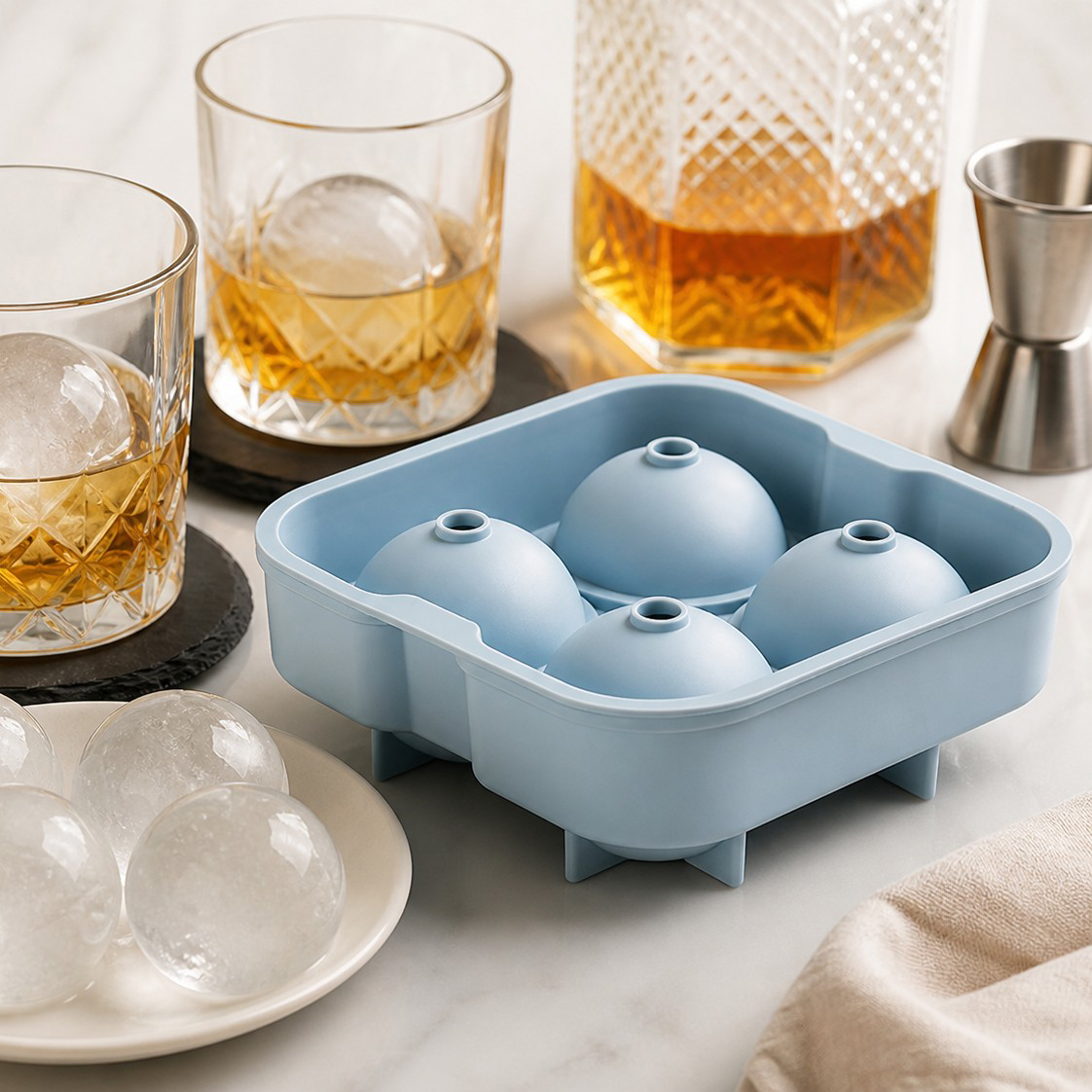
The most important comparison condition is volume. A two-inch sphere and a two-inch cube do not contain the same amount of ice.
| Comparison point | Whiskey ice sphere molds | Large square ice cube molds |
|---|---|---|
| Equal-volume surface area | Lower | Higher |
| Expected melting behavior | Generally slower under comparable conditions | Generally faster initially at equal volume |
| Typical construction | Often two-piece with filling openings | Often open cavities with an optional lid |
| Filling considerations | Alignment, venting, and fill level matter | Usually easier to inspect visually |
| Release considerations | Separate mold halves carefully | Flex individual cavities |
| Visual presentation | Rounded, sculptural appearance | Geometric, substantial appearance |
| Useful positioning | Whiskey accessories and gift sets | Everyday barware and cocktail accessories |
| Main purchasing check | Finished sphere volume and seam quality | Finished cube volume and cavity stability |
These are design tendencies, not universal product specifications. A well-engineered sphere mold can be easier to use than a poorly supported cube tray.
Ice melts as it absorbs heat from its surroundings. The exposed surface provides the interface through which that heat enters.
For an equal volume, a sphere has less surface area than a cube. This creates a geometric advantage: less external area is available for heat transfer.
However, actual melting also depends on liquid movement, immersion depth, ice temperature, glass temperature, and room conditions. Surface area explains the expected direction of the comparison; it does not establish a universal stopwatch result.
Statements such as "spheres always last twice as long" therefore need product-specific testing.
Slower melting does not mean that a sphere delivers identical cooling with no water added.
Ice absorbs heat as it warms toward its melting temperature and then as it melts. Melting contributes both cooling and dilution. A shape that transfers heat more slowly may also cool the drink more slowly initially.
This distinction matters when comparing whiskey ice ball molds with large cube trays. The objective is usually a suitable balance between temperature and dilution over the drinking period—not simply the longest-lasting piece of ice.
A common comparison places a two-inch-diameter sphere beside a cube with two-inch edges. Their maximum dimensions match, but their volumes differ substantially.
The following figures are geometric calculations for ideal shapes, not measurements from a drinking experiment.
| Finished ice shape | Volume | Total surface area |
|---|---|---|
| Sphere, 2-inch diameter | Approximately 4.19 cubic inches | Approximately 12.57 square inches |
| Cube, 2-inch edges | 8.00 cubic inches | 24.00 square inches |
| Sphere matching the cube's volume | 8.00 cubic inches | Approximately 19.34 square inches |
The two-inch cube contains approximately 91% more ice by volume than the two-inch sphere. A sphere needs a diameter of approximately 2.48 inches to match that cube's volume.
At equal volume, the sphere has approximately 19.4% less total surface area.
That percentage is not a measured reduction in melting speed. It describes geometry only. Real-world heat transfer changes as the ice moves, melts, and becomes rounded.
For buyers, the practical lesson is straightforward: request cavity volume or finished ice weight alongside diameter and edge length.
A warm glass and room-temperature whiskey introduce different heat loads from a chilled glass and cooler liquid.
Ice taken directly from a freezer also differs from ice left on a counter. Comparing products without controlling these starting conditions makes the results difficult to interpret.
Stirring brings warmer liquid into contact with the ice surface and changes heat transfer.
A continuously stirred cube cannot be fairly compared with an untouched sphere. The same applies to differences in swirling, pouring technique, and handling.
A larger piece contains more ice, but it must fit the intended glass.
Check the glass opening, internal taper, and remaining space for the pour. A sphere that fits through the rim may still sit awkwardly near the bottom. A cube may catch against tapered sides.
Glass compatibility is therefore part of product performance, not merely styling.
Ice that has started melting before service carries surface water into the drink. Cracked ice also introduces additional exposed surfaces and less predictable behavior.
For meaningful comparisons, use intact pieces and standardize the time between removal from the freezer and placement in the glass.
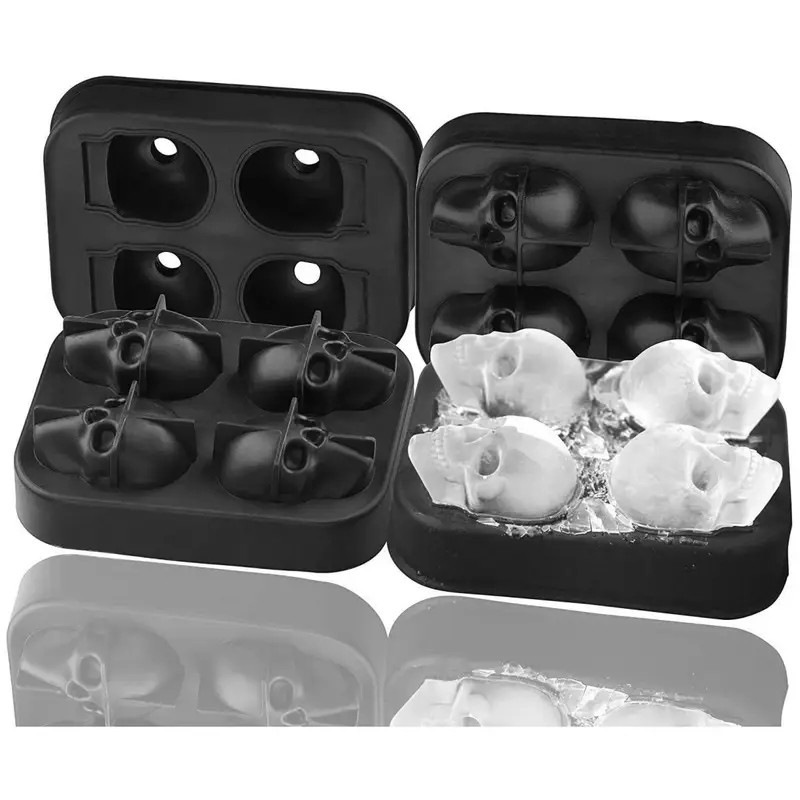
Whiskey ice spheres suit products positioned around deliberate sipping and distinctive presentation.
Their equal-volume surface-area advantage supports a slower-melting design rationale. Nevertheless, the benefit should be described conditionally rather than as a guaranteed duration.
For gift-oriented collections, consider the complete experience: filling, freezing, release, glass compatibility, and storage between uses.
Large square ice cubes provide a different visual identity and can serve both whiskey and spirit-forward cocktails.
Open-cavity designs also let users see the fill level directly. Depending on the tray, they may be convenient for preparing multiple pieces in one batch.
Neither format is automatically better for every drink. Serving temperature, intended dilution, and user preference remain important.
For a broader product range, offering both shapes can address different serving styles without making unsupported performance comparisons.
Many silicone ice sphere molds use upper and lower sections.
Evaluate:
- Alignment between the two halves.
- Stability when the filled mold is moved.
- Filling-hole accessibility.
- Air escape during filling.
- Leakage around the seam.
- Ease of separating the frozen mold.
A pronounced seam or inconsistent fill can affect the finished appearance. Buyers should inspect actual frozen samples, not just empty molds.
Large cavities place greater demands on tray support during filling and transport.
Check whether the base remains stable, whether cavities distort when lifted, and whether users can release one cube without disturbing the others.
If the design includes a lid, verify its fit separately. A cover should not be described as leakproof unless testing supports that claim.
Instructions should match the finished product's validated limits.
Specify suitable cleaning methods, drying and storage guidance, and any restrictions involving dishwashers or temperature exposure.
Avoid treating "silicone" as a complete performance specification. Buyers should evaluate the material formulation, construction, and documented conditions of use.
A simple, repeatable protocol offers more useful evidence than an isolated promotional demonstration.
Run two separate comparisons where possible:
1. Equal-volume ice to examine shape.
2. As-sold ice sizes to evaluate the customer's actual experience.
Keep those conclusions separate.
Use the same water source, freezer conditions, whiskey batch, pour volume, glass model, and starting temperatures.
Record room temperature and handling time. Avoid stirring unless every sample receives the same treatment.
Useful observations include:
- Initial ice mass.
- Drink temperature at fixed intervals.
- Remaining ice mass at the selected endpoint.
- Cracking and shape changes.
- Ease of filling and release.
Use a consistent draining method before weighing remaining ice. Otherwise, liquid clinging to the surface can distort the comparison.
Repeat each condition at least three times as a practical screening exercise. Report the range as well as the average.
This is a proposed evaluation method, not a claim that our company has already completed these tests. Any published result should identify the tested dimensions and conditions.
For supermarkets, wholesalers, brands, and online retailers, a mold must work beyond the first photograph.
| Evaluation category | What to verify |
|---|---|
| Ice output | Dimensions, cavity volume, and consistency |
| User experience | Filling, transport, release, and cleaning |
| Construction | Seam alignment, support, and lid fit |
| Documentation | Material identity and applicable test scope |
| Packaging | Instructions, warnings, protection, and labeling |
| Production consistency | Agreement between approved samples and shipments |
Request samples from the proposed production specification. Changes in material, colorant, dimensions, or construction may require renewed review.
The strongest purchasing decision combines drink performance with repeatable usability and documentation.
Yangjiang Hongyuan Trading Co., Ltd. manufactures silicone kitchenware, including silicone ice trays, and provides OEM and ODM services.
Our supplied company profile lists a 4,500-square-meter main factory and a 2,000-square-meter branch factory, with capacity to complete a one-million-piece order within 60 days. Project schedules should still be confirmed against tooling, specifications, packaging, and order requirements.
We serve supermarkets, wholesalers, brands, and online retailers across the EU, United States, United Kingdom, Australia, and South America.
Our profile also lists ISO 9001, BSCI, LFGB, FDA, and REACH credentials or compliance references. Buyers should not treat these different frameworks as interchangeable product approvals. Request current documents and verify their scope against the exact product, material, market, and intended use.
For U.S. food-contact applications, compliance assessment concerns the relevant substances and authorized conditions of use—not simply an "FDA" label on packaging.
Choose sphere molds when rounded presentation and equal-volume surface-area efficiency support your product concept. Choose large cube molds when the serving style and tray configuration better match your customers.
For a private-label project, send Yangjiang Hongyuan Trading Co., Ltd. your target market, preferred ice dimensions, cavity count, packaging requirements, and order quantity. Request samples and applicable documentation before approving the final specification.
No. Spheres have a geometric advantage at equal volume, but a substantially larger cube may last longer. Starting temperatures, movement, and glass conditions also matter.
An ideal sphere has approximately 19.4% less surface area than an equal-volume cube. This does not mean that it automatically melts 19.4% more slowly.
No. A two-inch-diameter sphere holds approximately 4.19 cubic inches. A cube with two-inch edges holds 8 cubic inches.
No. Shape and mold material alone do not guarantee clarity. Do not promise clear results without a suitable freezing process and supporting product tests.
Not once the ice melts. Both shapes add water during melting. Their differences concern how cooling and dilution develop under particular conditions.
Request production-specification samples, finished ice dimensions, cavity volumes, care instructions, packaging details, and applicable documentation. Confirm the delivery schedule against the approved order requirements.
1. Wolfram MathWorld. "Sphere." Mathematical basis for sphere volume, surface area, and the geometric comparisons above. Cube figures use standard volume and surface-area formulas.
[https://mathworld.wolfram.com/Sphere.html] [mathworld.wolfram]
2. Dave Arnold, Cooking Issues. "Cocktail Science: Does Crushed Ice Dilute More?" December 3, 2009. Background on cooling, melting, dilution, surface water, and agitation. Its discussion of shaken drinks should not be interpreted as a direct sphere-versus-cube sipping trial.
[https://cookingissues.com/2009/12/03/cocktail-science-does-crushed-ice-dilute-more/] [cookingissues]
3. U.S. Food and Drug Administration. "Determining the Regulatory Status of Components of a Food Contact Material." Guidance on component-level compliance and applicable regulatory pathways.
[https://www.fda.gov/food/packaging-food-contact-substances-fcs/determining-regulatory-status-components-food-contact-material] [fda]
4. Electronic Code of Federal Regulations. "21 CFR Part 174—Indirect Food Additives: General." Regulatory provisions concerning food-contact substances and conditions of use.
[https://www.ecfr.gov/current/title-21/chapter-I/subchapter-B/part-174] [ecfr]


