


Views: 233 Author: Hongyuan Silicone Publish Time: 2026-11-19 Origin: Site


Content Menu
● What Makes a Leak-Resistant Ice Tray Different From a Standard Covered Tray?
>> Standard covered trays: A lid for upright storage
>> Leak-resistant ice trays: A closure designed to contain water
● Leak-Resistant vs Standard Covered Ice Trays: Side-by-Side Comparison
● Which Ice Tray Works Better in an RV Freezer?
● Which Ice Tray Is Better for a Boat or Marine Freezer?
● Three Details That Matter More Than the Lid Label
>> 1. Leave headspace without guessing the fill line
>> 2. Judge the tray while full, not just while empty
>> 3. Match cube size to how people serve drinks
● A Practical Leak Test for RV and Marine Ice Tray Samples
● What Retailers and Distributors Should Verify Before Ordering
>> Can I store a leak-resistant ice tray on its side?
>> Are silicone ice trays better than rigid trays for RV freezers?
>> Does a covered ice tray stop freezer odors?
>> Can I stack leak-resistant ice trays before freezing?
>> What is the best ice tray for a boat without a freezer?
>> Should buyers ask for an "FDA certificate" for a silicone ice tray?
Leak-resistant ice trays are the better choice for RV and marine use when you expect to carry, load, or store water-filled trays while the vehicle or boat is moving. Standard covered trays are usually the better value when you make ice while parked or docked, or load the freezer with cubes you've already frozen. The deciding factor isn't whether a tray has a lid. It's whether the lid can contain water under the conditions you'll actually encounter.
For an RV owner, that might mean getting a filled tray from the sink to a narrow freezer without spilling. For a boat owner, it could mean keeping water inside the tray when the boat rocks at its berth. And for a retailer sourcing a silicone ice tray for camping or boating, it means checking whether the product can deliver the performance the packaging promises. Here's how I would compare the two designs before choosing one for personal use or approving it for a product line.

A standard covered ice tray has a lid intended primarily to cover the cavities. Depending on the design, it may also let you stack trays or keep loose freezer debris off the ice. Some covers press on or slide into place; others snap onto the rim. A cover can feel secure without forming a continuous seal.
That distinction matters most before freezing. Once the cubes have set, you're mainly containing solid ice. Before they set, water can reach a corner or run along the rim when the tray tilts. If you fill and freeze the tray on a stable shelf, a simple cover may be all you need.
A leak-resistant design typically uses a close-fitting rim, a compressible sealing edge, or a gasket to restrict the paths water can take out of the tray. A rigid frame can help keep the rim from bending when you carry a full silicone tray. Clips or locking tabs can help hold the lid down, but their presence alone does not show that every corner seals evenly.
Leak-resistant is not the same as leakproof. Unless the supplier identifies the fill level, orientation, and test conditions behind the claim, don't assume the tray can be stored on its side or upside down. A tray can also contain water inside its lid while allowing it to move between cavities, leaving you with uneven cubes or a thin sheet of ice across the top.
| Buying factor | Leak-resistant ice tray | Standard covered ice tray |
|---|---|---|
| Liquid spill control | Better candidate when the filled tray may tilt; verify the assembled seal | Best for upright use; don't assume the lid retains liquid |
| RV use | Useful when loading a cramped freezer or making ice before departure | Practical for freezing at camp or storing solid cubes |
| Marine use | Preferable when a filled tray may rock or tilt, provided it is stored securely | Suitable for pre-frozen cubes or a stable freezer at the dock |
| Handling | A supportive rim can make a full tray easier to carry | A flexible tray may bow unless supported underneath |
| Opening with cold hands | Tabs or clips may need more effort; check grip and clearance | A simple lift-off cover can be quicker to remove |
| Cleaning | Seal channels and removable gaskets may need extra attention | A simple lid generally has fewer edges and grooves to clean |
| Storage and value | The closure earns its cost if it solves a recurring spill problem | Better value when you don't need liquid containment |
Compare the footprint of the *assembled* tray, not just the dimensions of the silicone mold. A clip that protrudes beyond the rim or a tab that you can't reach inside a shallow drawer can make an otherwise good design frustrating to use.
For road trips, I'd buy a leak-resistant ice tray if I regularly fill it shortly before leaving. The awkward moment often comes before the RV moves: one hand is holding the freezer drawer open while the other is guiding a full tray past frozen food. A firm perimeter and a lid that visibly seats at all four corners can matter more than extra cube capacity.
If you make ice only after leveling the RV at camp, start with a standard covered tray. Use the shelf with the most usable space, and make sure the tray can slide in without you lifting one end. For a short trip, freezing cubes at home is simpler still. Transfer them into a closed freezer container and skip transporting liquid water altogether.
Before ordering, measure the drawer opening, its usable depth, and the height under any shelf lip. Then check whether you can remove the tray without snagging its tabs. If you plan to stack trays, try the stack while filled: the upper tray should rest on a stable surface rather than press down on the lower lid.
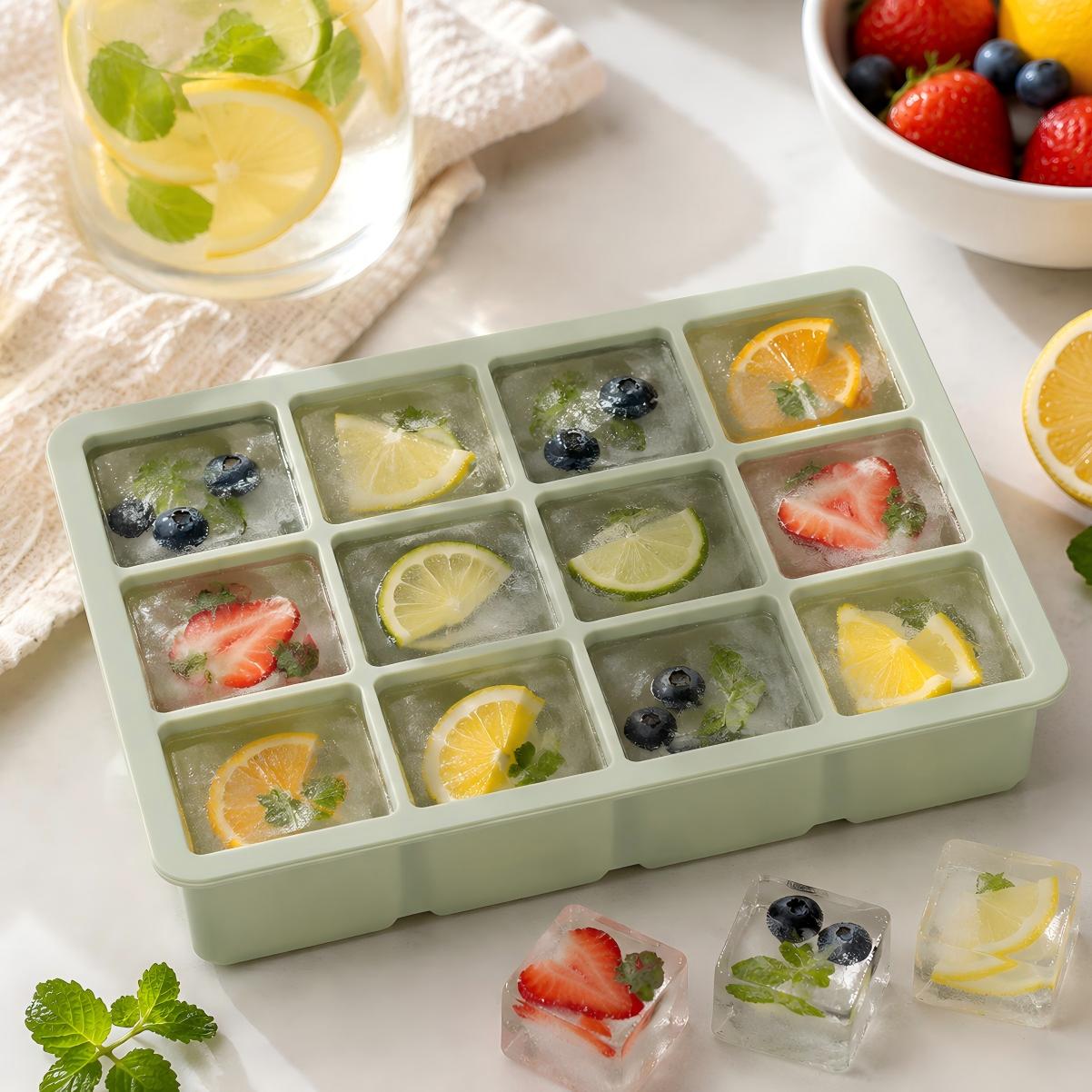
For making ice aboard, a leak-resistant silicone ice tray is the better starting point when the boat can rock before the water freezes. I'd prioritize a lid that is easy to inspect, a base that feels stable when full, and a footprint that fits a secured compartment. The seal controls water inside the tray; it does nothing to stop the tray itself from sliding.
For day boating, a standard covered tray can be entirely adequate if the cubes are already frozen. If you're carrying those cubes in a cooler rather than a freezer, a closed storage container may be easier to handle than leaving them in the mold. Pick the format based on whether you need to make ice aboard or simply bring it along.
Also check the lid in the space where you'll use it. A stiff four-clip design may look appealing on a workbench but be awkward in a top-opening marine freezer where you can't reach the far-side clips. If opening it takes both hands, lift the tray onto a stable surface first.
Headspace is the empty space above the liquid. Water takes up more space when it freezes, so filling a cavity to the brim leaves little room for expansion. It also gives water less room to move before it reaches the lid during loading.
Use the manufacturer's fill line or instructions rather than applying one universal allowance to every mold. Cavity shape and lid clearance differ. If you're developing a private-label model, check the marked fill level against both spill performance and cube release. The fill line should be easy to see in a galley and should produce the cube size promised on the package.
Silicone flexibility helps when you push cubes out. That same flexibility can make a water-filled tray sag during a one-handed carry. If the rim bends enough to pull away from the lid, a closure that looked snug on the counter may leak as you lift it.
I would check that the tray holds its shape when picked up by the intended grips and still lets you release a few cubes without twisting the entire mold. If the tray uses a rigid frame or a removable gasket, also check how those pieces come apart and whether they're easy to reassemble correctly after washing.
A large cocktail cube can be a selling point, but check that it fits the cups and bottles people actually carry on the road or on the water. For families filling narrow drink bottles, a tray that makes smaller or slimmer pieces may be more useful than one with a larger total capacity. For entertaining aboard, cube shape and presentation may matter more.
For retailers, photograph the assembled tray next to a ruler or list its outer dimensions alongside the cube dimensions. That answers two different questions: "Will the tray fit my freezer?" and "Will the ice fit my glass?"
This is a proposed comparison method, not an industry certification or proof of performance underway. Run it on a standard covered tray and a leak-resistant sample before deciding which one deserves the shelf space or higher price.
1. Fill each tray to its recommended level. Record the water volume, then dry the outside so filling drips won't be mistaken for leaks.
2. Close the lid as instructed. Carry each tray the same distance, using its intended grips, and set it down on dry absorbent paper. Record any wet spots and their location.
3. Compare controlled tilts over a sink or basin. For example, hold each tray at 15 degrees for 30 seconds, testing the long and short edges separately. Record external leakage and water movement between cavities as separate results. The angle and duration are sample screening conditions, not a travel rating.
4. Freeze the tray flat and inspect it afterward. Check for lid lift, ice bridges between cavities, and whether you can remove a few cubes without releasing all of them.
5. Wash, dry, and retest. Repeat on multiple samples before approving a bulk order. If you change the lid, gasket, or rim, retest the new assembly rather than carrying over the old result.
For a product claim, document which samples passed at what fill level, angle, and duration. "No visible external leakage during a 15-degree, 30-second tilt test at the marked fill line" is more useful than "boat-proof"—provided those are the conditions and results you actually recorded.
Start with the use case, not the material name. A camping assortment for customers who freeze ice at camp may need an affordable standard covered silicone tray. An RV or marine assortment can justify a premium model if a verified closure solves a problem buyers repeatedly face.
Ask for assembled dimensions, cavity capacity, lid and gasket materials, care instructions, and food-contact documentation for the exact configuration you plan to sell. For U.S. sourcing, confirm the applicable basis for compliance; 21 CFR 177.2600 may be relevant to repeated-use rubber components. For EU sourcing, review the general food-contact framework and applicable national requirements. A factory quality-management certificate or social audit is not a substitute for product-specific food-contact evidence.
Yangjiang Hongyuan Trading Co., Ltd. manufactures silicone ice trays and other silicone kitchenware. We provide OEM and ODM services for supermarkets, wholesalers, brands, and online retailers serving the EU, U.S., UK, Australia, and South America. Based on our company figures, our 4,500-square-meter main factory and 2,000-square-meter secondary factory support delivery of orders of up to one million units within 60 days. Confirm timing and document scope for your specific configuration, packaging, and destination market.
Request a sample from Yangjiang Hongyuan Trading Co., Ltd.. Share your target freezer dimensions, preferred cube size, destination market, and whether buyers will freeze water while parked, docked, or in motion. Use those details to compare closure options and agree on what the approved sample must demonstrate before production.
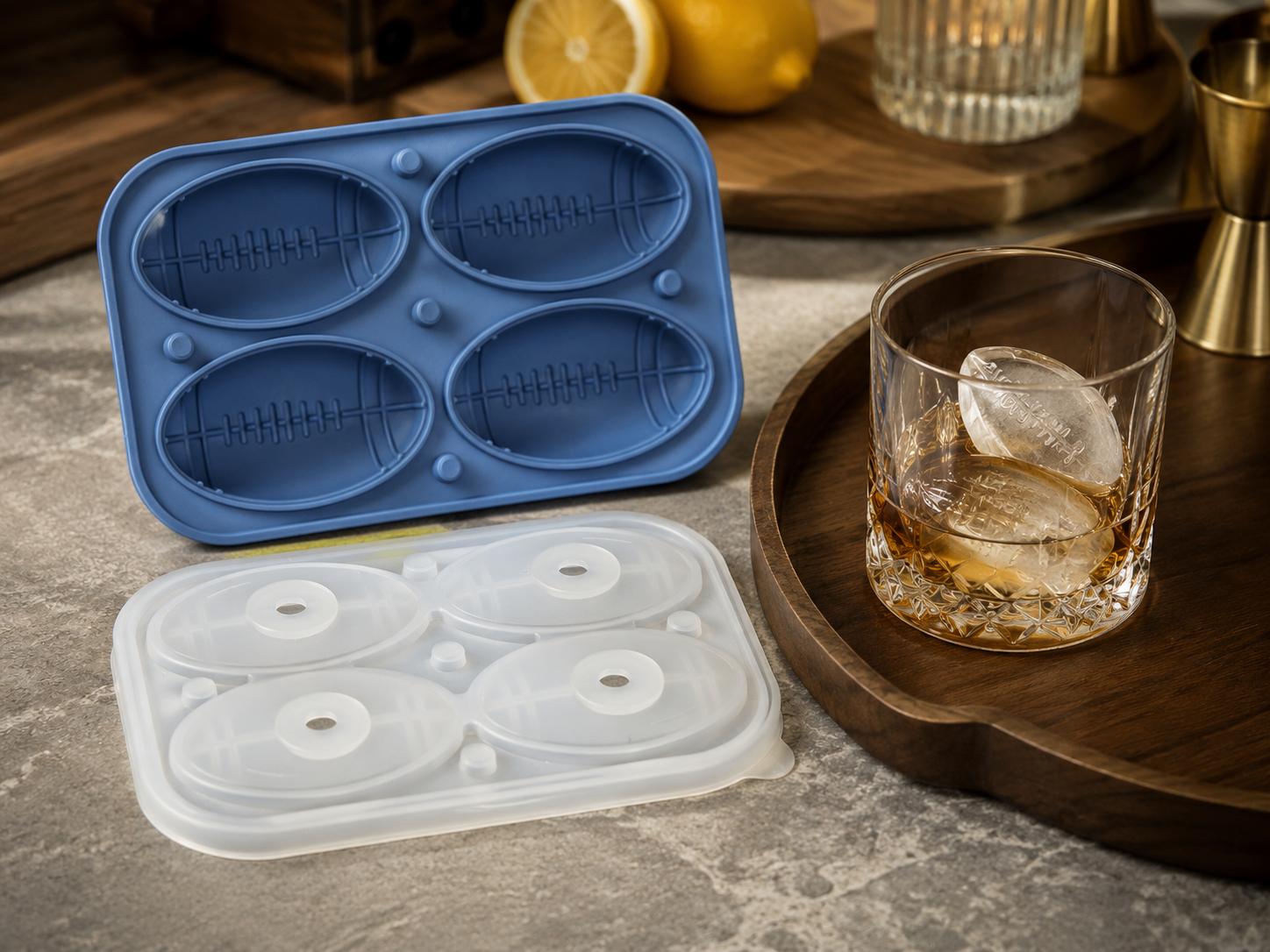
Only if the manufacturer explicitly supports side storage for that model at the intended fill level. A test at a modest tilt does not establish that the tray will hold water on its side. Store it upright unless that orientation has been verified.
Silicone is useful when you want to push out cubes individually. A rigid tray or a silicone tray with a supportive frame may be easier to carry while full. Compare cube release and handling separately; the material alone doesn't tell you how well the lid seals.
A lid limits direct exposure, but a loose cover should not be treated as an airtight odor barrier. If you plan to keep cubes for longer, move them into a clean, tightly closed freezer container.
Yes, if the model is designed for filled stacking and the stack remains upright and stable. Check that the top tray does not press on the lid below, interfere with the clips, or make either tray hard to remove.
If you're using a cooler rather than an onboard freezer, make the ice ashore and bring it in a closed container. In that situation, a standard covered tray is usually enough for making the cubes; you don't need to pay extra for liquid containment aboard.
Ask for the applicable U.S. food-contact compliance basis and supporting documentation for the specific product instead. Confirm that the reports cover the relevant components and intended use. A generic "FDA" claim does not tell you what was evaluated.
- U.S. Geological Survey, [Water Density]. Background for why water occupies more space as ice and why fill headspace matters. [usgs]
- Electronic Code of Federal Regulations, [21 CFR § 177.2600 — Rubber Articles Intended for Repeated Use]. U.S. regulatory text covering specified repeated-use rubber articles, including listed silicone elastomers, and applicable extractives requirements. [ecfr]
- EUR-Lex, [Regulation (EC) No 1935/2004 on Materials and Articles Intended to Come into Contact with Food]. General EU food-contact framework.


