


Views: 212 Author: Hongyuan Silicone Publish Time: 2026-10-31 Origin: Site


Content Menu
● Silicone Rubber vs Natural Rubber: Key Differences at a Glance
● What Are Silicone Rubber and Natural Rubber?
>> Silicone rubber: a synthetic elastomer
>> Natural rubber: a plant-derived elastomer
● Heat Resistance: Which Rubber Is Better for Kitchenware?
>> Why a material temperature rating is not enough
● Strength, Flexibility, and Wear: Where Natural Rubber Excels
>> Design details that influence service life
● Chemical Resistance, Oils, and Cleaning Conditions
>> Evaluate dishwasher claims separately
● Food-Contact Safety: Compare Evidence, Not Labels
>> Understand what different documents establish
>> Check that reports match the supplied product
● Sustainability: Avoid Simple "Natural vs Synthetic" Claims
● Three Practical Buying Scenarios
>> Scenario 1: A private-label baking mold
>> Scenario 2: A room-temperature jar-opening grip
>> Scenario 3: A protective foot for a kitchen accessory
● A Five-Step Qualification Plan for Custom Kitchenware
>> 1. Define the real use conditions
>> 2. Freeze the material specification
>> 3. Approve production-representative samples
>> 4. Verify compliance and performance
>> 5. Control changes and production batches
● Cost Comparison: Look Beyond the Unit Price
● OEM and ODM Silicone Kitchenware with Hongyuan
>> Is silicone rubber better than natural rubber?
>> Is silicone rubber the same as natural rubber?
>> Can natural rubber be used in food-contact products?
>> Is every silicone utensil oven-safe?
>> Which material lasts longer?
>> What should buyers request before ordering silicone kitchenware?
Silicone rubber vs natural rubber is more than a comparison of two flexible materials. For kitchenware buyers, the choice affects heat resistance, product durability, food-contact compliance, manufacturing cost, and customer satisfaction. Both materials have valuable properties, but they solve different problems.
From a kitchenware manufacturing perspective, our starting point is simple: application comes before material preference. A baking mold, a jar-opening grip, and a protective foot should not share the same specification merely because they all feel soft.
This guide explains the difference between silicone rubber and natural rubber, where each performs best, and how buyers can turn material comparisons into reliable purchasing decisions.

The following comparison describes general material behavior, not guaranteed specifications for every formulation.
| Buying consideration | Silicone rubber | Natural rubber |
|---|---|---|
| Base polymer | Synthetic polymer with a silicon–oxygen backbone | Primarily polyisoprene obtained from rubber-tree latex |
| Main strengths | Heat resistance, weathering resistance, formulation flexibility | Elastic recovery, abrasion resistance, mechanical resilience |
| Temperature suitability | Generally better for elevated-temperature applications | Generally better suited to moderate-temperature applications |
| Tear and wear performance | Highly dependent on formulation and product geometry | Often strong in demanding mechanical applications |
| Oil and chemical resistance | Must be checked against the specific substance | Generally unsuitable for petroleum oils and many hydrocarbons |
| Food-contact suitability | Requires an appropriate formulation and supporting evidence | Possible with appropriately formulated and verified grades |
| Typical kitchen-related uses | Spatulas, baking molds, pastry tools, selected seals | Grips, cushioning components, selected food-processing gaskets |
| Purchasing priority | Verify finished-product heat and food-contact performance | Verify wear performance, exposure conditions, and suitability |
Neither material is automatically food-safe, dishwasher-safe, or suitable for every kitchen task.
Silicone rubber is an elastomer built around a silicon–oxygen polymer backbone. Manufacturers combine the polymer with reinforcing fillers, curing systems, pigments, and other permitted ingredients to achieve specific properties.
Common processing options include high-consistency rubber molding and liquid silicone rubber injection molding. The appropriate route depends on geometry, production volume, tolerances, and tooling investment.
For buyers, the important distinction is between the material family and the finished formulation. Two silicone products can differ substantially in stiffness, tear strength, odor, and thermal performance.
Natural rubber comes primarily from the latex of rubber trees. Processing and vulcanization transform it into useful elastic compounds.
Its principal strengths include resilience, tensile performance, and resistance to abrasion and repeated flexing. These qualities explain its extensive use in wear-resistant industrial components.
However, plant origin does not make the finished compound additive-free, universally biodegradable, or automatically suitable for food contact.
Silicone rubber generally offers the stronger starting point for products exposed to baking temperatures and repeated heating.
Natural rubber has a narrower practical high-temperature operating window. For example, published specifications for certain industrial natural-rubber sheets list an operating range of approximately −50°C to +90°C. That is product-specific guidance, not a universal limit.
Silicone formulations also vary widely. Published sealing specifications demonstrate that even products within the silicone family carry different temperature ratings.
A silicone spatula includes more than a polymer. Its safe operating conditions may also depend on:
- The internal reinforcement.
- The handle material.
- Bonded or assembled joints.
- The thickness of the silicone covering.
- Contact duration and exposure conditions.
For an oven product, request evidence supporting the finished article at its claimed temperature. Do not convert a raw-material datasheet into a retail claim without validation.
Direct flame and prolonged contact with a hot heating element also require separate consideration.
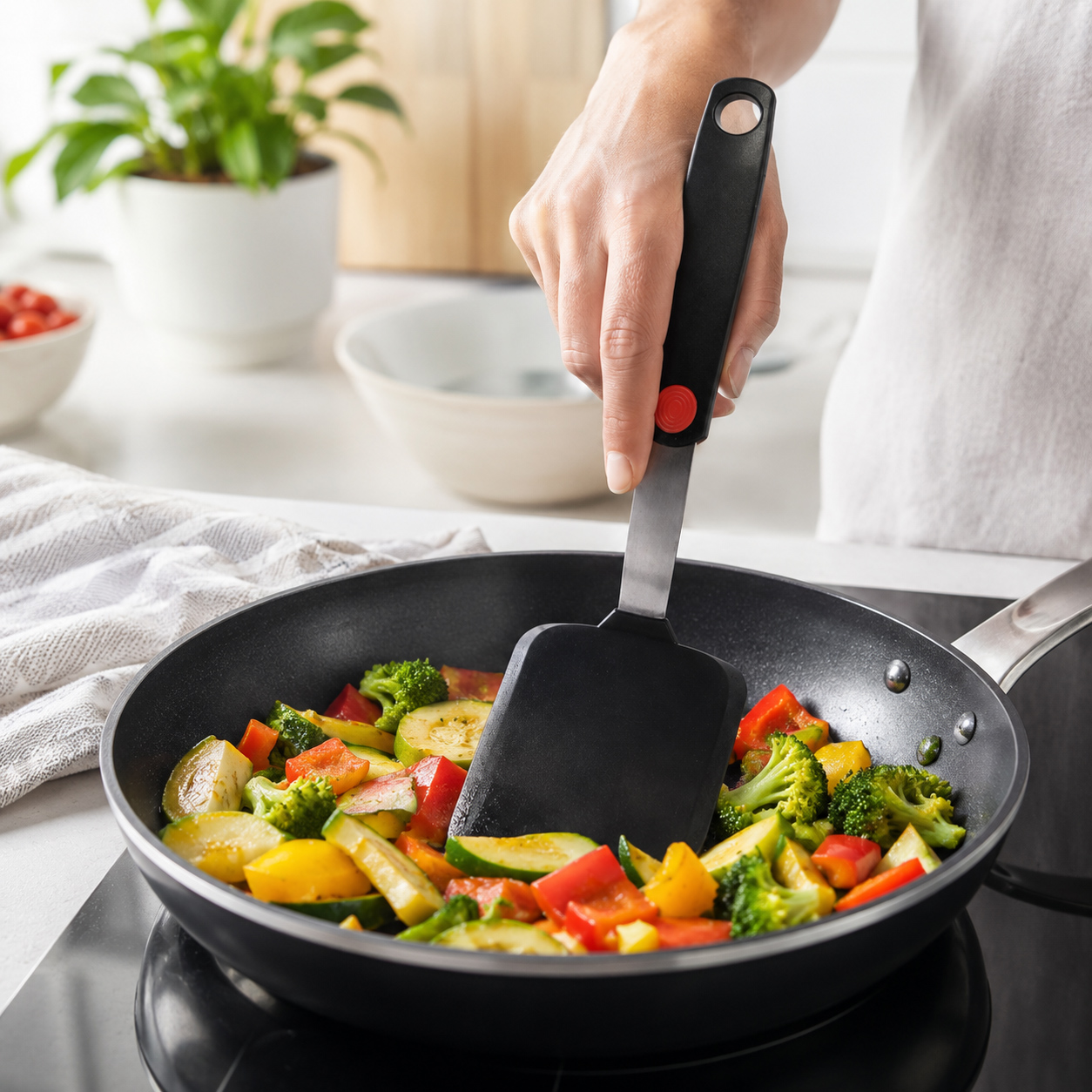
Natural rubber often performs well when products must stretch repeatedly, absorb impact, or resist abrasion.
Silicone can provide excellent flexibility, but softness alone does not demonstrate mechanical durability. A thin edge may feel pleasant while remaining vulnerable to cuts or tearing.
For silicone kitchen utensils, product geometry can matter as much as compound selection.
Buyers should examine:
- Thin transitions between the head and handle.
- Sharp internal corners.
- Exposed reinforcement.
- Molded hanging holes.
- Areas subjected to repeated bending.
- Joints that can loosen during cleaning.
Our practical recommendation is to test realistic failure points rather than judging samples only by appearance and hand feel.
A thicker section may improve strength, but it can also change flexibility, weight, curing requirements, and cost.
One common misconception is that silicone rubber resists all oils, solvents, acids, and cleaning chemicals. It does not.
Compatibility depends on the compound, chemical concentration, temperature, and exposure duration. Natural rubber also has limitations, particularly with petroleum oils and many hydrocarbons.
Kitchen conditions introduce a different exposure profile: cooking fats, acidic foods, detergent, hot water, and repeated drying.
A useful dishwasher assessment should examine more than whether the product survives one wash.
Check for:
- Changes in hardness or flexibility.
- Surface tackiness or cracking.
- Separation around inserts.
- Color changes.
- Persistent odor.
- Loss of dimensional stability.
Define the cleaning conditions and acceptance criteria before testing. Otherwise, "dishwasher-safe" becomes an unclear promise rather than a reproducible specification.
Food-contact suitability depends on formulation, manufacturing controls, intended use, and applicable requirements.
A silicone appearance, a familiar certification logo, or a statement that material is "food grade" is not sufficient evidence on its own.
Natural rubber can also be formulated for certain food-contact uses. Its suitability must be demonstrated for the intended conditions rather than assumed or dismissed.
For procurement purposes, distinguish between:
- ISO 9001: evidence concerning a quality management system within its certified scope.
- BSCI: a social-compliance assessment framework, not a food-contact product approval.
- FDA-related compliance: a claim that should identify the applicable requirements and supporting evidence.
- LFGB-related testing: documentation that should identify the methods, samples, and intended use assessed.
- REACH documentation: information addressing relevant chemical obligations, not a replacement for food-contact evaluation.
For repeated-use rubber articles in the United States, applicable requirements may include formulation restrictions and extraction testing under 21 CFR 177.2600.
German assessment guidance also addresses silicones intended for food contact. Product purpose matters: a silicone object intended as a toy should not automatically be used as a baking mold.
Confirm the tested model, material, color, manufacturer, test conditions, and report date.
Ask how changes to pigments, suppliers, curing conditions, or construction are assessed. A report has limited purchasing value if it cannot be connected to the product being delivered.
Natural rubber has a renewable biological feedstock. Silicone is synthetic and should not be presented as biodegradable.
Nevertheless, feedstock origin alone cannot establish which finished product has the lower environmental impact.
A meaningful comparison should consider:
- Raw-material sourcing.
- Manufacturing energy.
- Product mass.
- Expected service life.
- Packaging and transport.
- Replacement frequency.
- Available end-of-life routes.
A durable reusable silicone utensil may reduce replacement demand in a particular application, but that outcome should not be presented as a universal environmental advantage.
Likewise, a natural-rubber compound should not be marketed as compostable without evidence covering the finished product and relevant disposal conditions.
These scenarios illustrate material-selection logic; they are not customer case studies or laboratory results.
The priorities are elevated-temperature performance, food-contact suitability, dimensional stability, and release behavior.
Silicone is generally the more appropriate candidate. Qualification should cover the finished mold, its claimed use conditions, and repeated heating.
Natural rubber would not be the normal starting point for this application.
Here, grip, elastic recovery, wear, and cost may matter more than oven resistance.
Either material could merit evaluation. Compare actual prototypes on dry and wet surfaces, inspect stretching behavior, and define whether food contact is intended.
The best choice may differ from the best material for a spatula.
Compression, abrasion, surface staining, attachment strength, and cleaning exposure become central concerns.
Natural rubber may offer useful mechanical performance. Silicone may be attractive when temperature or weathering resistance matters.
The decision should follow component-level testing, not the material preference used elsewhere in the product range.
Specify foods, temperatures, contact times, cleaning methods, and expected mechanical loads. Separate normal use from foreseeable misuse.
Agree on the compound, hardness, color, reinforcement, dimensions, and permitted substitutions.
Hardness alone is insufficient: compounds with similar hardness can have different tear strength and thermal behavior.
Use samples made with the intended material and manufacturing process. Record appearance, dimensions, flexibility, and assembly quality.
Connect food-contact documentation to the approved product. Add use-specific checks such as repeated bending, washing, heating, or joint-strength testing.
Establish traceability, inspection criteria, and change-notification requirements before volume production.
For large orders, an approved reference sample and clear acceptance criteria help prevent disagreements about acceptable variation.
Natural rubber can be economical when its mechanical properties match the task. Silicone may justify a higher purchase price when heat performance or environmental resistance is essential.
However, neither material guarantees the lowest total cost.
Compare:
- Tooling and development charges.
- Material consumption.
- Inspection and testing.
- Packaging and freight.
- Rejects and rework.
- Returns and replacements.
Request quotations against the same specification. Comparing a lightweight, unreinforced utensil with a reinforced, tested alternative does not reveal the true cost difference between materials.
Yangjiang Hongyuan Trading Co., Ltd. manufactures silicone kitchenware and provides OEM and ODM services for supermarkets, wholesalers, brands, and online retailers.
According to our company-provided information, our operations include a 4,500-square-meter main factory and a 2,000-square-meter branch factory, with stated capacity to fulfill one million pieces within 60 days. Actual scheduling should be confirmed against product complexity, tooling, packaging, and approval requirements.
We serve customers across the EU, United States, United Kingdom, Australia, and South America. Market-specific documentation should be agreed for each project rather than treated as interchangeable global approval.
Send us your product drawing or reference sample, target market, intended temperature range, quantity, and packaging requirements. Our team can then discuss material selection, customization, documentation, and a project-specific production schedule.
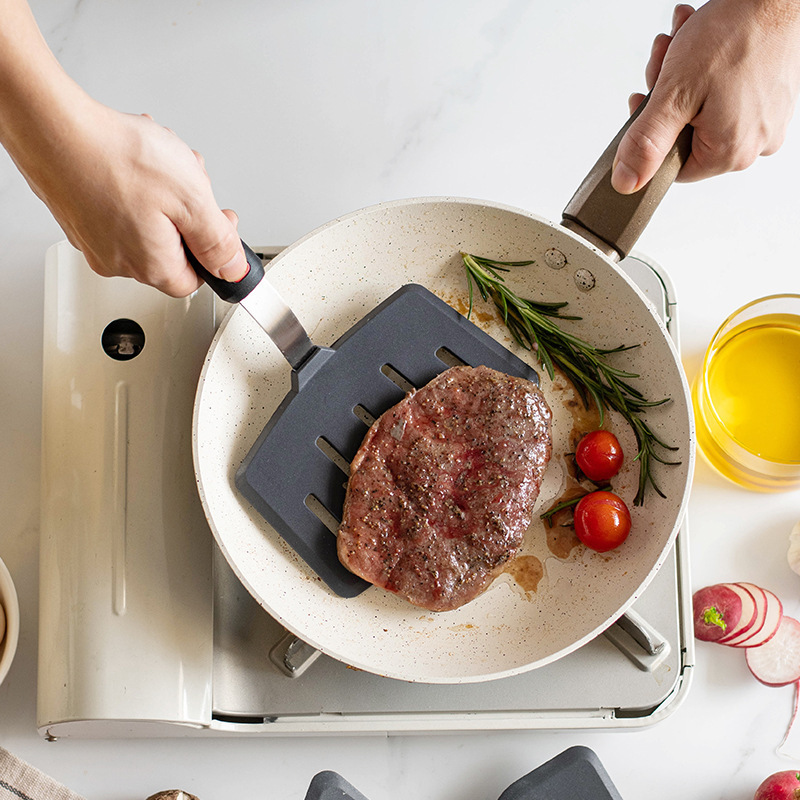
For heat-exposed kitchenware, silicone is generally the stronger candidate. Natural rubber may be preferable where resilience, abrasion resistance, and moderate-temperature performance dominate.
No. Silicone is a synthetic elastomer with a silicon–oxygen backbone. Natural rubber is primarily polyisoprene obtained from rubber-tree latex.
Yes, appropriately formulated grades have food-related applications. Suitability depends on the compound, intended conditions, and supporting compliance evidence.
No. The finished construction and validated use conditions determine suitability. Check the product-specific temperature rating and instructions.
Neither wins universally. Silicone generally resists heat and weathering better, while natural rubber can excel in abrasion and repeated mechanical deformation.
Request an agreed specification, production-representative samples, relevant food-contact reports, traceability information, inspection criteria, and written controls for material or process changes.
1. Trelleborg, "Materials Chemical Compatibility Guide." Technical background on elastomer properties, silicone performance, and application-dependent chemical compatibility. [trelleborg]
2. Trelleborg, "NR SBR." Product-specific natural-rubber temperature guidance, mechanical properties, and oil-exposure limitations. [trelleborg]
3. Trelleborg, "Isoprene, Synthetic (IR)." Background on the resilience, tear resistance, abrasion resistance, and chemical limitations of polyisoprenes, including natural rubber. [trelleborg]
4. Cornell Law School, Legal Information Institute, "21 CFR § 177.2600—Rubber Articles Intended for Repeated Use." Regulatory text covering composition, extraction limits, and repeated-use food-contact conditions. [law.cornell]
5. German Federal Institute for Risk Assessment, "BfR Advises Against Preparing Food in 'Pop-it Fidget Toys.'" Guidance on intended use, silicone food-contact suitability, and elevated-temperature migration concerns. [bfr.bund]
6. Trelleborg, "O-Rings & Back-up Rings." Examples of formulation-specific temperature ratings and limitations on applying laboratory operating limits to actual service conditions. [trelleborg]
7. Trelleborg, "Technical Rubber Sheets." Examples of natural-rubber grades intended for food-industry gaskets and distinctions between compound properties. [trelleborg]


