


Views: 278 Author: Hongyuan Silicone Publish Time: 2026-11-17 Origin: Site


Content Menu
● Airtight vs Ventilated Ice Tray Lids at a Glance
● Why Airtight Ice Tray Lids Keep Ice Fresher
>> The seal matters during storage as much as during freezing
>> What makes a sealed lid work in everyday use?
● Do Ventilated Ice Tray Lids Actually Freeze Faster?
>> Airflow helps only if it changes how heat leaves the tray
>> A frozen surface does not mean a finished cube
● Three Lid Designs for Different Freezer Routines
● How to Test Freezing Speed and Odor Transfer Before Ordering
>> Run a matched freezing trial
>> Separate odor testing from freezing testing
● What OEM and ODM Buyers Should Specify
>> Does an airtight ice tray lid stop all freezer odors?
>> Will a covered silicone ice tray always take longer to freeze?
>> Can I stack silicone ice trays while the water freezes?
>> Can I leave the vents open until the cubes freeze and then close them?
>> Why does my ice still taste bad with a sealed lid?
>> Is a snap-on lid the same as an airtight lid?
An airtight ice tray lid is the better choice for reducing freezer odor transfer, but it does not automatically freeze water as quickly as a ventilated lid. A ventilated ice tray lid can improve cooling at the water surface if its openings allow meaningful airflow. Those same openings expose the water and ice to freezer air. For most households, a well-fitted, low-profile sealed lid is the better starting point. For buyers who need faster batches, the most practical alternative is to freeze with the vents open, then store the solid cubes in a sealed container.
The distinction matters for anyone sourcing a silicone ice tray with a lid: a cover that keeps out crumbs is not necessarily airtight, and a cover with vent holes is not necessarily faster. The useful comparison is how much odor each design keeps out and how long the center of the last cube takes to freeze under the same conditions.
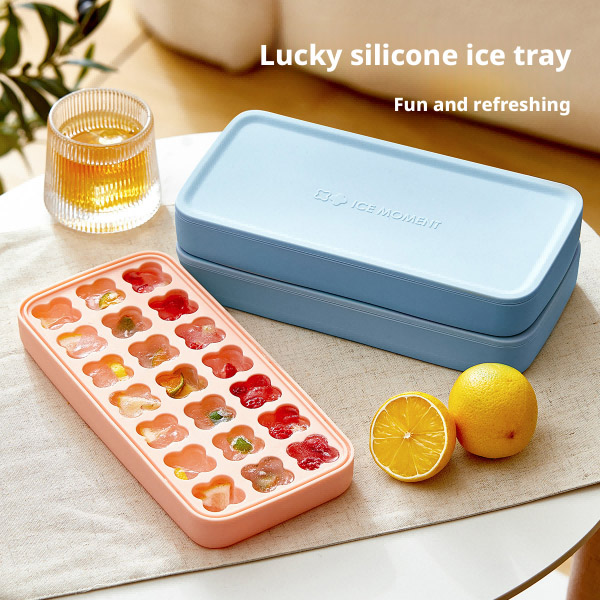
| Feature | Airtight or tightly sealed lid | Ventilated lid |
|---|---|---|
| Freezer odor protection | Better potential when the perimeter seals consistently | Lower potential while the vents are open |
| Freezing speed | May reduce cooling from above; the effect depends on the tray and lid | May improve cooling from above if the openings allow enough airflow |
| Spill resistance | Can be better with a secure closure, but test it separately | Water can escape through vents when the tray tilts |
| Stacking | Depends on lid rigidity, support points, and spacing | Stacking may block the very vents the design relies on |
| Best use | Shared freezers, advance preparation, and covered storage | Frequent batches in a clean, low-odor freezer |
| What to verify | Seal consistency, frozen fit, and odor performance | A measurable speed gain and acceptable odor exposure |
Treat airtight as a performance claim, not a description of how the lid looks. A loose dust cover, a snap-on lid, and a gasketed seal are different designs. A lid may resist a brief splash without providing a reliable barrier to air exchange. Likewise, a tiny vent may help air escape when the lid is pressed down without making the cubes freeze noticeably faster.
Ice can pick up off-flavors when it sits in circulating air near poorly wrapped foods. A sealed lid limits that exposure while it is closed. The benefit is easier to appreciate when you make ice ahead of a gathering or store cubes alongside strong-smelling leftovers. Plain sparkling water also makes an off-flavor easier to notice than a strongly flavored drink.
A sealed silicone ice tray works best as part of a simple routine: wrap strong-smelling foods, clean spills, and rotate stored ice. If cubes already taste or smell wrong, discard them and check the water, the tray, and the freezer before making another batch. A new lid will not fix stale water or residue in a rim groove.
Look for a continuous rim and a clear indication that the lid is seated. On a flexible silicone tray, inspect the corners while lifting the filled tray. A lid can appear flush on a countertop but lift slightly when the base flexes. Also check whether the sealing surfaces are easy to wash, rinse, and dry. A closure that works only when every corner is carefully pressed is harder to use consistently than one that seats with an obvious click or a visible fit.
Water loses heat through the top surface as well as through the tray walls and base. A lid that traps a still layer of air above the water can reduce heat transfer through the top. Vents can improve that route, but only if they allow enough air exchange. Vent size, placement, clearance above the lid, and the tray's location in the freezer all affect the result.
The other heat paths still matter. A shallow cavity and a deep cocktail-cube mold should not be judged by the same freezing-time target. Starting water temperature, fill depth, and freezer conditions can also change the result. A vented lid with another tray sitting directly on its openings may offer little airflow advantage. Conversely, a well-fitted sealed lid on a shallow tray may meet the buyer's time target without any vents at all.
Do not compare lids by checking which tray first forms a crust. A cube can look solid on top and still have liquid in its center. For a household check, sacrifice a center cube and inspect it for liquid. For a product test, use a consistent center-freeze endpoint across samples. The relevant question is not which tray looks frozen first, but when the batch is ready to release and serve.

1. Sealed lid for advance preparation. Choose this when ice will stay in the tray for days or share space with strong-smelling foods. If a sample misses the freezing-time target, compare a shallower tray or test it unstacked before switching to a permanently vented model.
2. Vented lid for frequent batches. Choose this when a side-by-side test shows a meaningful time saving, the freezer is kept clean, and the ice will be used soon. If you make more than you need, move the solid cubes into a clean, sealed freezer container.
3. Closable vent for flexible use. Open the vent while freezing, then close it for storage. This design only helps if the open position improves freezing under real conditions and the closed position reduces odor transfer. Check whether users can tell which position it is in and whether frost or residue makes the mechanism difficult to operate.
1. Use the same tray body for both lids where possible. Keep cavity dimensions, water source, fill mass, starting water temperature, and headspace consistent.
2. Set the freezer to 0°F (−18°C) and log the actual temperature near the trays. Use equivalent shelf positions and swap positions on repeat runs. Test trays unstacked first; repeat with the intended stack if that is part of the product promise.
3. Define the endpoint before starting. Use the same center-cavity location for both designs and confirm that the cube is solid through the center. For destructive checks, use separate samples at planned intervals so repeated handling does not change the comparison.
4. Repeat the comparison and report the observed range, not just the fastest run. Agree in advance what time difference would matter to the customer. A difference smaller than the variation between runs is a poor basis for a packaging claim.
For a storage comparison, start with cubes from the same batch. Divide them among the sealed-lid sample, the vented-lid sample, and an uncovered control. Keep the samples in the same freezer for a defined period with the same odor exposure, and code them so evaluators do not know which lid was used. Include a clean, separately sealed reference so evaluators can distinguish freezer odor from an off-note already present in the water or tray.
Smell the samples before and after melting, and record odor intensity on the same scale. A 24-hour check can represent overnight storage; a seven-day check can represent ice made for the week. These are suggested test windows, not published performance benchmarks. If the product claim covers odor protection during freezing as well as storage, run a separate trial that starts with water under each lid.
At Yangjiang Hongyuan Trading Co., Ltd., we manufacture silicone ice trays and other silicone kitchenware for supermarkets, wholesalers, brands, and online retailers. Our 4,500-square-meter main factory and 2,000-square-meter branch factory support order volumes of up to one million units within 60 days, according to our production figures. Confirm timing for the specific design, tooling, packaging, and order schedule before committing to a launch.
A useful sourcing brief covers four points:
- Seal and handling: Specify how the lid should seat, how the filled tray will be carried, and what spill resistance you expect. Recheck the fit after repeated freezing and washing.
- Freezing and storage: Define the cube size, fill line, stack configuration, and target time to a fully solid cube. Give odor protection its own acceptance criterion.
- Food-contact documentation: Request current records for the exact tray, lid, and any gasket or color variant, as applicable to the destination market. Keep ISO 9001 quality-management documentation and amfori BSCI social-audit records separate from food-contact evidence, such as applicable U.S. FDA requirements or German LFGB-related testing. Review REACH-related documentation according to the product and market.
- Retail wording: Use "helps reduce freezer odor transfer" only when the evidence supports it. Avoid "odor-proof," "leakproof," or "freezes faster" unless the finished product has been tested against a clear criterion or comparator.
For your next OEM or ODM silicone ice tray, send Yangjiang Hongyuan your target cube size, destination market, expected order volume, and preferred lid design. Request matched sealed and vented samples so you can compare freezing time, odor protection, and everyday handling before approving packaging or tooling.
No. A well-fitted seal can reduce exposure, but performance depends on the design, how well the lid is seated, and how often it is opened. It also cannot prevent off-flavors that originate in the water or on the tray itself.
No. A cover can reduce cooling from above, but cavity depth, water temperature, and airflow around the rest of the tray also affect freezing time. There is no universal time penalty for adding a lid.
Yes, if the trays are designed for stable stacking. Check that the upper tray does not bend the lid below it or block its vents. If batch speed matters more than saving shelf space, compare a stacked batch with an unstacked one.
Yes. A closable vent lets you separate freezing from storage. If the vents cannot close, transfer the fully frozen cubes into a clean, sealed freezer container.
Compare the water before freezing with a fresh batch made in a clean tray. Check for old ice, food residue, detergent left around the seal, or poorly wrapped food nearby. If the water tastes normal but only the stored ice develops an off-flavor, focus on the tray, lid fit, and freezer environment.
No. "Snap-on" describes how the cover attaches, not how much air it lets through. Judge the seal on the finished tray, including its fit at freezer temperature and after normal use.
- [Whirlpool Product Help — Ice Has Odor or Off Taste]. Supports the discussion of odor transfer, food wrapping, and when to discard affected ice. [producthelp.whirlpool]
- [Whirlpool — Ice Maker Troubleshooting]. Supports the household freezer setting and guidance on rotating stored ice. [whirlpool]
- [FAO — Freezing and Refrigerated Storage in Fisheries: Freezing Time]. Explains the roles of airflow, product thickness, packaging, and trapped air in heat transfer. These are general freezing principles, not measured results for silicone ice trays. [fao]
- [FAO — Freezing of Fruits and Vegetables: Introduction to Freezing]. Explains how starting temperature, geometry, and airflow affect freezing. The sample comparison protocol in this article is proposed, not a published test standard. [fao]
- [Electronic Code of Federal Regulations — 21 CFR § 177.2600: Rubber Articles Intended for Repeated Use]. Provides U.S. regulatory context where applicable to repeated-use rubber food-contact components; it does not verify an individual product's compliance. [ecfr]


