


Views: 264 Author: Hongyuan Silicone Publish Time: 2026-11-13 Origin: Site


Content Menu
● What Should You Look for in a China Silicone Kitchenware Factory?
>> Verify the Manufacturing and Contracting Entities
● Define Your Silicone Kitchenware Specifications Before Requesting Prices
● Understand Food-Contact Compliance Before Placing an Order
>> United States: Request the Relevant Regulatory Basis
>> European Union: Check the Framework and Destination Requirements
>> Separate Product Testing from Factory Credentials
● Evaluate Silicone Quality Through Evidence, Not Slogans
>> Match Heat Claims to the Finished Product
>> Approve Performance, Not Just Appearance
● Choose Between OEM and ODM Silicone Kitchenware
● Audit Production Capacity Beyond Factory Size
● Build a Sample-to-Production Control Plan
>> Stage 1: Development Sample
>> Stage 2: Approved Reference Sample
>> Stage 3: Preproduction Confirmation
>> Stage 4: Production and Shipment Inspection
● Compare Total Landed Cost, Not Just Unit Price
>> Illustrative Procurement Scenario
● Working with Yangjiang Hongyuan Trading Co., Ltd.
● Start Your Silicone Kitchenware Project with a Clear Brief
>> How do I verify a China silicone kitchenware factory?
>> What is the minimum order quantity for custom silicone kitchenware?
>> Does an FDA-related report prove compliance in Europe?
>> Can I customize silicone kitchen utensils with my own brand?
>> Can one million products be completed within 60 days?
>> What should I approve before mass production?
Choosing a China silicone kitchenware factory involves more than comparing prices and selecting colors. For supermarkets, wholesalers, brands, and online retailers, the real challenge is finding a manufacturing partner that can turn an approved sample into consistent, compliant bulk production.
At Yangjiang Hongyuan Trading Co., Ltd., we approach sourcing from a manufacturer's perspective: define the product clearly, verify the evidence, and agree on production controls before committing to volume.
This guide explains how to evaluate silicone kitchenware manufacturers in China, compare quotations, plan OEM and ODM projects, and reduce avoidable purchasing risks.

The strongest supplier is not necessarily the one with the largest catalog or lowest quotation. It is the one that can demonstrate a repeatable process for your specific product.
Start with five questions:
- Can the supplier identify where your products will be manufactured?
- Can it document the materials and components used?
- Do test reports match the products you intend to order?
- Can production capacity support your delivery schedule?
- Will the supplier accept written quality and change-control requirements?
Our buying principle is simple: prioritize traceability. A sample, quotation, test report, and production order should describe the same product—not four slightly different versions.
A company name alone does not establish who operates the factory. Equally, "Trading" in a registered name does not automatically mean a business lacks manufacturing operations.
Ask for the contracting entity, manufacturing-site details, business documentation, and payment beneficiary information. If different entities are involved, clarify their responsibilities in writing.
A factory visit or live video walkthrough should follow your product's route through material preparation, molding, finishing, inspection, and packing.
A useful quotation starts with a useful specification.
"Food-grade silicone spatula" is not detailed enough to produce comparable offers. Suppliers may interpret its weight, reinforcement, finish, packaging, and testing requirements differently.
| Specification | What buyers should define |
|---|---|
| Product construction | One-piece design, assembled handle, or reinforced core |
| Dimensions and weight | Target measurements and acceptable tolerances |
| Material requirements | Silicone formulation identification and component details |
| Intended use | Food types, contact duration, and operating conditions |
| Appearance | Color reference, texture, logo position, and finish |
| Performance | Flexibility, joint strength, cleaning, and heat-use requirements |
| Packaging | Retail format, barcode, carton quantity, and shipping dimensions |
| Compliance | Destination market and applicable testing scope |
Include photographs, drawings, or a reference sample wherever possible.
For silicone baking molds, prioritize cavity dimensions, stability, and release performance. For spatulas and spoons, focus on edge flexibility, handle comfort, and structural strength.
These details make wholesale silicone kitchenware quotations more meaningful.
"Certified for worldwide sales" is too broad to be a reliable purchasing specification.
Food-contact requirements depend on the destination, material composition, construction, and intended use. Different markets may require different supporting evidence.
For suitable repeated-use rubber articles, 21 CFR 177.2600 provides requirements covering permitted substances and extractives, among other provisions.
Ask your silicone kitchen utensils manufacturer to identify the applicable regulatory basis and provide supporting documentation for the finished article.
A document labeled "FDA certificate" is not enough by itself. Check the tested sample, material, method, laboratory, and use conditions.
Food-contact articles placed on the EU market must comply with Regulation (EC) No 1935/2004 and applicable good manufacturing practice requirements under Regulation (EC) No 2023/2006.
For silicone products, relevant national requirements also need consideration. Do not assume that documentation prepared for a plastic article automatically establishes silicone compliance.
For Germany-bound orders, ask what an "LFGB-tested" claim actually covers. The report should identify the applicable assessment criteria and tested product.
These terms address different issues:
| Term | What buyers should verify |
|---|---|
| ISO 9001 | Quality-management certificate, covered entity, site, and scope |
| amfori BSCI | Social audit report, site identity, findings, and corrective actions |
| FDA-related compliance | Applicable US requirements and supporting product evidence |
| LFGB-related testing | Product-specific assessment criteria and test results |
| REACH | Applicable chemical obligations and supporting documentation |
Amfori BSCI is an audit system, not a product-safety certification.
Neither a management-system certificate nor a social audit replaces food-contact testing.
For the UK, Australia, and South American destinations, request a separate market review rather than treating US or EU reports as universal approval.
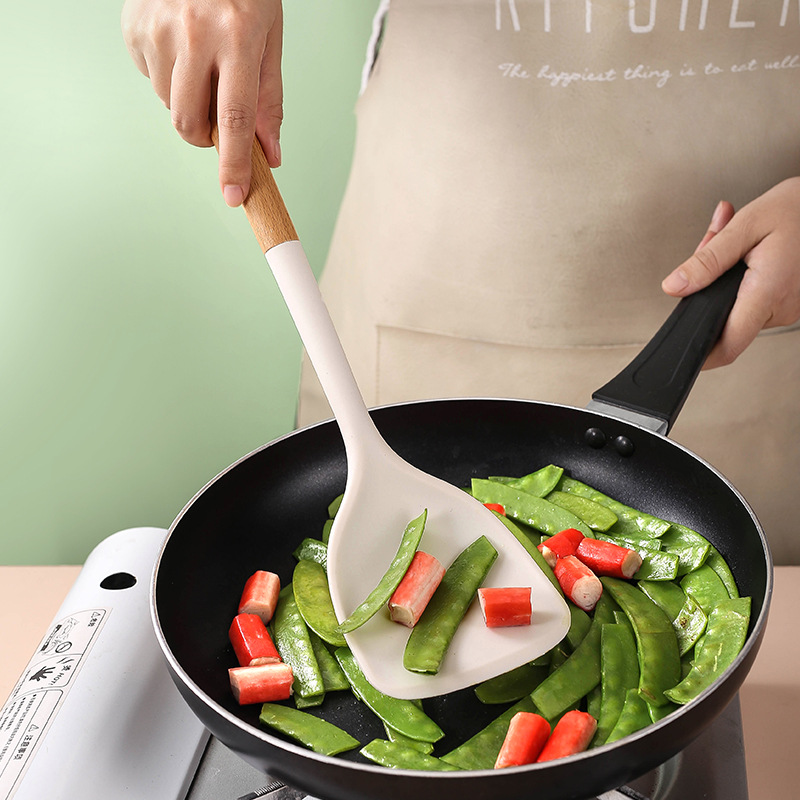
Terms such as "premium silicone" and "100% food-grade" need supporting specifications.
Request material identification, relevant supplier documentation, and finished-product testing appropriate to the intended application. Include pigments, inserts, adhesives, and other components where relevant.
Do not copy a generic silicone temperature range onto packaging.
The finished product may contain a plastic handle, metal core, printed decoration, or bonded joint. Each can affect its suitability for a particular use.
Ask the supplier to distinguish between:
- Continuous exposure and brief contact.
- Oven use and stovetop use.
- Food-contact temperature and surrounding air temperature.
- Recommended use and prohibited conditions.
Likewise, support dishwasher-safe claims with an agreed evaluation procedure.
A visually attractive sample can still fail commercially.
Evaluate grip comfort, scraping performance, flexibility, stability, cleaning access, and joint integrity as applicable.
Treat household checks as screening tools—not substitutes for laboratory analysis or documented production controls.
OEM and ODM projects involve different development responsibilities.
In an OEM arrangement, the buyer generally supplies more of the design and specification. In an ODM arrangement, the manufacturer generally offers an existing design platform for adaptation. Confirm the supplier's actual definitions before signing.
OEM can suit buyers seeking a distinctive shape, functional feature, or coordinated product collection.
Before commissioning tooling, agree on:
- Drawing approval and revision control.
- Tooling ownership and storage.
- Maintenance responsibilities.
- Design confidentiality.
- Exclusivity, if negotiated.
- Procedures for transferring or retiring molds.
ODM can suit buyers launching a private-label silicone kitchenware range using an existing product design.
Customization may include colors, logos, packaging, and set combinations, subject to feasibility.
However, an existing mold does not guarantee immediate availability. Confirm production slots, minimum quantities, material availability, and whether changes require additional testing.
Factory area provides context, but it does not establish output on its own.
Yangjiang Hongyuan Trading Co., Ltd. reports a 4,500-square-meter main factory and a 2,000-square-meter branch factory. Our stated fulfillment capability is one million products within 60 days.
For purchasing decisions, that capability should be translated into an order-specific schedule. Product complexity, mold availability, color changes, packaging, and testing all need confirmation.
Ask a prospective factory to explain:
1. Which machines and molds will support the order.
2. How capacity is allocated among products.
3. Where finishing and packing take place.
4. Which operations, if any, are subcontracted.
5. How delays or rejected batches will be handled.
Also distinguish production completion from delivery to your warehouse. Freight, customs clearance, and inland transport must be addressed separately.
One of the most valuable purchasing safeguards is a documented link between the approved sample and the bulk order.
Evaluate shape, function, appearance, and packaging direction. Record changes rather than relying on scattered messages.
Approve a final sample with the agreed material, color, dimensions, branding, and construction.
Both parties should retain identifiable reference samples.
Before mass production, confirm the specification revision, material identification, artwork, packaging files, and testing requirements.
Require written approval before substitutions.
Agree on inspection timing, sampling, defect classifications, acceptance criteria, and corrective actions.
Useful checks include:
- Dimensions and weight.
- Surface finish and cleanliness.
- Functional performance.
- Logo and color consistency.
- Packaging, barcode, and quantity accuracy.
Inspection cannot eliminate every risk. Its purpose is to detect defined problems before shipment and establish a clear response.
The cheapest quotation may exclude items another supplier includes.
Compare quotations on the same specification, quantity, delivery term, packaging format, and testing scope.
A practical purchasing model is:
Total landed purchasing cost = goods + tooling allocation + packaging + testing and inspection + freight + duties and taxes + other agreed import costs.
Keep assumptions visible. Do not compare an EXW quotation directly with an FOB quotation without adjusting the included responsibilities.
Consider two offers for the same private-label utensil set.
One excludes retail packaging, uses a different product weight, and provides only an unrelated test report. The other includes the agreed construction, packaging, and product-specific testing.
The first offer is not yet a like-for-like alternative. Request a revised quotation before deciding which provides better value.
This is a comparison method, not a claim about any particular supplier.
We manufacture silicone kitchenware for supermarkets, wholesalers, brands, and online retailers, supporting OEM and ODM projects.
Our company background includes customers across the EU, United States, United Kingdom, Australia, and South America, alongside our two reported manufacturing facilities.
We also identify ISO 9001, BSCI, LFGB, FDA, and REACH among our quality and compliance credentials. Buyers should request the underlying certificates, audit reports, and product documentation to verify their respective scope.
Our recommendation is to begin with your destination market and product requirements—not simply a catalog selection.
Send Yangjiang Hongyuan Trading Co., Ltd. your product list, quantities, destination markets, customization requirements, packaging format, and target delivery date.
Request an itemized quotation, sample-development plan, relevant compliance documentation, and an order-specific production schedule.
A clear brief gives both sides a stronger basis for discussing price, feasibility, and repeat orders.

Confirm the legal entity, manufacturing sites, production process, and payment details. Review relevant documentation and arrange a visit, independent audit, or live walkthrough.
There is no universal minimum. Ask for quantities by product, color, logo method, and packaging option, since each can affect production planning.
No. US and European requirements differ. Request documentation addressing the destination market and the finished product's intended use.
OEM and ODM projects can include branding and packaging customization. Confirm technical feasibility, artwork approval, minimum quantities, and any testing implications.
That is Hongyuan's stated capability. Confirm its applicability to your order's product mix, molds, materials, packaging, and approval schedule before making downstream commitments.
Approve the specification, reference sample, artwork, packaging, compliance plan, inspection criteria, delivery terms, and substitution-control procedure.
1. European Commission — [Food Contact Materials]. Explains the EU framework, good manufacturing practices, and the role of national requirements. [food.ec.europa]
2. European Commission — [Food Contact Materials: Legislation]. Describes safety, inertness, labeling, and traceability principles. [food.ec.europa]
3. Electronic Code of Federal Regulations — [21 CFR § 177.2600: Rubber Articles Intended for Repeated Use]. Provides composition, extractives, and other requirements for articles within its scope. [ecfr]
4. amfori — [Understanding the amfori Social Auditing Procedure]. Explains social-audit scope and distinguishes it from product-quality and food-safety assessment. [amfori]
5. amfori — [amfori BSCI]. Clarifies that BSCI is not certification and explains its audit approach. [amfori]


