


Views: 201 Author: Hongyuan Silicone Publish Time: 2026-11-18 Origin: Site


Content Menu
● The Best Silicone Bakeware Products to Stock First
>> Silicone Muffin Pans: The Best Starting Point for a Core Range
>> Silicone Baking Mats: The Best Option for a Compact Two-Pack
>> Silicone Loaf Pans: A Useful Test of Structural Design
>> Silicone Cake Molds, Mini Molds, and Baking Cups: Add With a Purpose
● How to Build a Private-Label Silicone Bakeware Assortment
● A Buyer's Sample Test for Silicone Bakeware
● Food-Contact Documentation: What Retail Buyers Should Request
● OEM vs. ODM: When Custom Silicone Bakeware Is Worth It
● Work With Yangjiang Hongyuan on Your Silicone Bakeware Range
>> What silicone bakeware should a retail brand launch first?
>> Is a thicker silicone baking pan always better?
>> Can different colors use the same food-contact report?
>> What temperature should appear on silicone bakeware packaging?
>> What should I include in a private-label silicone bakeware RFQ?
>> How can I reduce returns on silicone bakeware?
The best silicone bakeware products for retail brands are the ones shoppers can understand at a glance and use successfully on the first bake. For a first private-label assortment, start with a muffin pan, a pair of baking mats, and a loaf pan. These three products cover different baking tasks, give retailers clear ways to demonstrate their value, and let buyers compare performance without committing to a long list of custom molds.
At Yangjiang Hongyuan Trading Co., Ltd., we approach silicone bakeware as both a manufacturing project and a retail product. The question is not simply, "Can we make this shape?" It is, "Can shoppers carry it when filled, release the bake cleanly, and find the instructions they need?" This guide uses those questions to compare products, build a practical assortment, and approve samples before placing a production order.

| Product | Best retail fit | What to verify before ordering |
|---|---|---|
| Silicone muffin pan | Supermarkets, kitchenware chains, and starter collections | Cavity consistency, filled-pan stability, and release |
| Silicone baking mat set | Online retailers and baking accessory ranges | Tray compatibility, flatness, and cleaning |
| Silicone loaf pan | Private-label bakeware collections and gift sets | Sidewall stability, usable capacity, and loaf release |
| Silicone cake mold | Seasonal promotions and specialty baking ranges | Detail release, cleaning, and packaging protection |
| Mini silicone mold | Confectionery, dessert, and craft-baking ranges | Cavity volume, filling access, and demolding |
| Silicone baking cups | Entry-price displays and companion purchases | Cup dimensions, shape retention, and pack count |
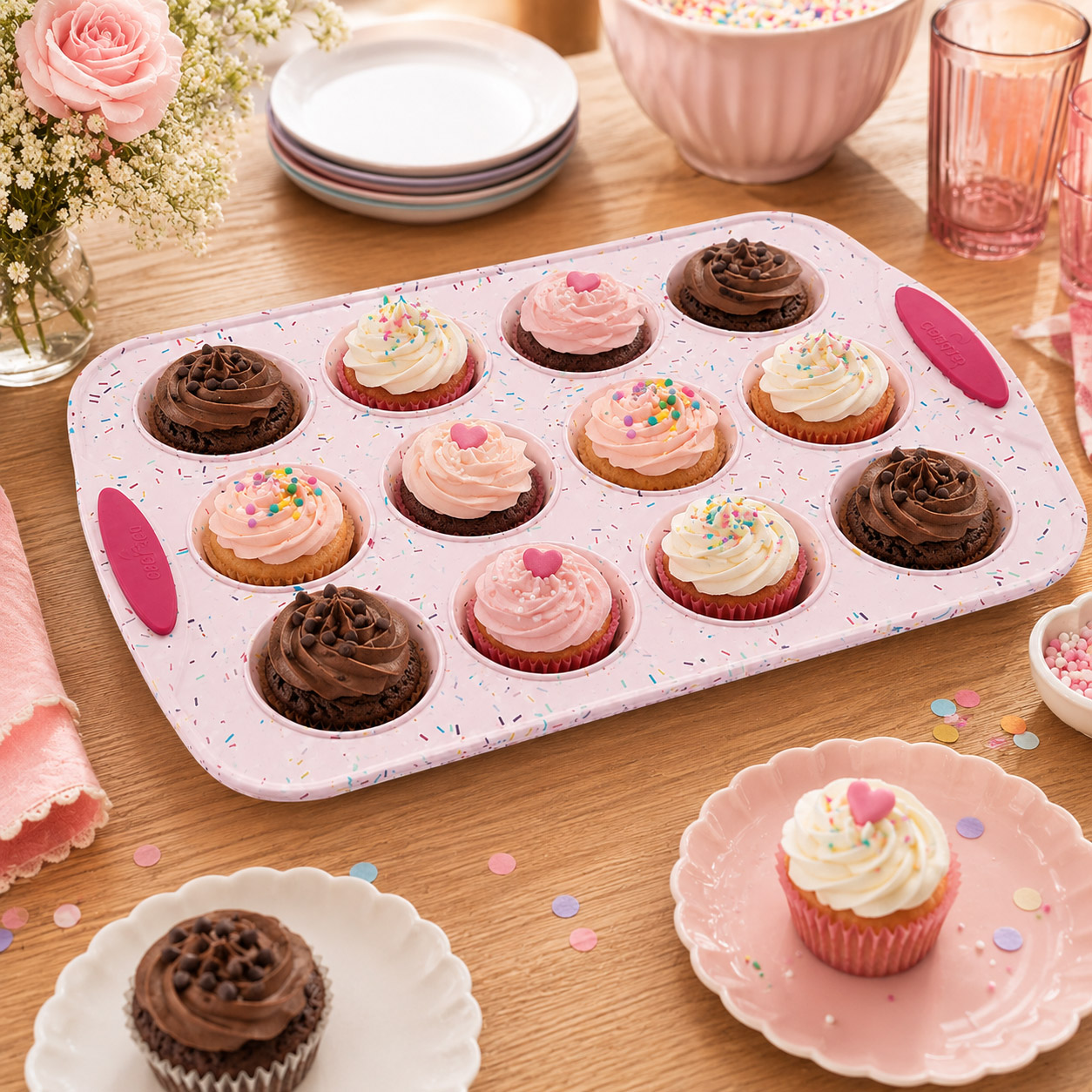
A muffin pan gives customers a familiar product, so your packaging can focus on what makes yours easier to use. Choose the cavity count based on the buyer's shelf space, the customer's likely oven size, and the intended recipe yield. Test a fully loaded sample, not just an empty one. A pan that feels sturdy in the hand can behave differently once every cavity is filled.
Put the cavity size and external dimensions on the pack. If the pan should be placed on a rigid baking tray before filling or moving, show that setup in a product image and in the instructions.
Baking mats are a good candidate for a two-pack, but the size combination should solve a real problem. Two identical mats can suit shoppers who bake on two trays. Two different sizes can serve shoppers who own both a smaller and a larger tray. In either case, give actual mat dimensions rather than relying on a label such as "standard."
When reviewing samples, compare how the mats lie after unpacking, after a bake, and after cleaning. Review them in the final packaging too: a mat that arrives with a persistent crease may disappoint shoppers even if it looked flat at the factory.
A loaf pan has a larger continuous cavity than a muffin pan, so sidewall movement is easier to see when the mold is full. Evaluate the shape with the intended batter load on the support surface specified in the instructions. Compare the finished loaves side by side. If one sample bows noticeably, a lower unit price may not make it the better buy.
List both the outside dimensions and the usable cavity dimensions. The first tells shoppers whether the pan fits their oven or tray; the second helps them judge whether it suits their recipe.
A detailed cake mold can anchor a holiday display, but choose a design based on the finished cake, not the empty mold. Bake it, release it, photograph it, and check how easily batter residue comes out of the smallest recesses. For mini molds, specify cavity volume and the intended use. A mold that works well for a chilled dessert should not automatically inherit oven-use claims from another item.
Reusable baking cups work best as an entry-price item or as a companion to an existing baking range. Show the cup diameter and height, not only the quantity, and state whether the cups are intended to stand alone or sit in a muffin tin.
Before adding colors, shapes, or pack sizes, give each item a distinct job. An opening-price product should be easy to understand. A core product should solve an everyday baking task. A seasonal item should offer a visual reason to buy without forcing the whole range into a short selling window.
- For supermarkets, keep the first range easy to shop: a muffin pan, baking cups, and a mat pack with sizes visible from the shelf.
- For online retailers, start with products that are easy to demonstrate. Show a mat inside a measured tray and a muffin pan supported and filled. Answer fit and handling questions before the shopper reaches checkout.
- For brand owners, use color and packaging to tie the range together, but pay for custom tooling only when the design improves the bake, handling, storage, or presentation.
- For wholesalers, agree on inner packs, master cartons, and barcode placement early. A product can fit the shelf and still be awkward for a distribution customer to receive and replenish.
The most useful sample review recreates the first bake a shopper will attempt. Compare samples using the same recipe, fill quantity, oven setting, and cooling time. For loaf pans, bake the same batter in each sample and compare sidewall movement and the finished loaf profile. For mats, bake the same quantity of cookies and compare release, cleanup, and whether the mat continues to lie flat. This is a product-performance check, not a substitute for food-contact testing.
1. Confirm dimensions before baking. Record the sample ID, overall and cavity dimensions, product weight, and any fit requirements.
2. Test handling when filled. Place the product on its intended support, fill it consistently, and check whether it stays level while being moved.
3. Record the bake and release. Note the recipe, fill quantity, baking conditions, cooling time, and any sticking, tearing, or distortion.
4. Check cleanup and repeat use. Follow the proposed care instructions. If the pack will claim dishwasher compatibility, include the dishwasher in your review rather than testing only by hand.
5. Retain the approved sample. Keep a signed reference sample, photographs, and agreed inspection criteria so the production team and buyer judge the same features.
A "food-grade silicone" claim is not enough to approve a product. Ask what was tested and whether it represents the finished item you plan to order. Match the report to the specification: product or material identifier, formulation and color coverage, intended foods, and the conditions of use. If the factory proposes a different pigment, formulation, or production process, agree on how the change will be reviewed before it goes into production.
- United States: Where applicable, ask for documentation addressing 21 CFR 177.2600 for rubber articles intended for repeated use. Describe the actual compliance basis rather than printing a blanket "FDA approved" claim.
- European Union: Review the finished article against Regulation (EC) No 1935/2004 and applicable destination-market requirements. For silicone, Germany's BfR Recommendation XV is a technical reference, not an EU-wide product approval. If a buyer asks for "LFGB testing," clarify the exact test scope before commissioning it.
- Supplier records: An ISO 9001 certificate concerns the quality management system, while a BSCI audit concerns social compliance. Neither replaces a food-contact report. Review applicable REACH obligations separately; do not treat them as another name for food-contact testing.
For the UK, Australia, or any South American market, confirm the destination and applicable requirements with the importer before approving labels. Do not assume the evidence or wording accepted for one market carries over to another.
An existing mold is the better starting point when a retailer needs familiar dimensions, has a tight launch window, or wants to test demand before investing. Customize the brand presentation first: an approved color, a size guide, clear care instructions, and packaging that makes the product easy to identify.
An OEM project is more compelling when the buyer has a defined specification that an existing design cannot meet. Examples include a pan that fits a particular tray, a proprietary cavity shape, or a rim designed to improve handling. Before approving tooling, agree on ownership, sample rounds, dimensional tolerances, change costs, and whether the mold can be used for other customers. With an ODM project, the supplier can help develop the design from a retail brief, but the buyer should still define what the product must do and how approval will be determined.
Yangjiang Hongyuan Trading Co., Ltd. provides OEM and ODM silicone kitchenware for supermarkets, wholesalers, brands, and online retailers serving the EU, United States, United Kingdom, Australia, and South America. We operate a 4,500 m² main factory and a 2,000 m² secondary factory. Our company reports that we can complete orders of one million units within 60 days. Treat that as a capacity benchmark, not a guaranteed door-to-door schedule: confirm the timing for your product mix, tooling, testing, packaging, inspection, and shipping terms.
To request samples and a quotation, send us your target market, sales channel, preferred products, estimated quantities, packaging requirements, and launch date. We can then compare existing mold options with custom development and identify which samples and documents to review before you commit to production.
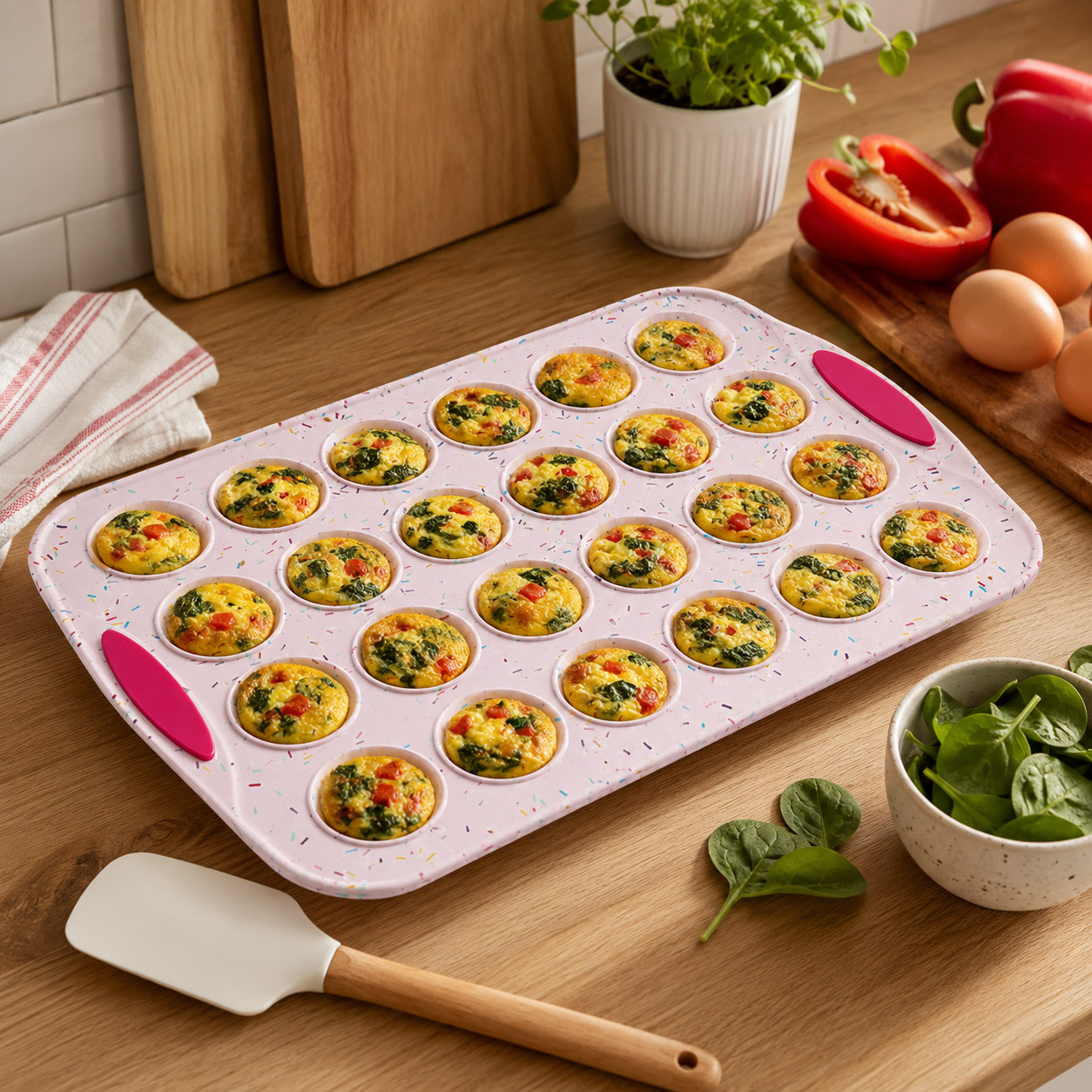
Start with a muffin pan, a baking mat set, and a loaf pan. For a smaller launch, choose the item your customers can evaluate most easily: a mat with clearly stated dimensions online or a familiar muffin pan on a supermarket shelf.
No. Thickness is one design variable. Test the filled pan under the intended conditions and judge its stability, handling, release, and storage. Use the approved sample to define what production must match.
Do not assume they can. Ask for evidence showing which formulations and pigments the report covers. If the proposed color is outside that scope, have the supplier and testing partner determine what additional assessment is needed.
Use the verified limit for the specific finished product and its intended use. Avoid copying a temperature from a competing listing or from a different item in the range. Keep the packaging, instructions, and online listing consistent.
Include the destination market, intended use, dimensions, annual forecast, first-order quantity, materials and colors, packaging format, documentation needs, and target delivery date. If you have a reference sample or drawing, identify which features are mandatory and which can change.
Make size and handling visible before purchase. Show the pan on its support tray if one is needed, publish usable cavity dimensions, and provide clear release and cleaning instructions. Review return reasons by SKU to see whether the product, packaging, or listing needs to change.
- [Electronic Code of Federal Regulations — 21 CFR § 177.2600: Rubber articles intended for repeated use]. U.S. regulatory basis for the repeated-use rubber articles discussed above. [ecfr]
- [German Federal Institute for Risk Assessment — BfR Recommendations on Food Contact Materials]. Explains the status of the recommendations and their relationship to the EU food-contact framework. [bfr.bund]
- [UL Solutions — Food Contact: Germany, Latest Version of BfR Recommendations]. Technical overview of Recommendation XV on silicones and its testing provisions. [ul]
- [Silicones Europe — Good Manufacturing Practices for Organosilicon Materials Intended for Food Contact]. Industry guidance on finished articles, production controls, and traceability. [silicones]


