


Views: 278 Author: Hongyuan Silicone Publish Time: 2026-11-10 Origin: Site


Content Menu
● PP Lids vs Silicone Lids: Quick Comparison
● What Makes PP Lids and Silicone Lids Different?
>> PP lids: Shape retention through rigidity
>> Silicone lids: Shape recovery through elasticity
● Which Ice Tray Lid Resists Warping Better?
>> Silicone generally handles thermal cycling better
>> PP warping depends heavily on processing and design
● Which Material Resists Odor Absorption Better?
>> Separate three different odor problems
● Sealing, Stacking, and Ease of Use
>> A lid is not automatically airtight
>> Stackability requires a load-bearing design
>> Opening force matters to the customer
● A Practical Test Plan for OEM Ice Tray Lids
>> Step 1: Establish a dimensional baseline
>> Step 2: Run representative thermal cycles
>> Step 3: Compare odor retention fairly
● Food-Contact Documentation: What Buyers Should Request
● Choosing the Right Lid for Your Product Range
● Manufacturing Support from Yangjiang Hongyuan Trading Co., Ltd.
>> 1. Are silicone ice tray lids less likely to warp than PP lids?
>> 2. Do PP lids prevent freezer odors completely?
>> 3. Why does a silicone ice tray lid smell like soap?
>> 4. Can both types of lids go in the dishwasher?
>> 5. Does platinum-cured silicone guarantee odor-free ice?
>> 6. Can I heat a lid to remove unwanted smells?
PP lids vs silicone lids for ice trays involves two different priorities: maintaining a reliable fit and protecting ice from unwanted smells. Silicone generally has the advantage against heat-related permanent deformation, while a well-designed polypropylene lid is often the more practical starting point when freezer-odor resistance, rigidity, and economical stacking matter.
Neither material wins automatically. Silicone can retain food and detergent odors. PP can also absorb aroma compounds, and poorly designed PP lids may distort during manufacturing or repeated washing.
From our manufacturing perspective at Yangjiang Hongyuan Trading Co., Ltd., the deciding factor is fit: the relationship between material, lid geometry, tray rim, and actual use. A premium material cannot compensate for a lid that closes unevenly or traps cleaning residue.

| Buying consideration | PP lids | Silicone lids |
|---|---|---|
| Material structure | Rigid or semi-rigid thermoplastic | Flexible, crosslinked elastomer |
| Heat-related warping | More dependent on resin grade, geometry, and washing conditions | Generally more resistant to permanent heat-related distortion |
| Freezer performance | Cold-impact performance varies by PP grade | Generally retains flexibility at low temperatures |
| Odor absorption | Can absorb certain aroma compounds | Can retain freezer, food, and detergent odors |
| Seal design | Depends on rim accuracy, clips, or a separate gasket | Can conform to the rim when properly designed |
| Stacking | Often provides a stable platform | May need reinforcement or dedicated stacking features |
| Handling | Convenient for lifting and carrying | Convenient for peeling and flexible removal |
| Commercial positioning | Often suitable for value-focused ranges | Often suitable for flexible, premium-positioned ranges |
These are material-selection tendencies, not guaranteed specifications. Finished-product testing should determine dishwasher claims, odor performance, and closure durability.
Polypropylene is a thermoplastic. Manufacturers mold it into lids with features such as ribs, snap edges, and stacking recesses.
Its rigidity can help support predictable handling. However, "PP" describes a family of grades rather than one fixed performance level. Resin selection affects stiffness, shrinkage, clarity, and cold-impact behavior.
For an ice tray lid, that means a suitable grade must work with the actual wall thickness and closure design. A resin selected mainly for appearance may not deliver the same freezer durability as one selected for low-temperature impact resistance.
Cured silicone rubber forms a crosslinked structure. Instead of behaving like a rigid plastic sheet, it flexes and recovers.
This makes silicone useful for peel-off closures and sealing lips. Its broad temperature flexibility also supports repeated movement between freezer storage and approved washing conditions.
However, flexibility is not the same as structural support. A thin silicone lid may recover after bending yet still sag under another filled tray.
For resistance to heat-related permanent deformation, silicone is usually the stronger material choice.
Its crosslinked structure supports flexibility across a broad temperature range. Unlike a thermoplastic, cured silicone does not simply soften and remold through the same mechanism.
That does not make every silicone lid dimensionally perfect. Uneven thickness, insufficient support, processing variation, or sustained loading can still create poor fit or visible distortion.
The useful distinction is between temporary flexing and permanent deformation. A silicone lid that bends during removal and returns to its intended shape has not necessarily warped.
PP lid warping can begin before the product reaches a kitchen.
Uneven cooling, differential shrinkage, and an unbalanced geometry can leave a molded lid with residual distortion. Repeated washing may then reveal an already marginal fit.
Important design considerations include:
- Consistent wall thickness.
- Balanced rib placement.
- Controlled molding and cooling conditions.
- A closure that does not require excessive force.
- Adequate support across large, flat areas.
Our purchasing recommendation is simple: approve the finished lid after representative wash-and-freeze cycles, not just when it arrives as a new sample.
Silicone's temperature resistance should not be confused with odor resistance.
Consumer testing and materials commentary identify lingering freezer smells and detergent fragrances as recurring problems with silicone kitchenware. A lid may look clean while retaining an unwanted scent.
For ice trays, this matters because the product's purpose is unusually sensory. An odor that seems minor on an empty lid may become noticeable when the ice melts into drinking water.
A flexible silicone closure may reduce air exchange around the rim, but that does not prove the lid material itself resists aroma uptake.
PP is not an odor-proof barrier either.
Food-packaging research shows that polypropylene can absorb aroma compounds, including citrus-related compounds such as limonene. Uptake depends on the compound, polymer characteristics, exposure time, and temperature.
Those studies explain a mechanism; they do not establish a universal performance ranking for every finished PP and silicone ice tray lid.
For an odor-sensitive product range, we would start by evaluating a well-fitting PP lid. However, we would not publish "absorbs less odor than silicone" without a controlled comparison of the actual products.
A useful investigation distinguishes:
1. New-product odor from the lid itself.
2. Retained odor after exposure to food, freezer air, or detergent.
3. Odor transferred into ice or meltwater.
These problems require different corrective actions. Changing detergent will not resolve every manufacturing-related odor, and changing materials will not fix an open gap around the tray rim.
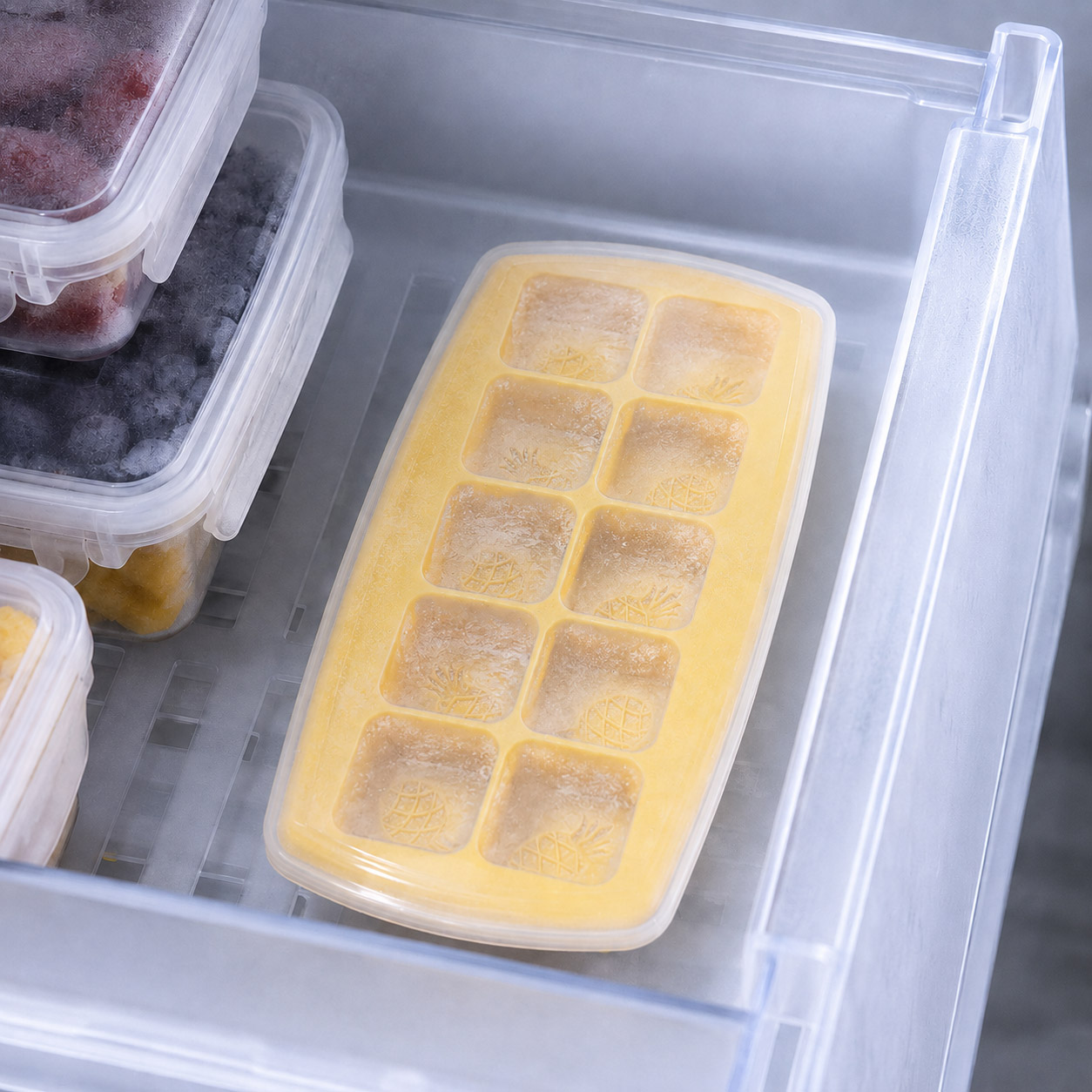
A cover can reduce spills and shield exposed water without providing an airtight seal.
For PP, closure performance depends on dimensional accuracy and how the rim engages. Some designs use a separate gasket.
For silicone, sealing depends on lip geometry, material hardness, and consistent contact around the perimeter. A soft lid that wrinkles at one corner may leave a leakage path.
"Airtight," "leakproof," and "odor-blocking" should therefore be separate, verified claims.
Rigid PP often offers a straightforward route to a stable stacking surface. Nevertheless, a thin, unsupported center panel can still bow.
Silicone may need a reinforced perimeter, structural frame, or stacking feet that transfer weight into the tray body.
When evaluating stackable silicone ice trays with lids, place filled trays above the sample. An empty-product display does not represent freezer loading.
An overly tight PP closure can be frustrating to remove. A very soft silicone lid may peel easily but be harder to position consistently.
Test the complete opening sequence:
- Can users identify the lifting tab?
- Can they remove the lid without twisting the tray?
- Does closure require checking every corner?
- Can the product be handled comfortably when cold?
These details often matter more in daily use than a broad material claim.
The following is a proposed purchasing protocol, not a published universal standard or a report of completed company testing.
Record lid flatness, corner lift, closure force, and visible rim gaps.
Measure samples from different production positions or batches where practical. Keep an unused control for comparison.
Agree on acceptance criteria before testing. "Looks acceptable" is too subjective for repeat orders.
Use the intended freezer conditions and the washing method stated in the proposed instructions.
For example, an initial development screen could include 30 wash-and-freeze cycles. This is a proposed screening count, not evidence of a specific service life.
After cycling, reassess:
- Flatness and corner lift.
- Closure security.
- Opening force.
- Cracking, tearing, or whitening.
- Performance under the intended stacking load.
Use separate samples for an unscented control and selected odor exposures. Keep exposure time, temperature, washing, and drying consistent.
Assess both the lid and ice made afterward. Use coded samples so assessors do not know which material they are evaluating.
A sensory comparison can support product development. It does not replace chemical migration testing or a food-contact safety assessment.
Material names and promotional badges do not establish compliance for every application.
For the United States, food-contact suitability depends on the substances involved and their authorized conditions of use. For Germany and other relevant destinations, buyers should identify applicable requirements and supporting test methods for the finished article.
BfR Recommendation XV provides guidance for silicone materials, including limits on volatile organic and extractable components. These measurements are not equivalent to a freezer-odor test.
A practical documentation request should cover:
- The exact product and material formulation.
- Applicable destination-market requirements.
- Intended food types, contact time, and temperature.
- Relevant migration and other laboratory reports.
- Colorants and separate components where applicable.
- Traceability between tested samples and supplied goods.
ISO 9001 concerns quality management. BSCI concerns social-compliance auditing. Neither substitutes for product-specific food-contact evidence. Likewise, FDA, LFGB, and REACH references should be explained by scope rather than presented as interchangeable certifications.
| Commercial requirement | Sensible starting point | Validation priority |
|---|---|---|
| Economical supermarket range | PP lid | Fit, cold-impact durability, stacking |
| Flexible premium kitchenware | Silicone lid | Odor retention, tear resistance, closure |
| Frequent dishwasher use | Suitably specified silicone or validated PP | Actual wash-cycle performance |
| Odor-sensitive drinks application | Compare finished designs | Ice and meltwater sensory assessment |
| Heavy stacked storage | Reinforced PP or supported silicone | Loaded deflection and closure stability |
A hybrid design may also be worth considering: for example, a rigid lid with a flexible gasket. However, additional components introduce cleaning, assembly, and documentation requirements.
The right specification balances performance with the customer's actual routine—not simply the highest advertised temperature rating.
At Yangjiang Hongyuan Trading Co., Ltd., we manufacture silicone ice trays and other silicone kitchenware for supermarkets, wholesalers, brands, and online retailers.
Our manufacturing footprint includes a 4,500-square-meter main factory and a 2,000-square-meter branch factory. Our stated production capability supports delivery of one million products within 60 days, subject to the agreed product specification and order schedule.
We provide OEM and ODM services for customers serving the EU, United States, United Kingdom, Australia, and South America.
For a new project, we recommend agreeing on lid material, odor expectations, washing instructions, stacking requirements, and destination-market documentation before final sample approval.
Send our team your target market, tray dimensions, expected order volume, and preferred lid concept. Request a comparative sample plan and product-specific documentation before confirming your production specification.
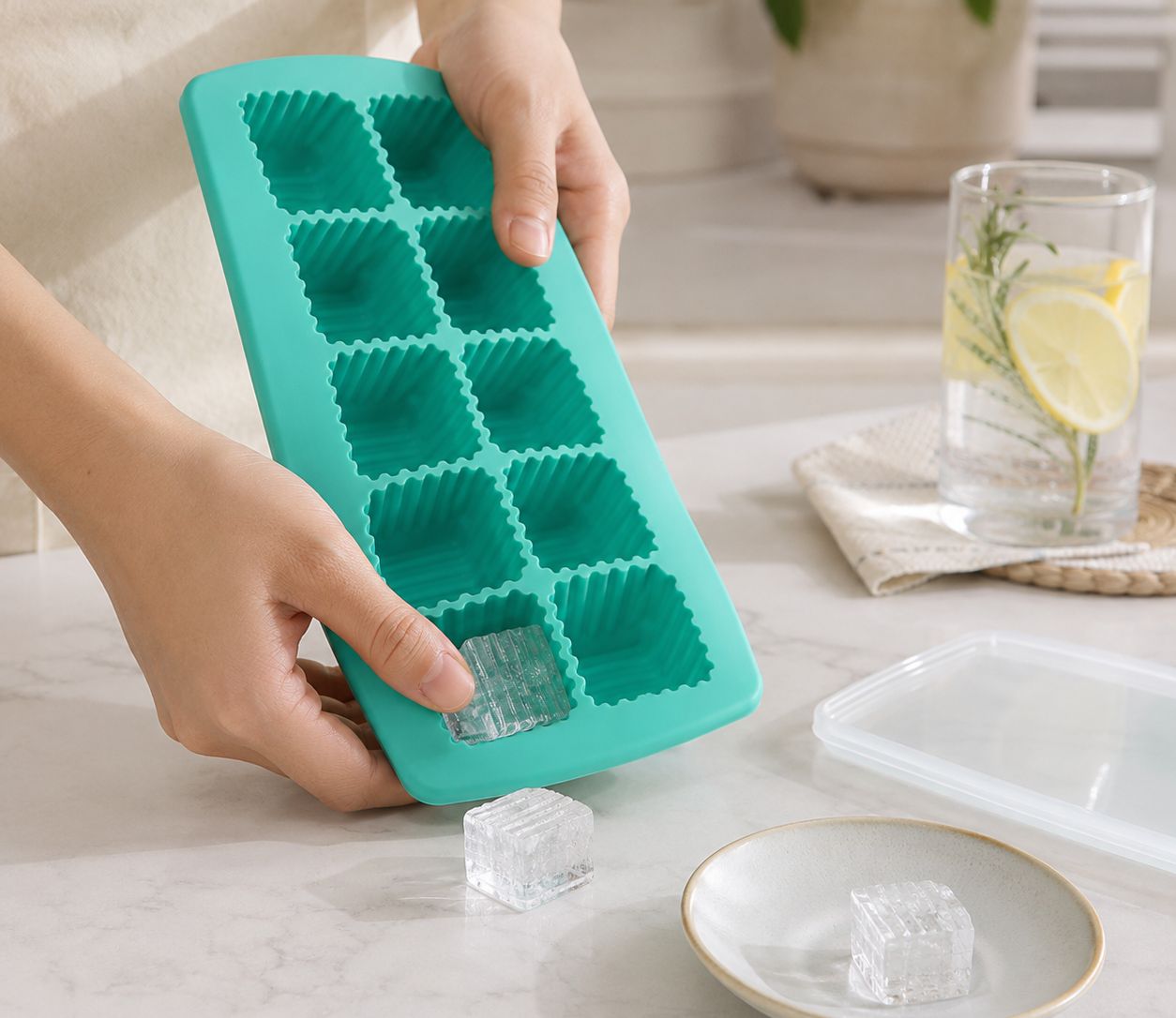
Generally, silicone offers better resistance to heat-related permanent deformation. However, thin or unsupported silicone lids can sag, while properly engineered PP lids can maintain a reliable fit under their specified conditions.
No. A close-fitting PP lid can help limit exposure, but gaps and aroma absorption remain possible. The complete tray-and-lid assembly needs testing before making strong odor-protection claims.
Silicone can retain detergent fragrances. Use a mild, unscented cleaner, rinse thoroughly, and follow the manufacturer's care instructions. Persistent odor should be investigated rather than masked.
Only when the finished product's instructions permit it. Material identity alone does not establish dishwasher suitability. The lid's design, components, and validated washing conditions matter.
No. Cure chemistry alone does not prove odor resistance. Formulation, processing, cleaning, storage conditions, and the complete product design also influence performance.
Do not apply a generic oven treatment. PP lids and mixed-material assemblies may be damaged. Follow the exact product instructions; even a silicone lid may include components with different heat limits.
1. WACKER. "ELASTOSIL® Silicone Rubbers." Manufacturer explanation of silicone's crosslinked structure, low-temperature flexibility, and heat resistance. [Read the material overview]. [wacker]
2. LyondellBasell. "Material Selection." Technical guidance covering polypropylene grade selection, shrinkage, warpage, and cold-temperature impact differences. [Read the technical document]. [lyondellbasell]
3. Wirecutter, The New York Times. "The Best Ice Cube Trays." Product testing and materials commentary addressing silicone's susceptibility to freezer odors and scented detergents. [Read the review]. [nytimes]
4. Van Willige, R. W. G. "Effects of Flavour Absorption on Foods and Their Packaging Materials." Wageningen University research on aroma absorption by packaging polymers, including polypropylene. Packaging findings explain mechanisms and should not be treated as direct finished-lid comparisons. [Read the research]. [edepot.wur]
5. U.S. Food and Drug Administration. "Determining the Regulatory Status of Components of a Food Contact Material." Guidance on component authorization, specifications, and intended-use limitations. [Read the regulatory guidance]. [fda]
6. German Federal Institute for Risk Assessment, BfR. "Recommendation XV: Silicones." Recommendations addressing silicone materials intended for food contact, including volatile and extractable components. [Read Recommendation XV]. [bfr.bund]
7. German Federal Institute for Risk Assessment, BfR. "Determination of Volatile Compounds in Silicone Consumer Products." Analytical procedure for measuring released volatile components; not a sensory odor-resistance test. [Read the analytical method]. [bfr.bund]


