


Views: 270 Author: Hongyuan Silicone Publish Time: 2026-10-09 Origin: Site


Content Menu
● How Silicone Manufacturers Turn Brand Ideas into Product Specifications
>> Define the Product's Intended Use
>> Choose Between OEM and ODM Manufacturing
● Custom Silicone Kitchenware That Supports Brand Differentiation
>> Evaluate the Complete Product, Not Just the Silicone
● Food-Contact Compliance for Private Label Silicone Kitchenware
>> Understand What the Documents Actually Demonstrate
>> Match Evidence to the Destination Market
● A Five-Step Approval Process Before Mass Production
>> 1. Establish a Written Product Specification
>> 2. Approve a Representative Sample
>> 3. Confirm Testing and Documentation
>> 4. Retain a Signed Reference Sample
>> 5. Set Inspection and Release Criteria
● Production Capacity and Delivery Planning for Growing Brands
>> Separate Production Completion from Arrival
>> Plan Complex Orders at SKU Level
● How Customer Feedback Should Improve Private Label Products
>> Translate Comments into Testable Questions
● Evaluate Total Cost, Not Only the Unit Price
>> Compare Quotes Against the Same Specification
● Start Your Private Label Silicone Kitchenware Project
>> 1. How do silicone manufacturers support private label brands?
>> 2. What is the difference between OEM and ODM silicone kitchenware?
>> 3. Can silicone kitchenware be customized with brand colors and logos?
>> 4. Does an FDA-related report prove compliance in every market?
>> 5. How should buyers verify a manufacturer's production capacity?
>> 6. What should buyers prepare before requesting a quotation?
Silicone manufacturers support private label brands by turning product ideas into market-ready kitchenware through design development, material selection, customization, compliance preparation, and controlled production. For buyers sourcing silicone kitchenware, the right manufacturing partner contributes far more than a logo: it helps connect product performance, brand positioning, and reliable supply.
At Yangjiang Hongyuan Trading Co., Ltd., we provide OEM and ODM services for supermarkets, wholesalers, brand owners, and online retailers. Our manufacturing footprint includes a 4,500-square-meter main factory and a 2,000-square-meter branch factory.
We report the capacity to complete orders totaling one million products within 60 days, subject to agreed specifications and production arrangements. Our customers serve the European Union, United States, United Kingdom, Australia, and South America.
From a manufacturer's perspective, successful private label partnerships begin with consistency: the approved product, delivered repeatedly, with documentation that matches its intended market.
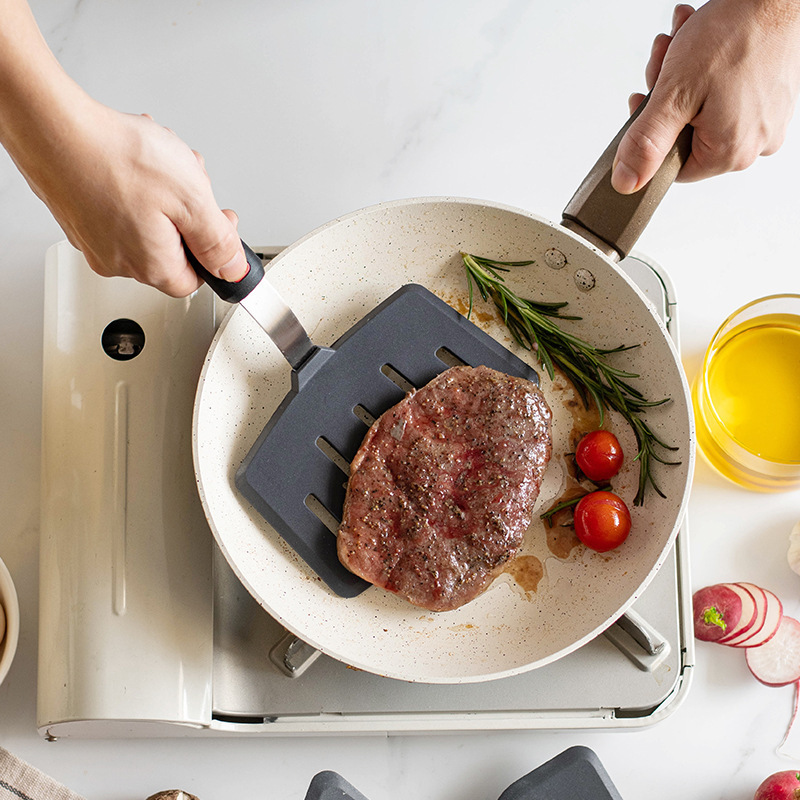
A private label project should begin with the customer's needs, not simply a catalog selection.
A cooking-focused brand may prioritize spatula flexibility and handle control. A supermarket buyer may need coordinated colors, shelf-ready packaging, and predictable replenishment. An online retailer may place greater emphasis on presentation and clear care instructions.
These differences should become measurable specifications before sampling begins.
A useful development brief identifies:
- The product category and intended food-contact applications.
- Target markets and sales channels.
- Required dimensions, weight, and color references.
- Expected cooking, baking, freezing, or cleaning conditions.
- Packaging format and labeling requirements.
- Target order quantity, budget, and launch date.
Avoid vague descriptions such as "premium silicone" or "high heat resistance." Define what those claims mean for the finished product and how they will be verified.
OEM and ODM terminology can vary between suppliers. Buyers should therefore confirm responsibilities in writing.
| Manufacturing route | Typical starting point | Key buyer decision |
|---|---|---|
| OEM silicone kitchenware | Buyer-developed design or detailed specifications | Who controls design files, tooling, and revisions? |
| ODM silicone kitchenware | Manufacturer-developed product platform | Which modifications and exclusivity rights are available? |
| Private label customization | Agreed existing product with branding changes | What can change without additional tooling or testing? |
Existing designs can reduce development work. However, a new color, construction, or intended-use claim may still require technical review.
Original designs offer stronger differentiation, but they introduce additional sampling, tooling, and validation tasks.
Private label silicone kitchenware should provide a recognizable customer experience. Color coordination helps, but functional improvements can create more meaningful differentiation.
Possible development priorities include:
- A spatula edge suited to scraping bowls.
- A handle shape designed for comfortable control.
- A hanging hole positioned for convenient storage.
- A coordinated utensil set with consistent dimensions.
- Packaging that explains intended use and care.
Not every feature belongs in every product. Extra components can introduce assembly requirements, cleaning concerns, or additional inspection points.
A silicone utensil may include a metal core, wooden handle, adhesive, printed decoration, or separate connector.
Each component affects the finished item. A well-performing silicone head does not compensate for a loose handle or an unclear care instruction.
Before approving a design, buyers should ask:
1. Which components contact food?
2. Which materials support the product structurally?
3. Where could food residue collect?
4. How will the product be cleaned?
5. What evidence supports the proposed use claims?
This approach keeps product development focused on customer experience rather than appearance alone.
Compliance support is one of the most important responsibilities of a silicone kitchenware manufacturer.
However, "food grade" is not a complete purchasing specification. Suitability depends on material composition, finished construction, intended use, and the requirements of the destination market.
Manufacturers and buyers should agree on the applicable assessment before production—not after a shipment is ready.
Yangjiang Hongyuan identifies ISO 9001, BSCI, LFGB, FDA, and REACH among its quality, social-compliance, and regulatory credentials. These terms describe different types of evidence and should not be presented as interchangeable product certificates.
| Term | What buyers should understand | Documentation to request |
|---|---|---|
| ISO 9001 | A quality-management-system standard | Current certificate, scope, and covered manufacturing site |
| amfori BSCI | A social-compliance audit system, not certification | Audit report, rating, date, and improvement status |
| FDA-related compliance | Applicable U.S. food-contact requirements and conditions of use | Relevant regulatory basis and supporting assessment |
| LFGB-related assessment | German food-contact requirements and relevant testing | Product-specific reports and assessment scope |
| REACH | EU chemicals legislation with applicable substance obligations | Relevant declarations and supporting substance information |
A management-system certificate does not establish the food-contact suitability of every product. Similarly, a social audit does not replace product testing.
For U.S. applications, 21 CFR 177.2600 is relevant to certain rubber articles intended for repeated use. Its applicability and requirements must be assessed against the actual formulation and intended use.
In the European Union, Regulation (EC) No 1935/2004 establishes general food-contact safety principles. Silicone assessments may also involve national requirements and relevant technical recommendations.
Germany's BfR recommendations provide scientific guidance but are not themselves binding legislation. REACH considerations are separate from food-contact performance and require their own review.
A report should identify the tested sample, test methods, conditions, and results. Buyers should confirm that it represents the product they intend to sell.
The strongest private label manufacturing process creates clear approval gates.
These gates reduce uncertainty about what was agreed, what was tested, and what will be delivered.
Record dimensions, material requirements, color references, logo placement, construction, packaging, and acceptance criteria.
Include the intended destination market and proposed product claims. Assign a revision number so both parties work from the same document.
Evaluate the sample for appearance, handling, flexibility, fit, and cleaning practicality.
A display sample may not represent normal production. Ask how the approved sample relates to the manufacturing method planned for the order.
Agree on necessary assessments, sample selection, laboratory arrangements, and responsibility for costs.
Changes to materials, colors, components, or manufacturing conditions should trigger a review of whether existing evidence remains applicable.
Keep an approved reference sample with the specification.
This gives purchasing teams, factory staff, and inspectors a shared comparison point. It is especially valuable when subjective descriptions such as "soft feel" could cause disagreement.
Define which defects are unacceptable and which measurements require checking.
For utensil sets, also verify component counts, packaging accuracy, and product identification. Agree on how nonconforming goods will be corrected before shipment.
A manufacturing partner must support both launch orders and replenishment.
Yangjiang Hongyuan's stated production capability—one million products within 60 days—provides a useful starting point for high-volume discussions. However, a capacity statement is not automatically a delivery commitment for every product configuration.
A delivery schedule should distinguish:
- Design and specification approval.
- Tooling and sampling.
- Testing and document preparation.
- Mass production.
- Inspection and shipment release.
- Freight transit and import clearance.
Buyers should clarify whether "60 days" begins after sample approval, deposit receipt, material confirmation, or another milestone.
They should also distinguish factory completion from arrival at a warehouse.
A large order containing one standardized item differs from an order involving many shapes, colors, and packaging formats.
Ask for a schedule showing quantities by SKU, packaging readiness, and shipment priorities. This makes bottlenecks visible before they affect the launch.
For repeat orders, agree on forecast updates and specification controls. Predictable replenishment depends on communication as well as manufacturing capacity.
Customer reviews can reveal the gap between an approved sample and everyday use.
No customer reviews were supplied for this article. The following framework is therefore a recommended process, not a report of actual customer feedback.
| Illustrative customer comment | Question for product review | Possible response |
|---|---|---|
| "The spatula feels too soft." | Does flexibility suit the intended task? | Review geometry and stiffness |
| "The handle becomes loose." | Does the joint meet agreed performance criteria? | Investigate construction and assembly |
| "The product has an odor." | Are processing and sensory checks adequate? | Review production and testing conditions |
| "The color differs from the pictures." | Are product and photography references aligned? | Improve color approval and image accuracy |
| "The set arrived incomplete." | Are packing counts controlled? | Add documented completeness checks |
One review does not establish a manufacturing defect. Teams should look for repeated patterns, investigate affected batches, and separate product problems from shipping or listing issues.
A useful improvement cycle records the complaint, checks traceability, investigates the cause, and validates any corrective change.
Keep revisions controlled. Otherwise, a change intended to solve one problem may introduce another or invalidate earlier approvals.
A competitive quotation should be transparent enough to compare.
For private label silicone kitchenware, ask suppliers to separate:
- Product cost.
- Tooling and development charges.
- Logo and decoration costs.
- Packaging costs.
- Testing and inspection charges.
- Freight assumptions and delivery terms.
Also clarify minimum quantities by product and color.
A lower unit price may not produce a lower total cost if packaging, inspection, replacement goods, or freight are excluded.
Send each shortlisted manufacturer the same brief.
Require clear answers on tooling ownership, sample revisions, defect handling, and documentation. This creates a fair comparison and reduces the chance of selecting an apparently cheaper but incomplete offer.
Yangjiang Hongyuan Trading Co., Ltd. supports OEM and ODM sourcing for international supermarkets, wholesalers, brand owners, and online retailers.
To begin a focused discussion, send your product references or drawings, target market, estimated quantities, color requirements, packaging needs, and desired launch date.
Request a quotation that separately confirms sampling, tooling, applicable documentation, production timing, and shipment terms.
The objective is straightforward: a distinctive product, an agreed approval process, and a supply plan that supports your brand beyond the first order.

They help convert a brand's requirements into specifications, samples, customized products, packaging, and production plans. Depending on the agreement, support may also include testing coordination, quality inspections, and replenishment planning.
OEM generally involves manufacturing to buyer-provided designs or specifications. ODM generally starts with a manufacturer-developed design. Confirm ownership, customization rights, and responsibilities because suppliers may use these terms differently.
Customization can include colors, logos, shapes, product combinations, and packaging. Available methods depend on construction and tooling. Approve samples before production and review whether changes affect testing requirements.
No. Requirements differ by destination and intended use. A report must also match the relevant product and assessment scope. Buyers should establish a market-specific documentation plan rather than rely on a universal claim.
Request a project-specific schedule covering quantities, tooling availability, materials, packaging, inspection, and shipment readiness. Clarify the starting milestone and whether the quoted lead time refers to production completion or delivered arrival.
Provide product references, dimensions, target markets, quantities, customization details, packaging specifications, and timing. Identify any required tests or retailer requirements so quotations include the same scope.
1. [Yangjiang Hongyuan Trading Co., Ltd.]
Source of the stated factory areas, one-million-product/60-day capability, customer markets, OEM/ODM services, and reported credentials. No public company page or supporting documents were supplied. These company-specific claims have not been independently verified.[ecosiliconehub]
2. [ISO — ISO 9001:2015: Quality Management Systems — Requirements]
Official explanation of the quality-management standard, its purpose, and its application to organizational processes. Supports the distinction between management-system certification and product-specific compliance evidence. [iso]
3. [amfori — amfori BSCI Help Topic]
Official clarification that amfori BSCI is not certification. Supports the recommendation to examine audit information rather than describe BSCI as a product certificate. [amfori]
Primary U.S. regulatory text establishing conditions for covered repeated-use rubber articles. Supports the discussion of product formulation, intended use, and applicable regulatory requirements. [ecfr]
5. [U.S. Food and Drug Administration — Inventory of Food Contact Substances Listed in 21 CFR]
Official inventory explaining that authorizations depend on substance identity, intended use, and conditions of use. Supports the need to review the applicable regulation rather than rely on a broad FDA-related claim. [hfpappexternal.fda]
6. [German Federal Institute for Risk Assessment — BfR Recommendations on Food Contact Materials]
Official guidance explaining the relationship among BfR recommendations, Regulation (EC) No 1935/2004, and Germany's LFGB. Clarifies that BfR recommendations are not binding legal standards. [bfr.bund]
7. [European Chemicals Agency — Candidate List of Substances of Very High Concern for Authorisation]
Official resource identifying Candidate List substances and related REACH obligations. Supports the recommendation to review chemical-substance obligations separately from food-contact performance. [echa.europa]
Industry guidance connecting silicone manufacturing practices with the EU food-contact framework and good manufacturing practice requirements. Used as background for the manufacturing-control discussion, not as proof of this company's operating procedures. [silicones]


