


loading


T64186
A Safer First Bite of Fresh Fruit
Designed for little ones who are beginning their journey with real food, this baby fruit feeder offers a simple, enjoyable way to introduce fresh fruit, soft vegetables, and other age-appropriate foods. It allows babies to experience the natural taste, aroma, and juice of real ingredients while helping caregivers reduce the risk of large food pieces entering the mouth. Parents can place small portions of fruit inside the feeder, close it securely, and let babies safely suck, bite, and chew through the feeding pouch.
This practical feeding accessory supports early self-feeding and sensory development. As babies explore foods such as banana, strawberry, melon, pear, mango, steamed carrot, or chilled cucumber, they are exposed to a variety of flavors, colors, and textures. The small openings in the feeder allow juice and tiny food particles to pass through while helping keep larger pieces contained. This creates a more controlled feeding experience for babies who are still learning how to chew and swallow solid foods.
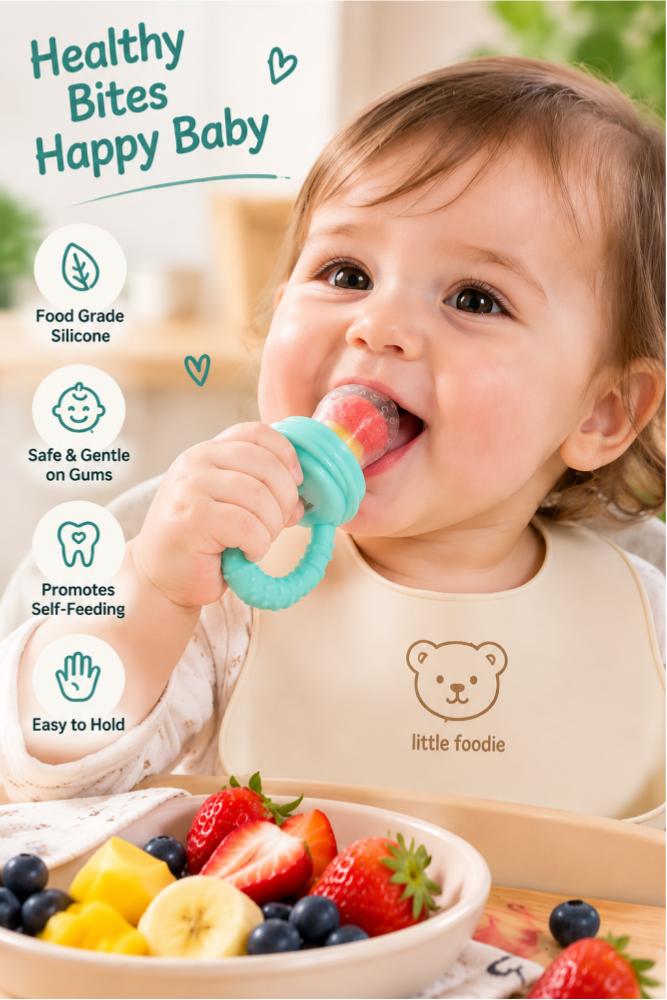
The easy-grip teething handle is specially designed for small hands. Its ergonomic shape helps babies hold the feeder independently, encouraging hand-eye coordination and confidence during mealtimes. At the same time, the textured handle can provide gentle relief for babies who are teething and looking for something safe to bite. The lightweight construction makes it comfortable for everyday use, whether at home, in a high chair, during travel, or while visiting family and friends.
For added convenience, the feeder includes a practical container that helps keep fruit portions clean, fresh, and ready for feeding on the go. It is an ideal solution for busy parents who want to prepare healthy snacks in advance without relying on highly processed alternatives. The design is easy to assemble, take apart, rinse, and clean after use, supporting a more efficient daily feeding routine.

Made with safety and quality in mind, this fruit feeder can support a range of international compliance requirements, including LFGB, FDA, and REACH standards. It also undergoes rigorous testing for durability, heat resistance, and dishwasher safety. Built for repeated daily use, it combines child-friendly functionality, convenient portability, and dependable material performance—making it a valuable addition to baby feeding and teething product collections.


Explore the silicone prototype development process for kitchenware buyers, from design briefs and material selection to sample testing, compliance planning, and production approval. Learn how to control revisions, clarify costs, and prepare an OEM or ODM project with Yangjiang Hongyuan Trading Co., Ltd.

Compare liquid silicone rubber molding and solid silicone rubber molding for kitchenware. Explore tooling costs, precision, heat resistance, food-contact requirements, and production planning to choose a practical manufacturing process for your next OEM or ODM silicone kitchenware collection.

Develop a custom silicone kitchen product from concept to delivery. Learn how to define specifications, choose materials, validate samples, check food-contact requirements, control tooling costs, and plan reliable OEM or ODM production with Yangjiang Hongyuan Trading Co., Ltd. for your target markets.

Compare 10 silicone bakeware manufacturers in China for OEM and ODM sourcing. Explore factory capacity, MOQ, compliance claims, customization capabilities, and supplier verification. Learn how to assess food-contact testing, prevent material substitution, and plan dependable global order deliveries.

Compare TPU, TPE, and silicone for kitchenware through heat resistance, durability, grip comfort, food-contact compliance, manufacturing, and cost. This practical guide helps brands and wholesale buyers choose suitable materials, validate samples, and plan custom silicone kitchenware with Yangjiang Hongyuan.

Compare OEM and ODM silicone kitchenware for your brand. Learn how tooling, product design, food-contact testing, ownership, lead times, and landed cost affect your choice. Explore practical sourcing steps and see how Yangjiang Hongyuan can support custom or private-label kitchenware.

Compare large-cube and standard-cube silicone ice trays for cocktails. Learn why cube size affects chilling and dilution, when each format works best, how to test melting fairly, and what OEM and ODM buyers should check before ordering.

Learn how ODM silicone kitchen products can shorten development without sacrificing product control. This guide covers ODM versus OEM, assortment planning, sampling, food-contact evidence, realistic timelines, quality checks, and the information brands should send a manufacturer before launch.

Stackable ice trays can free up valuable shelf space, but they are not the best fit for every freezer. Compare tray footprint, stack height, cube capacity, lid performance, and daily handling to choose a silicone ice tray that genuinely works in a compact freezer.

Follow the silicone kitchenware OEM process from product brief and design to sampling, compliance planning, mass production, inspection, and delivery. Learn what brands and retail buyers should approve at each stage to reduce sourcing risks and build a reliable private-label range.

Compare 10 Chinese silicone chocolate mold suppliers by customization, reported capacity, MOQ and compliance evidence. Learn how to assess food-contact reports, approve production samples, prevent material substitutions and choose a partner for private-label or confectionery projects.

Open silicone ice trays vs ice trays with lids: which keeps freezer odors out of your ice? Compare exposure, lid fit, silicone odor retention, cleaning, storage, and OEM specifications. Learn why a fitted cover helps, when an open tray works, and how buyers can test samples before ordering.

Explore how a professional silicone kitchenware factory operates, from material control and mold development to quality checks, food-contact documentation, OEM/ODM customization, packaging, and high-volume order delivery for global brands, wholesalers, retailers, and online sellers.

Discover the silicone rubber temperature range for kitchenware, including oven, freezer, and food-contact use. Learn how to choose safe, durable silicone spatulas, baking mats, molds, lids, and custom OEM products for global markets.

Discover what overseas buyers should know about silicone factory production capacity, quality control, food-contact documentation, OEM and ODM customization, tooling, inspection, and delivery planning. Learn how Yangjiang Hongyuan supports silicone kitchenware orders of up to 1 million pieces within 60 days.

Compare thick-wall and thin-wall silicone ice cube trays for repeated freezing cycles. Learn how wall thickness, silicone quality, cavity design, reinforcement, and compliance affect durability, ice release, shape retention, and OEM sourcing decisions.

Learn how to audit a silicone kitchenware factory before cooperation. This buyer’s guide covers factory capacity, food-contact documents, quality control, OEM and ODM evaluation, certification checks, warning signs, and practical supplier-audit steps for global sourcing projects.

This guide reviews 10 China-based silicone cake mold manufacturers for global buyers seeking OEM/ODM supply. Compare their product focus, production scale, certifications, customization capability, MOQ considerations, and buyer-verification practices before selecting a long-term partner.
Compare LFGB silicone and FDA-grade silicone ice cube trays for global sourcing. Learn which standard importers should specify for U.S., German, EU, and multi-market kitchenware programs, plus documentation, testing, quality-control, and OEM purchasing tips.

Discover the key differences between silicone and rubber for kitchenware, bakeware, food-contact products, industrial seals, and OEM manufacturing. Compare heat resistance, durability, compliance, cost, applications, and sourcing considerations to choose the right material for your brand.


