


Views: 261 Author: Hongyuan Silicone Publish Time: 2026-09-25 Origin: Site


Content Menu
● Why a Silicone Kitchenware Factory Tour Matters
● A Quick Overview of Our Manufacturing Facilities
● Step 1: Material Selection and Incoming Inspection
● Step 2: Mold Design for Silicone Kitchenware
>> What Buyers Should Confirm Before Tooling
● Step 3: Molding, Curing, and Deflashing
● Step 4: Quality Control at Every Production Stage
● Food-Contact Compliance: What Buyers Should Ask For
>> Why "FDA" and "LFGB" Are Not Interchangeable
● Practical Factory-Audit Checklist for Buyers
>> Social and Operational Responsibility
● How Our 60-Day, 1-Million-Piece Capability Works
● OEM and ODM Support for Global Kitchenware Brands
● What Makes a Reliable Silicone Kitchenware Partner
● Start Your Silicone Kitchenware Project
● FAQ
>> 1. Can you produce custom silicone kitchenware with our brand logo?
>> 2. What is your production capacity for silicone kitchenware orders?
>> 3. Do you offer food-contact documentation for silicone kitchen products?
>> 4. What information do you need for an OEM quotation?
>> 5. Can you develop new silicone kitchenware products from a drawing or idea?
>> 6. How can we reduce quality risks before mass production?
>> 7. Which markets do you serve?
Choosing a silicone kitchenware manufacturer is not only about comparing prices or selecting colors. For importers, supermarket buyers, wholesalers, brand owners, and online retailers, the real question is whether a factory can consistently turn a product idea into compliant, scalable, and repeatable production.
At Yangjiang Hongyuan Trading Co., Ltd., we manufacture silicone kitchenware and related silicone kitchen products for customers across the EU, the United States, the United Kingdom, Australia, and South America. Our production network includes a 4,500 m² main factory and a 2,000 m² supporting factory, allowing us to complete orders of up to 1 million pieces within 60 days, subject to product complexity, tooling readiness, packaging requirements, and confirmed production schedules.
This factory tour guide explains what professional buyers should look for inside a silicone kitchenware manufacturing facility—from raw-material control and molding to testing, packaging, documentation, and OEM/ODM project management.
A factory tour gives buyers information that product photos, quotations, and catalogues cannot fully reveal.
Silicone utensils, spatulas, baking molds, ice trays, food storage products, cooking tools, and accessories may look simple. However, product quality depends on a chain of decisions made before the final product reaches the carton:
- Whether the supplier controls incoming silicone materials.
- Whether the molding process is stable and repeatable.
- Whether flash, odor, color variation, and surface defects are inspected.
- Whether the supplier understands food-contact documentation.
- Whether packaging, labeling, and carton loading are managed consistently.
- Whether the factory has enough real capacity for your launch schedule.
A strong supplier should be able to show not just finished products, but also the systems behind them.
For buyers sourcing food-grade silicone kitchenware, this visibility is particularly important. Food-contact materials sold in the EU must meet the general safety requirements of Regulation (EC) No 1935/2004 and be produced according to good manufacturing practice requirements. Kitchenware testing conditions can also vary by intended food contact, temperature, and duration of use.
Yangjiang Hongyuan Trading Co., Ltd. serves global buyers seeking OEM and ODM silicone kitchenware solutions. Our factory setup is designed to support both established product programs and new product development projects.
| Facility area | Main purpose | Buyer value |
|---|---|---|
| 4,500 m² main factory | Core silicone kitchenware production, molding, inspection, and assembly | Supports stable order execution and product consistency |
| 2,000 m² supporting factory | Supplementary production and operational support | Adds flexibility during larger or multi-SKU programs |
| Mold development support | Tooling preparation and product customization | Helps transform drawings, samples, and concepts into manufacturable products |
| Quality-control workflow | Incoming, in-process, and finished-product checks | Reduces the risk of defects reaching final shipment |
| Packing and export preparation | Retail, bulk, custom, and e-commerce packaging | Supports buyer-specific branding and shipping needs |
Our operation is built for customers such as:
- Supermarkets and retail chains
- Kitchenware wholesalers
- Brand owners
- Promotional-product companies
- Amazon and other online retailers
- Importers and distributors
- Private-label purchasing teams
We provide OEM and ODM support for silicone kitchen tools and accessories, including customization of product shape, color, logo, packaging, labels, barcode placement, inserts, and retail presentation.
The first reliable indicator of a silicone kitchenware supplier is how it handles raw materials.
Not every silicone material is appropriate for every end use. A spatula used with hot cookware, a flexible baking mold, and a cold-food storage accessory may have different performance expectations. Buyers should ask suppliers how they evaluate the product's intended use before production begins.
At the material stage, a professional factory should verify:
- Material batch identity and traceability
- Color consistency and pigment quality
- Appearance and contamination risks
- Material condition before mixing or molding
- Compatibility with the intended product design
- Relevant food-contact documentation requirements
For products intended to contact food, the key issue is not simply whether the word "silicone" appears in a specification. The material, additives, colorants, curing system, finished-product use conditions, and test scope all matter.
In the United States, a food-contact substance that is considered a food additive generally must be authorized for its intended use before it is marketed. For food-contact submissions involving elevated temperatures, FDA guidance notes that testing should reflect the highest expected use temperature and maximum expected contact time.
That is why buyers should avoid vague requests such as "please make it food safe." Instead, provide a clear use profile:
1. What food will contact the item?
2. Will the product be used with hot, cold, acidic, oily, or dry foods?
3. What is the maximum expected temperature?
4. Will it be used in an oven, microwave, freezer, or dishwasher?
5. Is the product intended for repeated use?
6. Which destination market will receive the goods?
Expert tip: A supplier can prepare documentation more accurately when the buyer defines the actual application rather than requesting a generic certificate package.
A silicone kitchenware product begins with manufacturable mold design.
For a standard item, buyers may choose an existing mold and focus on color, logo, packaging, or bundle configuration. For a custom project, the process may involve product drawings, 3D files, physical samples, material selection, prototype review, tooling, trial production, and final approval.
The best mold design considers more than appearance. It must also consider:
- Product wall thickness
- Demolding direction
- Handle strength
- Flexible areas and reinforcement points
- Hanging holes or storage features
- Logo placement
- Texture and surface finish
- Flash-control requirements
- Assembly needs for multi-material products
- Packaging dimensions
A thin, attractive design can become difficult to produce consistently if it has poor flow, uneven thickness, weak transitions, or complicated undercuts. In practice, an experienced manufacturer should identify these risks before tooling begins—not after mass production has started.
Before approving a new mold, request a documented review covering:
- Product dimensions and tolerance expectations
- Target material and hardness range
- Intended temperature and food-contact use
- Logo method and placement
- Color standard or reference
- Packaging format
- Expected order quantity
- Sample timeline
- Tool ownership and maintenance terms
- Revision procedure if the first sample needs changes
This early review can prevent costly redesigns later.
In a silicone kitchenware manufacturing facility, molding is where the product begins to take its final physical form.
The exact process depends on the product and production setup, but buyers should expect controlled handling of key manufacturing variables such as material preparation, mold condition, pressure, temperature, cycle time, curing, and part removal.
During a factory visit, pay attention to whether the operation appears organized and repeatable. A production line should have clear separation between materials, semi-finished products, finished goods, rejected items, and approved packing materials.
The visible details matter:
- Are molds clean and maintained?
- Are operators following consistent procedures?
- Are parts placed on clean racks or containers?
- Is flash removal controlled?
- Are rejected pieces clearly isolated?
- Are different colors and orders separated?
- Is there a defined process for rework?
- Are operators checking parts during production?
Flash control is especially important for silicone kitchen tools. Excess material around the edges can affect appearance, user comfort, cleaning performance, and retail quality perception. A professional supplier should not treat deflashing as an afterthought. It should be integrated into the production plan and inspection criteria.
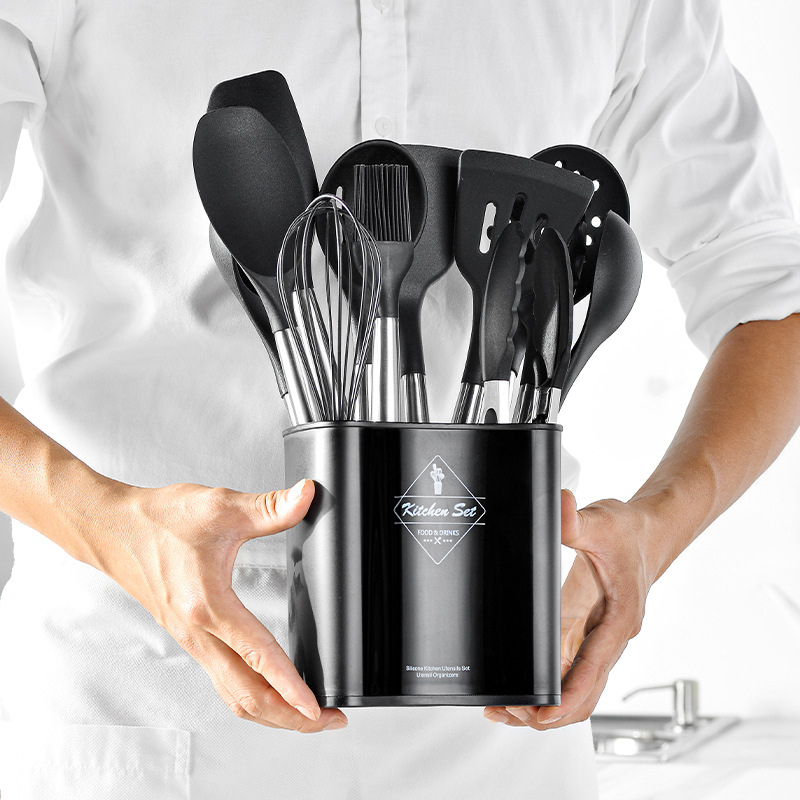
Finished-product inspection is necessary, but it is not enough by itself. Quality should be built into the workflow from the beginning.
A practical silicone kitchenware quality-control system typically includes three layers:
| Inspection stage | What is checked | Why it matters |
|---|---|---|
| Incoming inspection | Materials, color references, packaging materials, components | Prevents unsuitable inputs from entering production |
| In-process inspection | Dimensions, appearance, flash, contamination, deformation, color, assembly | Detects problems before large quantities are completed |
| Final inspection | Product appearance, function, packaging, labeling, carton condition, quantity | Confirms the shipment matches the approved standard |
For silicone kitchenware, common inspection points include:
- Color matching against approved samples
- Surface cleanliness
- Sharp edges or excess flash
- Cracks, bubbles, tears, or deformation
- Product odor
- Logo clarity
- Handle-to-head connection quality for assembled utensils
- Size and weight consistency
- Functionality of hanging holes, lids, clips, or inserts
- Packaging accuracy
- Barcode and label placement
- Carton drop-resistance expectations where applicable
A buyer should also request a clear golden sample or approved reference sample before mass production. This becomes the shared standard for appearance, color, dimensions, logo position, and packaging details.
Compliance should be treated as a product-specific and market-specific process—not a marketing label.
The European Commission states that food-contact materials placed on the EU market must comply with the general safety framework under Regulation (EC) No 1935/2004. The EU Reference Laboratory for Food Contact Materials also provides agreed testing conditions for kitchenware made from materials including silicone and rubber, helping support comparable official-control measurements.
For silicone kitchenware sold into different markets, buyers should clarify the following before production:
- Target market and import destination
- Product category and intended food contact
- Expected use temperature and duration
- Whether the item is for repeated use
- Applicable test report requirements
- Required declarations or supporting documents
- Packaging and labeling rules
- Any retailer-specific restricted-substance requirements
Yangjiang Hongyuan Trading Co., Ltd. works with product programs requiring documentation related to ISO 9001, BSCI, LFGB, FDA, and REACH. Buyers should always confirm that the documentation applies to the relevant product, material composition, manufacturing batch or product family, intended use, and destination-market requirements.
Many buyers use "FDA silicone" and "LFGB silicone" as shorthand, but they should not be treated as identical claims.
The appropriate evidence depends on the specific product and intended market. A baking mold used at high temperature may require a different evaluation approach than a cold-food storage item or a silicone spoon used for cooking. The conditions of contact—such as time, temperature, and food type—are central considerations in food-contact assessment.
For that reason, procurement teams should request documents early in the sourcing process, rather than waiting until the goods are ready to ship.
A supplier visit becomes more useful when buyers arrive with a structured checklist.
- Does the factory manufacture the product itself or mainly outsource?
- What are the main production processes performed on site?
- How many production lines are actively operating?
- What is the realistic monthly capacity for your product type?
- Can the facility handle your order quantity without compromising lead time?
- How does the factory manage peak-season orders?
- Is there a written incoming, in-process, and final inspection procedure?
- Are inspection records available?
- How are defective products identified and isolated?
- Is there an approval process for samples and production standards?
- How are customer complaints analyzed and corrected?
- Are measuring tools maintained and checked?
- Can the supplier review drawings for manufacturability?
- How are prototype samples made and approved?
- Who owns custom tooling?
- What is the process for mold modifications?
- Can the supplier support retail packaging and product bundles?
- Are working areas organized and safe?
- Are employees trained for their assigned processes?
- Is there evidence of controlled material storage?
- Are chemical and waste-management practices visible?
- Can the supplier provide relevant audit documentation when required?
This checklist helps buyers compare factories based on evidence, not promises.
A stated capacity figure only has value when the production plan behind it is realistic.
Our facility network is designed to support orders of up to 1 million silicone kitchenware pieces within 60 days. However, the final lead time depends on several variables:
- Whether an existing or new mold is used
- Number of colors and SKUs
- Product complexity
- Assembly requirements
- Custom packaging complexity
- Test-report requirements
- Artwork approval speed
- Order confirmation date
- Production-slot availability
- Final inspection and shipping arrangements
For a smoother project, buyers should approve the following as early as possible:
1. Final product specification.
2. Approved color standard.
3. Logo artwork and method.
4. Packaging dieline and print files.
5. Carton marks and barcode requirements.
6. Product and packaging samples.
7. Required documentation list.
8. Shipping plan and delivery destination.
The earlier these items are confirmed, the lower the risk of delays caused by late revisions.
OEM and ODM projects require more than placing a logo on an existing product.
For an OEM program, buyers may provide final designs, technical drawings, packaging artwork, product specifications, and compliance requirements. The manufacturing team then focuses on producing the approved item consistently.
For an ODM program, buyers may begin with a market need rather than a finished design. For example:
> A retailer wants a coordinated silicone utensil set for small kitchens, with neutral colors, a hanging-storage feature, recyclable-looking retail packaging, and a price point suitable for a mid-market homeware range.
In this situation, the supplier's role may include recommending existing shapes, adjusting dimensions, selecting colors, combining suitable products into a set, refining packaging, and preparing samples for buyer approval.
Our export experience covers customers in the EU, United States, United Kingdom, Australia, and South America. This cross-market experience helps us understand why documentation, packaging language, barcode placement, color preferences, carton requirements, and retail expectations must be clarified early.
The strongest supplier relationship is based on transparency.
A reliable manufacturing partner should be willing to discuss both strengths and limitations. If a requested delivery time is unrealistic, if a design needs reinforcement, or if a test scope does not match the intended use, the supplier should explain the issue before production—not after shipment.
When evaluating a silicone kitchenware manufacturer, look for these signals:
- Clear and realistic production communication
- Documented sample-approval process
- Stable quality-control checkpoints
- Product-specific compliance support
- Flexible OEM and ODM capability
- Capacity matched to your purchase volume
- Willingness to provide factory visibility
- Responsive handling of revisions and corrective actions
- Experience with export packaging and international buyers
At Yangjiang Hongyuan Trading Co., Ltd., our objective is to help buyers build silicone kitchenware programs that are practical to manufacture, reliable to inspect, suitable for their target markets, and ready for scalable retail distribution.
If you are sourcing silicone kitchenware, food-contact silicone utensils, baking tools, kitchen accessories, or private-label kitchenware sets, share your product idea with our team.
Please send us your target market, expected order quantity, product images or drawings, preferred colors, logo requirements, packaging concept, and required testing or documentation list. We can then recommend the most suitable OEM or ODM production route and prepare a clear quotation and development plan.
Yes. We support OEM projects that include custom logos, colors, packaging, barcode labels, inserts, product bundles, and selected product modifications. The available logo method depends on the product design, surface area, order quantity, and branding requirements.
Our 4,500 m² main factory and 2,000 m² supporting factory are configured to support orders of up to 1 million pieces within 60 days. Actual lead time depends on mold readiness, product complexity, number of SKUs, packaging, approvals, testing needs, and production scheduling.
We work with product programs requiring ISO 9001, BSCI, LFGB, FDA, and REACH-related documentation. Buyers should provide the target market and intended product use early so the relevant documentation and testing scope can be confirmed for the specific item.
Please provide product images, drawings, dimensions, target quantity, destination market, color requirements, logo artwork, packaging needs, and expected delivery date. If you need test reports or retailer-specific documentation, include those requirements at the quotation stage.
Yes. For ODM or custom-development projects, we can review product drawings, reference samples, use requirements, expected quantity, branding details, and packaging direction. We then assess mold feasibility, sampling steps, and the production plan.
Approve a physical sample or golden sample, confirm product specifications in writing, define acceptable tolerances, verify packaging artwork, clarify inspection standards, and confirm compliance requirements before mass production begins. These steps reduce misunderstandings and make final inspection more efficient.
We serve buyers in the EU, United States, United Kingdom, Australia, South America, and other international markets. Requirements may vary by product and destination, so buyers should identify the final sales market during the project briefing.
1. [European Commission — Food Contact Materials]
3. [U.S. Food and Drug Administration — Chemistry Recommendations for Food Contact Substance Submissions]
4. [European Union Reference Laboratory for Food Contact Materials — Testing Conditions for Kitchenware]
7. [amfori — BSCI Sustainability Platform]
8. [International Organization for Standardization — ISO 9001 Quality Management Systems]


