


Views: 278 Author: Hongyuan Silicone Publish Time: 2026-09-15 Origin: Site


Content Menu
● Silicone vs. Rubber at a Glance
>> Why Silicone Performs Well in Kitchenware
● Heat Resistance: Silicone vs. Rubber
>> Practical Kitchenware Example
● Flexibility, Stretching, and Mechanical Strength
>> Choose Silicone When You Need
>> Choose Rubber When You Need
● Food Contact: Material Claims Must Match the Product
>> What Responsible Buyers Should Request
● Durability and Product Lifespan
>> Total Cost of Ownership Matters
● Manufacturing Considerations for OEM and ODM Buyers
>> Design Recommendations for Silicone Kitchenware
>> A Useful Product Development Sequence
● Silicone vs. Rubber for Specific Applications
● How to Choose Between Silicone and Rubber
>> Is silicone better than rubber for kitchen utensils?
>> Is silicone the same as rubber?
>> Can silicone kitchenware be used in an oven?
>> What is the main disadvantage of silicone?
>> Is rubber cheaper than silicone?
>> Which is more durable, silicone or rubber?
>> Can silicone kitchenware be customized for private-label brands?
When buyers compare silicone vs. rubber, the right answer depends on the product's working environment, required lifespan, food-contact conditions, temperature exposure, and target market. For reusable kitchen tools, bakeware, utensils, lids, mats, and similar products, food-contact silicone is often the more dependable option because it remains flexible across a wide temperature range and resists heat, moisture, weathering, and ultraviolet exposure.
However, "rubber" is not one single material. Natural rubber, nitrile rubber, EPDM, neoprene, and other synthetic rubber compounds perform very differently. A strong sourcing decision therefore requires more than comparing price per kilogram. It requires comparing the finished product performance, compliance documentation, tooling requirements, use conditions, and total cost over the product's usable life.
At Yangjiang Hongyuan Trading Co., Ltd., we manufacture silicone kitchenware for global supermarkets, wholesalers, brands, and online retailers. With a 4,500 m² main facility and a 2,000 m² supporting facility, our production system is designed to support large OEM and ODM projects, including orders of up to 1 million pieces within 60 days. This practical manufacturing perspective shapes the comparison below: material selection should be based on the real demands of end users, retailers, and import markets—not assumptions.
Silicone and rubber are both elastomeric materials. In simple terms, they can bend, stretch, compress, and return toward their original shape. That similarity often causes confusion in procurement discussions.
The crucial difference lies in their chemical structures and resulting performance characteristics.
Silicone is a synthetic polymer built around a silicon-oxygen backbone. This structure gives silicone strong thermal stability and dependable resistance to weathering, ozone, moisture, and ultraviolet light.
Rubber can refer to natural rubber or many synthetic elastomers. Natural rubber is primarily derived from latex. Synthetic rubbers are formulated for specialized requirements such as oil resistance, abrasion resistance, elasticity, or lower material cost.
| Comparison Factor | Silicone | Rubber |
|---|---|---|
| Main structure | Silicon-oxygen polymer backbone | Natural latex-based or synthetic hydrocarbon elastomer |
| Heat resistance | Usually excellent | Varies widely by rubber type |
| Cold flexibility | Generally strong | Can decline significantly in cold conditions |
| UV and ozone resistance | Usually excellent | Natural rubber is relatively vulnerable |
| Oil and fuel resistance | Limited in standard grades | Strong with selected grades such as nitrile rubber |
| Elastic rebound | Good | Often excellent, especially natural rubber |
| Food-contact kitchenware | Common with properly formulated compounds | Possible, but depends heavily on formulation and compliance |
| Outdoor durability | Generally strong | Depends on compound; EPDM performs well outdoors |
| Initial material cost | Often higher | Often lower, depending on rubber type |
| Best-known applications | Bakeware, utensils, seals, baby products, medical and electronic components | Tires, grips, belts, industrial seals, footwear, anti-vibration parts |
The most useful conclusion is this: silicone is not automatically better than rubber, but it is frequently the stronger choice when high heat, repeated washing, food contact, and long-term appearance matter.
Silicone is a family of synthetic materials that can be formulated as liquids, gels, resins, or elastomers. For kitchen products, the most relevant type is silicone rubber, usually molded into flexible and durable finished goods.
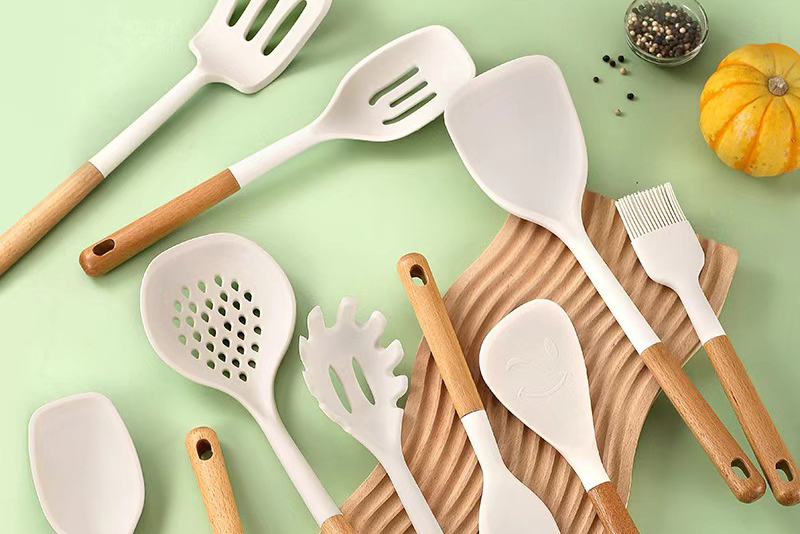
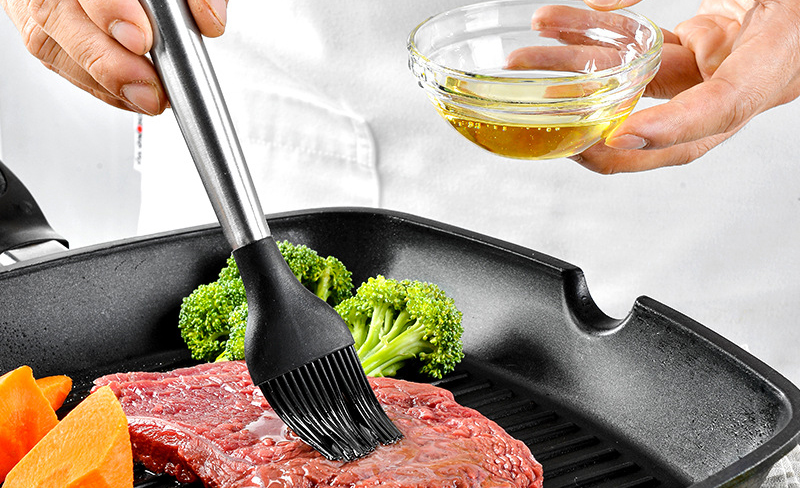
A silicone spatula, baking mat, pot holder, ice tray, pastry brush, utensil head, or collapsible food container is not simply "silicone." Its performance depends on the exact formulation, curing system, fillers, pigments, design thickness, and molding quality.
Silicone's molecular structure provides a useful balance of flexibility and stability. In kitchen environments, this helps products perform under repeated cycles of heating, cooling, washing, bending, and storage.
Key silicone advantages include:
- High heat tolerance for baking, cooking, and handling hot cookware.
- Low-temperature flexibility for freezer-safe applications such as ice trays and food-storage items.
- Resistance to UV and ozone, helping preserve flexibility and appearance during storage or outdoor use.
- Resistance to moisture, making it well suited to frequent washing and humid kitchen conditions.
- Soft-touch flexibility, useful for ergonomic handles, scraping edges, folding tools, and non-slip surfaces.
- Color versatility, allowing brands to create coordinated product collections and distinctive retail packaging.
Typical silicone elastomers can remain stable and elastic at temperatures around 200°C, while specially modified grades may withstand higher temperatures. These characteristics help explain why silicone is widely used in bakeware, oven accessories, automotive seals, electronics, and specialized medical components.
Silicone is not the best choice for every performance requirement.
- It can cost more than basic rubber compounds.
- It may have lower tear strength or abrasion resistance than selected engineered rubber compounds.
- Standard silicone is not ideal for continuous exposure to certain oils, fuels, or aggressive industrial chemicals.
- A poorly formulated silicone compound can create quality, odor, migration, or durability problems.
For this reason, a buyer should never select silicone kitchenware based only on a product photo or a supplier's general claim. The product must be evaluated as a complete system: material formulation, mold design, production control, testing plan, packaging, and intended use.
Rubber is a broad category rather than one uniform material. It includes natural rubber as well as synthetic elastomers designed for specific working conditions.
Natural rubber is valued for elasticity and tensile behavior. It is commonly associated with tires, elastic bands, grips, footwear components, anti-vibration parts, and industrial products. Synthetic rubbers can be engineered to improve resistance to heat, oil, weathering, abrasion, or chemicals.
| Rubber Type | Typical Strength | Common Applications |
|---|---|---|
| Natural rubber | Excellent elasticity and resilience | Tires, gloves, grips, elastic products |
| Nitrile rubber | Strong oil and fuel resistance | Gaskets, seals, industrial hoses |
| EPDM rubber | Good weather, ozone, and water resistance | Outdoor seals, automotive parts, roofing |
| Neoprene | Balanced weather and chemical resistance | Protective goods, industrial components |
| SBR rubber | Good abrasion resistance and value | Tires, mats, footwear, general industrial goods |
| Fluoroelastomer | Excellent chemical and heat resistance | High-performance industrial seals |
This variety makes rubber a flexible material category for industrial manufacturing. It can offer excellent grip, tensile strength, abrasion resistance, and cost efficiency. Yet rubber performance changes dramatically according to the selected compound.
A statement such as "rubber is heat resistant" is incomplete. EPDM, nitrile, natural rubber, and fluoroelastomer do not perform the same way. The same principle applies to silicone: a general material name cannot replace a product-specific technical specification.
For cookware accessories and bakeware, heat resistance is usually the first major decision point.
Silicone generally has a much broader useful temperature range than natural rubber. Many standard silicone kitchenware products are designed for repeated exposure to baking, steaming, boiling, freezer storage, and dishwasher cycles. It retains flexibility more effectively through large temperature changes.
Natural rubber can become less stable at elevated temperatures. It may harden, crack, lose elasticity, or degrade more rapidly when exposed to heat, sunlight, ozone, and oxygen over time.
Consider a silicone baking mat and a basic rubber mat:
- A properly formulated silicone baking mat can be designed for repeated oven use.
- It can remain flexible after cooling and can be washed repeatedly.
- It can be produced in custom colors, sizes, edge shapes, and logo designs.
- A general-purpose rubber material may not be suitable for repeated high-temperature food-contact use.
- Rubber may also introduce odor, surface degradation, or compliance concerns if it is not specifically formulated and tested for that purpose.
For oven mitts, trivets, spatulas, and baking molds, silicone normally offers a more practical combination of heat resistance, softness, and cleanability.
Both silicone and rubber are flexible, but they behave differently under stress.
Natural rubber is widely respected for its elasticity. It can stretch significantly and recover well, making it a strong material for products that need repeated extension, shock absorption, or high resilience.
Silicone is also flexible, but its major strength is consistency across changing temperatures. A silicone utensil head may remain soft and functional after exposure to freezer temperatures or hot cookware, whereas some rubbers can become harder or less stable under similar conditions.
- Flexible performance in hot and cold environments.
- A soft scraping edge for cookware protection.
- Repeated dishwasher cleaning.
- Stable color and shape over extended use.
- Low odor expectations for food-contact products.
- Long-term resistance to UV, ozone, and ordinary weathering.
- High tensile stretch or rebound.
- Strong abrasion resistance.
- A lower-cost solution for non-food-contact applications.
- Oil or fuel resistance through a suitable rubber grade.
- Specialized industrial sealing or vibration-control performance.
For kitchenware, a product often requires functional flexibility rather than maximum stretch. That is one reason silicone has become a preferred material for many premium reusable kitchen tools.
The term "food-grade silicone" is widely used, but buyers should understand what it should mean in practice.
Food-contact safety is not determined only by the word "silicone." It depends on the materials used in the formulation, the intended use, the curing process, potential migration, finished-product testing, and the regulatory requirements in the destination market.
In the European Union, food-contact materials must comply with the general safety requirements of Regulation (EC) No. 1935/2004. They must be manufactured according to Good Manufacturing Practices under Regulation (EC) No. 2023/2006. Materials should not transfer substances into food in amounts that could endanger health, unacceptably change food composition, or negatively affect taste or odor.
In the United States, food-contact substances are regulated according to their identity, intended use, and conditions of use. For reusable rubber articles intended for food contact, 21 CFR 177.2600 is a commonly relevant regulatory reference.
For silicone kitchenware intended for export, ask the manufacturer for product-specific documentation and a testing plan appropriate to the target market.
A practical checklist includes:
1. Material declaration identifying the relevant silicone compound and intended use.
2. Third-party test reports relevant to the destination market and product category.
3. Migration testing information when required by the applicable standard or buyer specification.
4. Factory quality documentation covering incoming material control, production inspection, and final inspection.
5. Batch traceability for large or recurring orders.
6. Colorant and pigment confirmation, especially for bright or custom colors.
7. Sample approval records for product dimensions, hardness, appearance, odor, logo placement, and packaging.
At Yangjiang Hongyuan Trading Co., Ltd., we support buyers with products developed for international markets and certifications including ISO 9001, BSCI, LFGB, FDA, and REACH. For any final purchasing decision, importers should confirm that the exact product, color, formulation, and intended use are covered by the relevant documentation rather than relying on a generic certificate.
A lower purchase price does not always mean lower overall cost. For retailers, online sellers, and brand owners, product returns, negative reviews, replacement rates, and damaged brand reputation can cost much more than a small material saving.
Silicone generally offers good resistance to:
- Heat and cold cycling.
- Moisture and frequent washing.
- UV exposure and ozone.
- Everyday household chemicals.
- Surface cracking caused by environmental aging.
Rubber may provide better abrasion resistance in applications such as tires, industrial mats, footwear soles, and certain grips. But for reusable kitchen products, silicone's resistance to high heat and environmental aging can create a longer-lasting user experience.
When evaluating silicone vs. rubber, compare more than the unit price.
| Cost Factor | Silicone Kitchenware | Basic Rubber Product |
|---|---|---|
| Initial material cost | Often higher | Often lower |
| Heat-use reliability | Usually stronger | Depends heavily on compound |
| Long-term appearance | Often more stable | May age faster in heat or UV |
| Product replacement risk | Often lower in suitable applications | Can be higher if exposed to unsuitable conditions |
| Brand positioning | Supports premium reusable collections | Can suit utility-oriented or industrial ranges |
| Retail value perception | Often higher for kitchen and bakeware lines | Depends on product and market |
For a premium kitchenware brand, the correct question is not "Which material is cheaper?" It is: Which material helps the product deliver the expected experience throughout its retail life?
Material selection affects product development from the first drawing to final packaging.
For silicone kitchenware, manufacturers commonly use compression molding, injection molding, or liquid silicone rubber processes, depending on the design and volume. Product geometry, wall thickness, undercuts, logo style, texture, color, and assembly requirements all influence mold cost and production efficiency.
- Use even wall thickness where possible to improve molding consistency.
- Avoid extremely thin edges unless the product function requires them.
- Specify hardness according to the intended application, not visual preference alone.
- Use reinforced cores or inserts where a utensil needs extra rigidity.
- Define acceptable color variation before mass production.
- Test logos, embossed patterns, and matte textures on pre-production samples.
- Consider retail packaging early, especially for supermarket displays and e-commerce fulfillment.
1. Define the target user and market.
2. Confirm whether the item will contact food, heat, steam, oil, or freezing temperatures.
3. Choose the material grade and hardness range.
4. Review the drawing for molding feasibility.
5. Produce prototypes or initial samples.
6. Verify dimensions, appearance, odor, heat-use performance, and packaging.
7. Complete required testing and document review.
8. Approve the production sample.
9. Start controlled mass production with in-process inspections.
10. Conduct final quality checks before shipment.
This approach prevents a common sourcing problem: discovering after production that the product looks good but does not perform correctly in real kitchen use.
| Product Application | Better Material Choice | Why |
|---|---|---|
| Baking molds | Silicone | Heat resistance, flexibility, easy release |
| Spatula heads | Silicone | Soft edge, heat resistance, cookware protection |
| Oven mitts and trivets | Silicone | Heat insulation and grip when properly designed |
| Ice trays | Silicone | Cold flexibility and easy demolding |
| Food-storage lids | Silicone | Flexible seal and repeated-use durability |
| Rubber bands | Natural rubber | High stretch and elastic recovery |
| Tire components | Rubber | Abrasion resistance and engineered mechanical performance |
| Oil-resistant seals | Nitrile rubber | Stronger resistance to oils and fuels |
| Outdoor weather seals | EPDM rubber | Good weather and ozone resistance |
| Premium kitchen utensil sets | Silicone | Suitable balance of appearance, durability, and household performance |
There is no universal winner. There is only the material that best fits the job.
For silicone kitchenware, silicone is usually the more suitable choice because it supports a combination of heat performance, flexibility, visual appeal, repeated cleaning, and long-term consumer use. For industrial, automotive, oil-contact, or high-abrasion projects, specialized rubber compounds may be more appropriate.
Use the following decision guide before requesting a quotation.
Choose silicone if your product must:
- Work in ovens, freezers, dishwashers, or high-temperature environments.
- Contact food repeatedly under controlled compliance requirements.
- Stay flexible after heat and cold cycles.
- Offer a soft, premium, colorful, and easy-to-clean user experience.
- Resist ordinary moisture, ozone, and UV aging.
- Support a reusable kitchenware or household product line.
Choose rubber if your product must:
- Stretch extensively or absorb vibration.
- Resist abrasion in a demanding mechanical environment.
- Handle oils, fuels, or chemicals with a specialized compound.
- Serve as a tire, belt, industrial seal, mat, sole, or grip.
- Meet a cost target where high-temperature food-contact performance is not required.
For brands, wholesalers, supermarkets, and online sellers building reusable kitchenware collections, silicone is generally the stronger material choice over general-purpose rubber. It is particularly suitable for spatulas, baking molds, oven accessories, lids, ice trays, pastry tools, and other products that face heat, cold, moisture, and frequent cleaning.
The best results come from matching the material to the product's real conditions of use, then working with a manufacturer that can control formulation, molding, quality inspection, documentation, and delivery at scale.
Yangjiang Hongyuan Trading Co., Ltd. provides OEM and ODM silicone kitchenware manufacturing for international buyers. Whether you need a new silicone utensil collection, customized bakeware, private-label accessories, branded colors, custom packaging, or high-volume supply, our team can help evaluate your design and turn it into a production-ready product.
Contact us today to discuss your silicone kitchenware project, request samples, or receive a tailored OEM/ODM quotation.
In most kitchen utensil applications, silicone is the better choice because it handles heat more effectively, remains flexible across hot and cold conditions, and is well suited to repeated washing. The final product should still use a properly formulated food-contact silicone compound and appropriate testing for its target market.
No. Silicone is an elastomer, but it has a silicon-oxygen backbone that differs from natural rubber and most synthetic rubber materials. This difference contributes to silicone's strong heat, weather, and UV resistance.
Many silicone kitchenware products are designed for oven use, but the exact temperature limit depends on the product formulation, thickness, design, and manufacturer instructions. Buyers should confirm the tested temperature range for the specific item rather than applying one general number to every silicone product.
No. Silicone should not be assumed to be food safe simply because it is silicone. Food-contact suitability depends on the compound ingredients, intended use, production controls, and compliance documentation for the destination market.
The main disadvantage is usually its higher initial cost compared with basic rubber materials. Silicone may also be less suitable than certain specialist rubbers for oil exposure, fuel exposure, extreme abrasion, or high-tensile mechanical applications.
Basic rubber compounds are often less expensive upfront. However, silicone can provide better value over time in kitchenware and heat-exposed products because it may last longer and maintain performance more reliably under repeated use.
It depends on the environment. Silicone is usually more durable against heat, UV, ozone, moisture, and temperature changes. Some rubbers can outperform silicone in abrasion resistance, stretching performance, or oil resistance.
Yes. Silicone kitchenware can be customized with product shape, color, hardness, texture, logo, insert materials, retail packaging, and product sets. For the best result, brands should confirm all specifications during the sample-approval stage before mass production.
1. European Commission. "[Food Contact Materials]." Information on Regulation (EC) No. 1935/2004 and Good Manufacturing Practices requirements for food-contact materials.
2. European Food Safety Authority. "[Food Contact Materials]." Overview of food-contact material safety requirements and the prevention of unacceptable chemical transfer into food.
3. U.S. Food and Drug Administration. "[Inventory of Food Contact Substances Listed in 21 CFR]." Searchable inventory of food-contact substances and regulatory references.
4. U.S. Food and Drug Administration. "[Guidance for Industry: Preparation of Premarket Submissions for Food Contact Substances]." Guidance on food-contact substances, intended use, and regulatory pathways.
5. American Chemistry Council. "[What Are Silicones? Uses, Benefits & How They Work]." Overview of silicone properties, including flexibility and resistance to heat, cold, moisture, chemicals, and ultraviolet radiation.
6. INMR. "[Chemistry & Properties of Silicones]." Technical discussion of silicone elastomer performance at high and low temperatures.
7. Lanxin. "[Silicone vs. Rubber: The Key Differences & Applications]." Comparison framework covering material composition, temperature resistance, durability, applications, sustainability, and cost.


