


Views: 228 Author: Hongyuan Silicone Publish Time: 2026-09-14 Origin: Site


Content Menu
● Why Silicone Kitchenware Testing Matters
● The Main Silicone Product Testing Standards
● FDA Requirements for Silicone Kitchenware
● LFGB Testing for European Silicone Kitchenware
>> Why Odor and Taste Testing Matter
● EU Food-Contact Compliance: What It Means
● The Difference Between Material Testing and Finished-Product Testing
● How to Build a Buyer Testing Plan
>> Step 1: Define the Product's Actual Use
>> Step 2: Identify Every Food-Contact Component
>> Step 3: Match Testing to the Sales Market
>> Step 4: Confirm Laboratory Scope Before Sending Samples
>> Step 5: Control Changes After Approval
● Factory Controls That Protect Test Results
● Common Buyer Mistakes to Avoid
>> Choosing "FDA Silicone" Without Asking for Evidence
>> Using One Report for Multiple Unrelated Products
>> Ignoring Color and Decoration
>> Testing Only After Mass Production
>> Treating Certifications as a Substitute for Product Controls
● A Practical Example: Silicone Air Fryer Liner
● Choosing a Silicone Kitchenware Manufacturer
● Partner With a Prepared Manufacturer
>> Is FDA silicone the same as LFGB silicone?
>> Does a silicone product need a test report for every color?
>> Can a factory's ISO 9001 certificate replace product testing?
>> What does migration testing mean for silicone kitchenware?
>> Why do silicone products sometimes smell when heated?
>> What should I send to a laboratory for testing?
>> How early should testing be planned?
When sourcing silicone kitchenware, buyers should not treat "food-grade silicone" as a complete purchasing specification. Silicone product testing standards determine whether a spatula, baking mold, utensil, lid, or ice tray is appropriate for its intended food-contact use, target market, and production volume.
From a manufacturer's perspective, the most successful sourcing projects begin with a clear compliance brief: product category, destination country, food-contact conditions, temperature range, color requirements, branding method, packaging, and required test reports. This approach reduces delays, prevents costly rework, and gives importers stronger documentation for retailers, marketplaces, customs checks, and internal quality reviews.
At Yangjiang Hongyuan Trading Co., Ltd., we manufacture silicone kitchenware and related silicone household products for buyers in the EU, the United States, the United Kingdom, Australia, and South America. With a 4,500 m² main factory and a 2,000 m² supporting factory, our production capacity supports delivery of up to 1 million pieces within 60 days, subject to final product design, tooling, packaging, testing scope, and order confirmation. We provide OEM and ODM support for supermarkets, wholesalers, brand owners, and online retailers, with quality systems and product compliance programs aligned with ISO 9001, BSCI, LFGB, FDA, REACH, and applicable market requirements.
Silicone kitchen tools are often chosen because they are flexible, reusable, heat-resistant, easy to clean, and suitable for many cooking applications. However, the finished product is not defined by silicone alone.
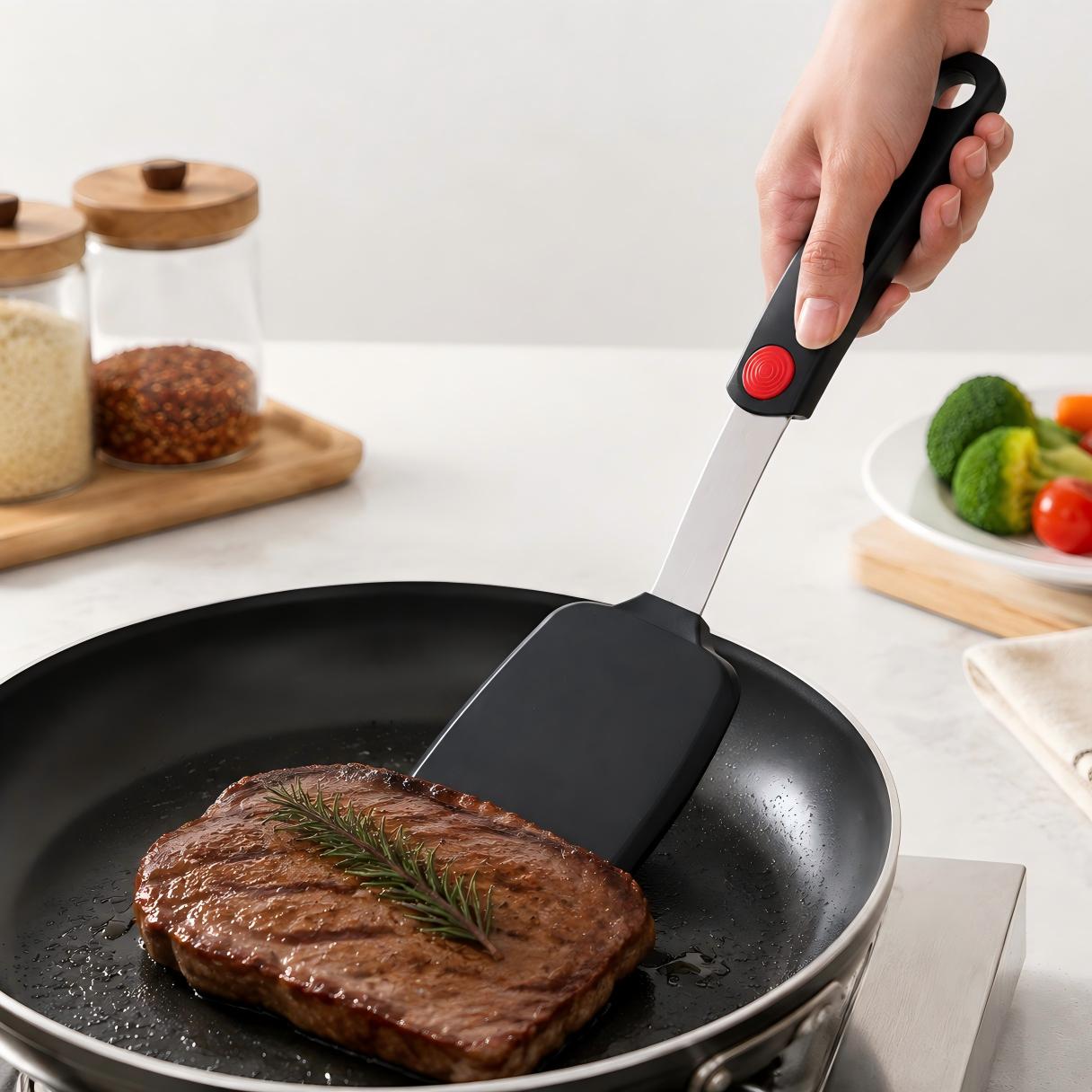
A silicone spatula may also include:
- Color pigments
- Fillers
- Curing agents
- Reinforcement materials
- Metal cores
- Plastic handles
- Adhesives
- Decorative coatings
- Printed logos
- Packaging inks
- Added components such as wood, stainless steel, or nylon
Each material and manufacturing step can affect the final product's quality, odor, appearance, durability, and food-contact suitability. A product can look clean and feel soft while still presenting a compliance risk if the formulation, curing process, decoration, or assembly has not been properly controlled.
For buyers, the key question is not simply, "Is this silicone?" The better question is:
> Can this finished product demonstrate suitability for its intended food-contact use in the market where it will be sold?
Food-contact rules focus on whether substances can transfer from the product into food in quantities that could harm health, change the food's composition unacceptably, or negatively affect taste and smell. Temperature, contact time, food type, and repeated-use conditions can all influence this transfer process.
For example, a silicone baking mold used in a hot oven requires a different risk assessment from a room-temperature silicone ice cube tray. Likewise, a red spatula for oily cooking applications may require careful consideration of the color masterbatch and intended use conditions.
Silicone kitchenware is commonly evaluated against several regulatory frameworks and customer specifications. These should not be treated as interchangeable certificates. Each framework has a different purpose, market relevance, and documentation expectation.
| Standard or Requirement | Primary Market Relevance | What Buyers Should Confirm | Typical Product Examples |
|---|---|---|---|
| FDA food-contact requirements | United States | Material suitability, formulation review, and relevant extractives testing for repeated-use rubber articles | Spatulas, baking molds, tongs, lids |
| LFGB and BfR-based evaluation | Germany and widely requested by European buyers | Migration performance, sensory characteristics, and test conditions relevant to food contact | Bakeware, cooking utensils, baby feeding items |
| EU Framework Regulation (EC) No 1935/2004 | European Union | Product must not endanger health, alter food composition unacceptably, or affect taste or odor | All food-contact kitchenware |
| Good Manufacturing Practice requirements | European Union | Consistent manufacturing controls, traceability, and quality assurance | All food-contact silicone products |
| REACH | European Economic Area and supply-chain compliance | Management of restricted substances and chemical communication obligations | Silicone products, components, packaging materials |
| ISO 9001 | Global quality-management relevance | Process control, corrective action, supplier management, and documentation discipline | Factory and production-system evaluation |
| BSCI | Social compliance and responsible sourcing | Ethical workplace and supply-chain expectations | Factory audit and buyer due diligence |
A professional buyer should define the applicable standards before sampling is finalized. Testing a finished product after mass production has started can create avoidable cost, especially when a formulation or colorant must be changed.
For the United States, silicone kitchenware is commonly assessed within the broader regulatory framework for food-contact substances and repeated-use rubber articles. The relevant documentation should be connected to the product's actual composition and intended use rather than relying on a generic statement such as "FDA approved."
A strong FDA-oriented compliance package may include:
- A product specification sheet
- Silicone raw-material information
- A declaration of conformity or compliance statement
- Relevant test reports from a qualified laboratory
- Details of food-contact conditions
- Information on components that touch food
- Batch or production traceability records
- Records for pigments, coatings, adhesives, and assembled components where applicable
Buyers should also ask whether the report applies to the exact item being purchased. A report for a blue silicone spatula head does not automatically cover a complete spatula with a stainless steel core, wooden handle, printed logo, or different red pigment.
Before confirming an order for the U.S. market, request clear answers to these questions:
1. Is the silicone formulation suitable for repeated food contact?
2. Does the report identify the exact material and color used in the final product?
3. Does the report cover the product's intended cooking temperature and food type?
4. Are metal, plastic, wood, or printed components included in the compliance review?
5. Is the document current and traceable to a recognized laboratory or supplier?
6. Can the factory provide a lot-specific quality record for the mass-production order?
A supplier that can answer these questions early is usually better prepared to support long-term retail or brand programs.
LFGB is frequently requested by buyers selling silicone kitchenware in Germany and by European customers seeking a high level of food-contact assurance. In practical sourcing discussions, "LFGB silicone" often refers to silicone products tested according to German food-contact expectations, including BfR recommendations that reflect current scientific and technical knowledge for high-polymer food-contact materials.
The most important point for buyers is that LFGB is not merely a marketing label. It should be supported by product-specific documentation.
A reliable LFGB testing program commonly considers:
- Overall migration or extraction behavior
- Volatile substances
- Sensory performance, including unwanted taste or odor transfer
- Testing under relevant time and temperature conditions
- Food simulants selected for the intended use
- Repeated-use conditions where relevant
- The complete finished article, not only the base silicone compound
Silicone kitchenware that is used with hot food, oils, acidic ingredients, or baking applications should be evaluated with use conditions in mind. Testing that does not reflect the product's actual use may not provide sufficient commercial confidence.
A silicone mold may pass a visual inspection and still create a poor consumer experience if it releases an unpleasant odor during baking or transfers an unusual taste to food.
This is especially important for:
- Cake molds
- Air fryer liners
- Ice trays
- Baby food feeders
- Baking mats
- Silicone lids
- Coffee accessories
- Microwave cooking products
For brand owners, sensory performance affects more than compliance. It affects reviews, repeat purchases, return rates, and retailer confidence. A buyer may initially focus on price, but consumers often judge a silicone product by what they smell the first time it is heated.
For products placed on the European market, food-contact materials must comply with Regulation (EC) No 1935/2004. The regulation covers materials used during food production, processing, storage, preparation, and serving, including kitchenware and tableware.
The core principle is straightforward: a food-contact product must not transfer substances into food in quantities that could:
- Endanger human health
- Cause an unacceptable change in food composition
- Harm taste, smell, or other sensory characteristics
This framework also connects with good manufacturing requirements. In other words, compliance is not just a laboratory result. It is also a manufacturing discipline.
A factory should be able to demonstrate control over raw-material approval, production procedures, equipment cleanliness, inspection standards, corrective actions, and product traceability. For a buyer, this matters because the sample tested by a laboratory must remain representative of the goods produced at scale.
One of the most common sourcing mistakes is assuming that a silicone raw-material report is enough for every finished product.
It is not always enough.
A material report may indicate that a silicone compound has passed a defined test. However, the final product can change after:
- Pigment addition
- Secondary curing
- Mold-release processing
- Decoration or printing
- Bonding with another material
- Assembly with a metal core
- Use of adhesives
- Packaging contact
- Changes in suppliers or production parameters
For this reason, buyers should distinguish between three levels of documentation.
| Documentation Level | What It Confirms | Buyer Value |
|---|---|---|
| Raw-material documentation | Information about the base silicone compound | Useful starting point for supplier qualification |
| Component-level testing | Performance of a silicone head, handle, print, or accessory component | Helpful for modular product development |
| Finished-product testing | Compliance of the actual retail item under defined conditions | Strongest evidence for launch and retailer review |
For a custom OEM project, finished-product testing is often the most commercially useful option because it matches the final color, construction, design, and intended use.
A practical testing plan should be created before the final pre-production sample is approved. This prevents the common situation in which a buyer discovers too late that the selected pigment, logo ink, or accessory does not fit the target-market requirements.
Start with the basics:
- Will the item touch food directly?
- Is it for cold, room-temperature, or hot food?
- Will it be used in an oven, microwave, dishwasher, freezer, or air fryer?
- Will it contact oily, acidic, alcoholic, or watery foods?
- Is it designed for repeated use?
- Is the target user a general consumer, child, or baby?
A silicone pastry brush used with hot oil requires a different evaluation from a silicone snack container lid.
Make a simple bill of materials. Include all parts that can touch food directly or indirectly.
For a silicone spatula, this may include:
- Silicone head
- Silicone coating over the handle
- Stainless steel core
- Adhesive or joining method
- Decorative print
- Hanging loop
- Packaging insert if it contacts the product surface
This exercise often reveals hidden risks. For example, the silicone head may be suitable, but an unverified coating or printed area could create an unnecessary documentation gap.
Do not request a broad list of certificates without a sales plan. Instead, connect the test request to the countries where the product will be sold.
A simple example:
| Sales Destination | Buyer Priority |
|---|---|
| United States | FDA-oriented food-contact documentation and relevant product testing |
| Germany | LFGB-oriented testing and sensory performance evidence |
| Wider European Union | EU food-contact framework, good manufacturing controls, and market-specific requirements |
| United Kingdom | Food-contact documentation aligned with applicable UK market expectations |
| Australia or South America | Confirm local importer, retailer, or product-category requirements before production |
This market-first approach avoids overtesting in some areas while leaving critical gaps in others.
A test request should state:
- Product name and model number
- Material composition
- Product color
- Intended food-contact use
- Temperature range
- Contact time
- Target market
- Required test standard
- Whether testing is for a component or complete item
- Number of samples required
- Whether destructive testing may affect sample availability
The test report should clearly identify the tested sample. If the report lists a vague description such as "silicone item," it may be less useful for retailer onboarding or a customer audit.
Any meaningful change can affect compliance status. Common changes include:
- Switching silicone suppliers
- Changing pigment or product color
- Adding a printed logo
- Modifying the curing process
- Replacing adhesive or packaging materials
- Moving production to a different factory line
- Changing from one handle material to another
For long-term programs, buyers should include a change-control clause in the supplier agreement. The factory should notify the buyer before changes are implemented, allowing time to review whether re-testing is needed.
Test reports are important, but they are only one part of a reliable quality system. During mass production, the factory must keep the final goods consistent with the tested sample.
At Yangjiang Hongyuan Trading Co., Ltd., the production process for silicone kitchenware can be structured around the following control points:
- Verification of approved raw materials before production
- Confirmation of product color, weight, and dimensions
- Monitoring of molding and curing conditions
- Inspection for flash, cracks, bubbles, deformation, and contamination
- Odor checks where appropriate
- Functional testing for flexibility, fit, and assembly strength
- Metal-core alignment checks for utensils
- Packaging inspection and carton-drop protection review
- Production lot identification for traceability
- Pre-shipment quality inspection against approved samples
For large programs, buyers may also request an approved golden sample, color limit sample, and packaging reference sample. These practical controls make it easier to compare mass production with the product that was originally tested and approved.
A supplier's marketing claim is not a compliance file. Ask for the supporting report, product scope, laboratory identity, testing date, and material details.
A silicone spoon, baking mold, lid, and ice tray may share a similar material, but they do not necessarily share the same product design, color, use conditions, or food-contact components.
Pigments, printed patterns, coatings, and adhesives can change the final product profile. They should be included in the sourcing review.
Late testing can lead to delayed shipments, rejected retailer submissions, or expensive rework. Plan the test timeline alongside tooling, sampling, and packaging development.
ISO 9001 and BSCI can be valuable supplier-assessment tools, but they do not replace food-contact test reports for a specific silicone kitchenware item.
Consider a brand developing a collapsible silicone air fryer liner for the EU and U.S. markets.
The product will contact hot, oily food. It may be exposed to repeated heating, dishwasher cleaning, and food residues. It may also have a reinforced rim, embossed logo, and multiple color options.
A strong buyer plan would include:
1. Confirming that the silicone formulation is appropriate for the intended temperature and repeated food-contact use.
2. Reviewing pigment options before finalizing colors.
3. Checking whether the reinforced rim or any additional component contacts food.
4. Defining FDA-oriented and EU/LFGB-oriented documentation needs before mass production.
5. Sending final-color production samples for the selected testing scope.
6. Approving odor, appearance, flexibility, size, and packaging standards through a golden sample.
7. Requiring notification if raw materials, pigments, curing conditions, or suppliers change.
This process may look detailed, but it is usually more efficient than solving compliance issues after containers are booked or retail listings are live.
The right manufacturer should do more than quote a unit price. For a serious OEM or ODM program, look for a partner that can connect product development, testing coordination, production capacity, and documentation management.
Ask potential suppliers:
- Can you provide a clear manufacturing and quality-control process?
- Which food-contact reports are available for comparable products?
- Can you support custom colors, logos, packaging, and molds?
- Can you identify every food-contact material in the final item?
- Can you coordinate third-party testing for the final product?
- Do you have production capacity aligned with our launch schedule?
- How do you manage material or process changes after approval?
- Can you support retailer documentation and pre-shipment inspections?
For buyers managing supermarket, wholesale, brand, or e-commerce programs, these questions matter as much as product design. A dependable supply chain reduces launch risk and protects the customer experience after delivery.
Silicone product testing should be planned as part of product development—not treated as a last-minute paperwork request. When the material, design, use conditions, market requirements, and production controls are aligned, buyers gain a safer and more efficient path from concept to shipment.
Yangjiang Hongyuan Trading Co., Ltd. supports global buyers with OEM and ODM silicone kitchenware development, production planning, testing coordination, and export-oriented quality control. Whether you are building a private-label utensil set, developing silicone bakeware, sourcing air fryer accessories, or expanding a retail kitchenware range, our team can help you define a product and documentation plan that fits your target market.
Contact us today to discuss your silicone kitchenware project, required compliance documents, custom design needs, and production schedule.

No. Both are commonly requested for silicone kitchenware, but they relate to different regulatory and testing expectations. FDA-oriented documentation is typically relevant for the U.S. market, while LFGB-oriented testing is often requested for Germany and by European buyers seeking additional food-contact and sensory assurance.
Not always, but buyers should not assume that one color automatically covers all colors. Pigments and masterbatches can affect the final formulation. The correct approach depends on the product, test scope, customer requirements, and whether colors use the same approved material system.
No. ISO 9001 demonstrates that a factory operates a quality-management system. It does not prove that a specific silicone spatula, baking mold, or air fryer liner meets food-contact requirements for a target market.
Migration testing evaluates whether substances can transfer from a food-contact material into food simulants under defined conditions. The test setup may consider the food type, contact time, temperature, and repeated-use conditions.
Odor can be influenced by formulation quality, volatile residues, curing conditions, pigments, processing aids, or contamination. A proper material-selection process and controlled production conditions help reduce this risk. Sensory testing may also be relevant for products intended for demanding food-contact applications.
Send representative final samples and provide the product name, model number, materials, color, intended food-contact use, target market, contact conditions, and required test standard. If the product has multiple components, identify each one clearly.
Testing should be discussed during product development and finalized before mass production. This allows enough time to adjust the formulation, color, design, or manufacturing process if the laboratory results reveal an issue.
1. European Commission. [Food Contact Materials – Food Safety]. Covers the EU framework for food-contact materials, including the requirement that materials must not endanger health or adversely affect food quality, taste, or smell. [food.ec.europa]
2. U.S. Food and Drug Administration. [Packaging & Food Contact Substances]. Provides regulatory background, industry guidance, and food-contact substance resources for the United States. [fda]
3. Carvalho, O. T., Tietz, T., Zellmer, S., Ebner, I., & Merkel, S. [Risk Assessment of Food Contact Materials]. *EFSA Journal*, 2022. Explains food-contact material migration, risk assessment, EU Regulation (EC) No 1935/2004, good manufacturing practices, and BfR recommendations. [pmc.ncbi.nlm.nih]
4. European Parliament and Council. [Regulation (EC) No 1935/2004 on Materials and Articles Intended to Come into Contact with Food]. Establishes the general safety requirements for food-contact materials placed on the European market.
5. European Commission. [Commission Regulation (EC) No 2023/2006 on Good Manufacturing Practice for Materials and Articles Intended to Come Into Contact With Food]. Defines good manufacturing practice expectations for food-contact material production.
6. European Chemicals Agency. [Understanding REACH]. Explains the EU framework for registration, evaluation, authorization, and restriction of chemicals.
7. German Federal Institute for Risk Assessment. [BfR Recommendations on Food Contact Materials]. Provides technical recommendations relevant to high-polymer materials and food-contact applications in Germany.


