


Views: 270 Author: Hongyuan Silicone Publish Time: 2026-09-04 Origin: Site


Content Menu
● Why Silicone Kitchen Tool Sets Remain a Strong Private-Label Category
● Start with a Clear Product Positioning Strategy
>> Define Your Customer and Sales Channel
>> Build a Product Brief Before Requesting Samples
● Choose the Right Silicone Kitchen Tools for Your Set
>> Core Tools for Everyday Cooking Sets
>> Consider Tool Function, Not Just Tool Quantity
>> Handle Construction Changes Product Perception
● Make Food-Contact Safety a Product Requirement
>> What Buyers Should Request from a Silicone Kitchenware Supplier
>> Avoid Unsupported Safety Claims
● Customize the Set Beyond a Printed Logo
>> High-Impact Customization Options
>> Build a Color System, Not Individual Colors
● Follow a Reliable OEM and ODM Development Process
>> Step 1: Product Consultation
>> Step 2: Product Selection and Quotation
>> Step 3: Design Confirmation
>> Step 5: Pre-Production Approval
>> Step 6: Mass Production and Quality Control
>> Step 7: Final Inspection and Shipment
● Plan Lead Times and Volume with Realistic Expectations
>> How to Reduce Delays Before Production Starts
● How to Evaluate a Silicone Kitchenware Manufacturer
● Common Mistakes When Developing Silicone Kitchenware
>> Choosing a Set Only by Appearance
>> Using Generic Certification Language
>> Ignoring Packaging Until the End
>> Approving Digital Colors Without Physical Samples
>> Skipping Pre-Shipment Inspection
● Build a Silicone Kitchenware Range That Can Grow
● Create Your Custom Silicone Kitchen Tool Set
● FAQ
>> 1. What is the best number of pieces for a silicone kitchen tool set?
>> 2. Can I add my logo to silicone kitchen utensils?
>> 3. What certifications should silicone kitchenware have?
>> 4. How long does it take to produce custom silicone kitchenware?
>> 5. What should I check before approving silicone kitchenware samples?
>> 6. Is LFGB silicone different from FDA-compliant silicone?
>> 7. Can a manufacturer help with packaging design?
Creating a custom silicone kitchen tool set is not simply a matter of choosing a spatula color and printing a logo. For retailers, wholesalers, supermarket buyers, and emerging cookware brands, the process involves product strategy, food-contact safety, functional design, packaging, production planning, and reliable quality control.
At Yangjiang Hongyuan Trading Co., Ltd., we work with international buyers who need OEM and ODM silicone kitchenware built for real retail conditions. With a 4,500 m² main factory, a 2,000 m² supporting factory, and the capacity to deliver up to one million pieces within 60 days, we help brands turn product concepts into scalable silicone kitchen tool sets for the EU, United States, United Kingdom, Australia, and South America.
This guide explains how brands can create a silicone kitchen utensil set that is safe, distinctive, commercially viable, and ready for long-term growth.
Silicone kitchenware has become a core category for modern kitchens because it combines practical cooking performance with flexible branding possibilities. A silicone spatula, turner, spoon, whisk, brush, or tongs set can be developed in multiple colors, textures, shapes, and packaging formats without requiring a brand to build an entire product line from scratch.
For buyers, the appeal is clear: a well-designed silicone kitchen tool set can serve everyday home cooks, gift buyers, online shoppers, supermarket customers, and premium cookware audiences.
The wider kitchenware sector also continues to grow. One market estimate values the global kitchenware market at USD 78.61 billion in 2026 and projects it could reach USD 96.14 billion by 2031. This expansion is supported by consumer demand for practical, health-conscious, and visually coordinated kitchen products.
For a brand, silicone tools offer several commercial advantages:
- Broad consumer appeal across cooking, baking, meal preparation, and gifting.
- Flexible product development, from a simple three-piece set to a complete 19-piece countertop collection.
- Color-based merchandising, allowing seasonal, trend-led, or brand-specific collections.
- Strong cross-selling potential with baking mats, ice trays, food storage products, utensils, and cookware.
- Private-label differentiation through materials, finishes, handles, packaging, and set composition.
- Suitable for multiple sales channels, including supermarkets, Amazon stores, specialty retailers, wholesalers, and direct-to-consumer brands.
However, the category is competitive. Generic products with unclear safety claims, inconsistent color matching, weak handle construction, and poor packaging can damage a buyer's reputation quickly. The most successful brands therefore begin with product positioning, not just a catalog selection.
Before selecting tools, a brand should answer one essential question:
Who is this silicone kitchen tool set designed for?
A product set for a supermarket value range will be very different from one designed for a premium cookware brand, a social-commerce retailer, or an eco-conscious specialty store. The material specification, packaging budget, tool quantity, colors, testing requirements, and target retail price should all follow the intended market position.
A clear buyer profile helps prevent unnecessary product changes later in development.
| Brand Position | Typical Customer | Recommended Set Direction | Packaging Approach |
|---|---|---|---|
| Value retail | Price-sensitive households | 3–6 essential utensils | Color box, header card, or polybag |
| Supermarket private label | Everyday home cooks | 5–10 coordinated tools | Shelf-ready color box |
| Online retail | Search-driven buyers and gift shoppers | 8–19 piece bundle with visible value | Strong e-commerce carton and lifestyle graphics |
| Premium kitchen brand | Design-conscious consumers | Curated tools with upgraded handles and finishes | Rigid box or high-quality gift box |
| Professional cooking line | Frequent home cooks and food-service users | Heat-resistant, durable, functional tools | Informative protective packaging |
| Seasonal or promotional range | Gift buyers or event shoppers | Limited colors, themed sets, compact bundles | Branded seasonal presentation |
For example, an Amazon-focused brand may prioritize a large set count, clear feature icons, detailed product photography, and compact packaging that reduces fulfillment costs. A boutique cookware brand may instead choose fewer tools, carefully matched colors, premium wood or stainless-steel handles, and a refined unboxing experience.
A strong product brief makes the factory quotation and sampling process faster and more accurate. It should include:
1. Target market: United States, Germany, United Kingdom, Australia, EU-wide, or another destination.
2. Customer segment: Value shopper, premium consumer, family household, baker, new homeowner, or gift buyer.
3. Set composition: Which utensils must be included?
4. Material expectations: Silicone type, core material, handle material, and color requirements.
5. Safety requirements: FDA, LFGB, REACH, and other market-specific expectations.
6. Branding method: Embossed logo, printed logo, laser marking, hangtag, or packaging-only branding.
7. Target quantity and delivery date: These affect tooling, purchasing, production scheduling, and freight planning.
8. Price target: A realistic target helps the manufacturer recommend the right construction and packaging solution.
A vague request such as "Please quote a silicone utensil set" often produces vague results. A structured brief creates a more reliable product-development path.
A silicone kitchen tool set should feel complete without becoming unnecessarily expensive or repetitive. The ideal tool mix depends on how the set will be positioned and sold.
For entry-level and mid-range collections, brands often begin with the following practical tools:
- Silicone spatula
- Slotted turner
- Solid spoon
- Slotted spoon
- Soup ladle
- Pasta server
- Basting brush
- Whisk
- Tongs
- Spatula scraper
These tools cover many everyday tasks, including stirring, frying, serving, baking, brushing, mixing, and turning food.
For a compact retail set, four to six essential pieces may be enough. For a higher-value e-commerce bundle, brands may add a utensil holder, measuring spoons, measuring cups, kitchen scissors, or a silicone trivet.
More pieces do not automatically mean better value. An oversized set may create attractive product images, but it can also increase carton size, freight cost, storage requirements, and return risk.
Instead, evaluate each item using four questions:
- Does this tool solve a real cooking task?
- Does it match the intended customer's needs?
- Does it reinforce the perceived value of the set?
- Can it be packed securely without creating unnecessary shipping volume?
A 10-piece set with clearly useful utensils can often outperform a 20-piece set filled with items consumers rarely use.
The handle is one of the most important choices in a silicone cooking utensil set. It affects comfort, durability, cleaning experience, price, and visual identity.
| Handle Type | Strengths | Considerations |
|---|---|---|
| Full silicone | Soft grip, unified appearance, easy to color match | Can feel less premium if the structure is too flexible |
| Stainless steel core | Strong, modern, suitable for many price levels | Requires reliable assembly and consistent finishing |
| Wooden handle | Warm, premium, natural appearance | Requires care in material sourcing, finishing, and cleaning instructions |
| Nylon core with silicone exterior | Cost-effective and lightweight | Must be evaluated for heat resistance and long-term stiffness |
| One-piece silicone construction | Seam-minimizing, easy to clean, suitable for baking tools | May not provide the rigidity needed for larger cooking tools |
For brands selling to design-led consumers, handle consistency matters as much as color. A beautiful dusty-blue spatula paired with a mismatched gray handle can make the entire set look less considered.
Silicone kitchenware directly contacts food, heat, oils, sauces, and cleaning agents. That makes safety documentation and material management central to a responsible sourcing process.
In the United States, reusable rubber articles intended for food contact, including relevant silicone products, are addressed under FDA regulation 21 CFR 177.2600. The framework includes requirements related to permitted ingredients and extraction testing for substances that could migrate from the material.
For Germany and many European buyers, LFGB testing is widely used as a higher-level reference point for food-contact silicone. It commonly includes migration-focused testing under use conditions and may consider odor and taste transfer, helping buyers evaluate whether the product is suitable for sensitive food-contact applications.
A professional supplier should be prepared to discuss the product specification and provide relevant documentation for the target market. Buyers should request:
- Material specification for silicone components.
- Food-contact test reports applicable to the intended destination.
- FDA-related documentation for U.S.-bound products where required.
- LFGB test reports for products positioned for Germany or demanding European customers.
- REACH-related documentation for relevant EU chemical-compliance expectations.
- Factory quality-management information, including ISO 9001 status where applicable.
- Social-compliance audit information, such as BSCI documentation where requested by retailers.
- Product-specific test reports, not only generic material certificates.
- Clear traceability procedures for colors, raw materials, and production batches.
At Yangjiang Hongyuan Trading Co., Ltd., our silicone kitchenware programs can be supported by ISO 9001, BSCI, LFGB, FDA, and REACH-related compliance documentation according to product and customer requirements. This gives global buyers a clearer foundation for evaluating products before placing large-volume orders.
Brands should be precise in packaging, listings, and marketing language. Do not use broad claims such as "100% safe" or "certified food grade" without matching documentation for the exact product, material formulation, and sales market.
A better approach is to communicate specific, verifiable information, such as:
- "Tested to applicable food-contact requirements for the target market."
- "Made with food-contact silicone according to approved product specifications."
- "Documentation available upon request for qualified wholesale and retail buyers."
- "Designed for repeated kitchen use when used and maintained as instructed."
This protects both the brand and the consumer while creating more credible product communication.
True OEM and ODM silicone kitchenware development goes beyond adding a logo to an existing utensil. The strongest private-label products make the brand recognizable through coordinated details.
Brands can customize a silicone kitchen tool set through:
- Custom Pantone or reference colors
- Matte, glossy, soft-touch, or textured silicone finishes
- Embossed, debossed, printed, or laser-marked logos
- Custom handle shapes
- Stainless steel, wood, silicone, or composite handle materials
- Tool-head shape and edge design
- Custom utensil holders or countertop storage containers
- Retail-ready color boxes
- Gift boxes, belly bands, sleeves, and hangtags
- Instruction cards and care guides
- Barcodes, warning labels, and multilingual packaging
- Bundled accessories, such as mats, trivets, measuring tools, or storage hooks
A brand does not need to customize every element at once. Often, a carefully selected color palette, a distinctive holder, and a professional package design are enough to create a recognizable range.
One common mistake is approving colors one product at a time. Silicone, stainless steel, wood, printed packaging, and product photography can all show color differently.
Instead, create a color system for the full range:
1. Select one primary brand color.
2. Add one neutral color for balance.
3. Choose one seasonal or limited-edition accent color.
4. Define acceptable color tolerances during sample approval.
5. Approve physical color standards before bulk production.
6. Check color consistency across all tools in the set.
For example, a "Nordic Kitchen" collection may use sage green, cream, and charcoal. A "Modern Baking" collection may use terracotta, blush pink, and warm gray. The goal is to help shoppers immediately recognize the collection as a complete family of products.
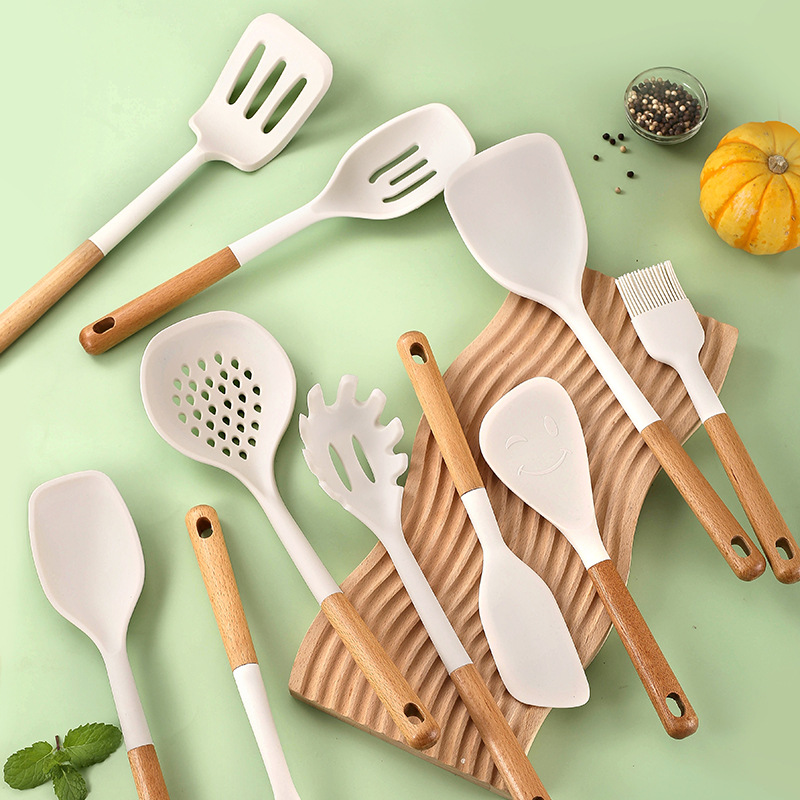
A transparent development process reduces delays, unexpected costs, and quality disputes. For most silicone kitchenware projects, the process should move through clear decision points.
The buyer shares the target market, product concept, desired quantity, price range, branding requirements, and delivery expectations. The manufacturer evaluates whether an existing design, modified design, or fully custom mold is most appropriate.
The supplier recommends suitable utensil models, materials, packaging options, and customization methods. The quotation should clarify:
- Product specifications
- Tool quantity per set
- Unit price basis
- Minimum order quantity
- Tooling cost, if applicable
- Packaging type
- Sample charges
- Lead time
- Shipping carton information
- Testing or inspection options
At this stage, the buyer approves colors, logo artwork, package layout, labeling language, and product dimensions. This is the best time to identify country-specific warnings, barcode requirements, and retailer packaging rules.
Samples are essential. They allow the buyer to inspect the silicone feel, flexibility, odor, color, logo quality, assembly, packaging, and overall presentation.
A useful sample review checklist includes:
- Is the silicone smooth and consistent?
- Does the utensil head feel appropriately firm for its intended function?
- Are seams, edges, and logo marks clean?
- Does the handle feel balanced in the hand?
- Does the set match the approved color reference?
- Is there any unacceptable odor?
- Does the packaging protect the products during shipment?
- Are all labels, warnings, and product claims accurate?
Before full production begins, the buyer should approve the final production standard. This may include a golden sample, approved packaging proof, color standard, and inspection criteria.
For volume programs, production planning matters. Yangjiang Hongyuan Trading Co., Ltd. operates from a 4,500 m² main facility and a 2,000 m² supporting facility, enabling coordinated production for large silicone kitchenware orders. Our capacity planning supports delivery of up to one million pieces within 60 days, subject to confirmed product specifications, packaging requirements, material availability, and order scheduling.
During production, quality control should focus on:
- Raw-material verification
- Silicone molding quality
- Color consistency
- Metal or wood handle assembly
- Logo placement
- Tool dimensions
- Surface cleanliness
- Packaging accuracy
- Carton drop resistance and shipment readiness
- Random final inspection based on agreed standards
Before shipment, buyers may conduct internal inspections, appoint a third-party inspection company, or use a mutually agreed quality-control process.
This step is especially important for supermarket, wholesale, and online retail orders, where a packing error can create substantial downstream costs.
Delivery performance is not just a factory issue. It is affected by artwork approval, color confirmation, packaging completion, testing schedules, raw material readiness, tooling needs, order complexity, and shipping arrangements.
For large-scale silicone kitchenware programs, buyers should avoid treating the production timeline as a last-minute detail. A 60-day production window for up to one million pieces requires early alignment on every major decision.
- Submit final artwork in the correct format.
- Confirm packaging dimensions early.
- Avoid changing colors after sample approval.
- Finalize required test standards before bulk production.
- Approve the set composition before purchasing materials.
- Confirm whether custom molds are required.
- Provide destination-market labeling requirements in advance.
- Build inspection time into the delivery plan.
- Reserve sufficient time for ocean freight, customs clearance, and warehouse receiving.
For seasonal retail programs, it is often wise to plan backward from the warehouse delivery date rather than the factory completion date. This protects the launch schedule if freight or customs processing takes longer than expected.
Selecting a supplier based only on the lowest price can create expensive problems later. A lower initial quotation may hide weak materials, limited testing support, inconsistent production, poor packaging control, or inadequate capacity.
A reliable silicone kitchenware manufacturer should be assessed across product, factory, compliance, communication, and commercial factors.
| Evaluation Area | Questions to Ask |
|---|---|
| Manufacturing capability | Can the supplier produce your required set quantity within the required delivery period? |
| Product experience | Does the supplier understand silicone molding, utensil construction, and food-contact applications? |
| Compliance support | Can the supplier provide relevant FDA, LFGB, REACH, ISO 9001, or BSCI information when needed? |
| Customization ability | Can they manage colors, logo methods, packaging, and product modifications? |
| Sampling quality | Are samples consistent, well-finished, and aligned with the quotation? |
| Quality-control process | What checks occur before, during, and after production? |
| Communication | Are specifications, quotations, and timelines documented clearly? |
| Export experience | Does the supplier understand labeling, packaging, and market expectations in your destination countries? |
| Scalability | Can the supplier support larger repeat orders without changing quality standards? |
The goal is not to find a supplier who says "yes" to everything. The goal is to find one who can identify risks early, propose workable alternatives, and execute consistently.
Even experienced buyers can face problems when product decisions are rushed. The following mistakes are especially common.
A beautiful color palette cannot compensate for tools that bend too easily, have poor edge finishing, or feel uncomfortable during use. Functional testing should be part of sample approval.
A factory certificate does not automatically prove that every product meets every destination-market requirement. Buyers should connect documentation to the specific product and target market.
Packaging affects retail presentation, protection, shipping cost, shelf placement, barcode scanning, and customer reviews. It should be developed alongside the product.
Screen colors are not enough for silicone production. Physical samples and approved color references reduce the risk of costly mismatches.
A bulky utensil holder or oversized gift box may look impressive but increase shipping and fulfillment costs. Product dimensions should be evaluated at both consumer and master-carton levels.
Small problems become large claims when thousands of sets are already in transit. Inspection is a practical investment, particularly for first orders and new product designs.
The best silicone kitchen tool set is rarely a one-time item. It can become the foundation for a larger kitchenware collection.
Once a core set is established, brands can add related products such as:
- Silicone baking mats
- Oven mitts and pot holders
- Ice cube trays
- Silicone food-storage bags
- Folding colanders
- Air fryer liners
- Silicone trivets
- Measuring tools
- Baking molds
- Kitchen organizers
- Baby feeding accessories, where appropriate product requirements are met
This range-building approach creates stronger brand recognition and gives customers more reasons to return. It also helps retailers build coordinated displays and online bundles.
For example, a retailer may begin with a six-piece silicone cooking utensil set in sage green. After validating demand, it can introduce matching baking mats, oven gloves, an air fryer liner, and a countertop utensil holder. The collection becomes easier to merchandise, easier to photograph, and more memorable for consumers.
A successful private-label silicone kitchenware program balances design, performance, compliance, cost, and dependable production. Brands that begin with a clear customer profile, product brief, safety plan, and realistic delivery schedule are better positioned to launch products that shoppers trust and retailers can reorder confidently.
Yangjiang Hongyuan Trading Co., Ltd. provides OEM and ODM support for silicone kitchen tools, silicone baking products, and custom kitchenware programs. We serve supermarkets, wholesalers, brand owners, and online retailers across global markets with flexible product development, certification support, controlled production, and scalable delivery capability.
Ready to create a silicone kitchen tool set that reflects your brand? Contact Yangjiang Hongyuan Trading Co., Ltd. with your target market, desired set configuration, quantity, logo file, and packaging idea to begin product development.
For entry-level retail, a three- to six-piece set can provide strong value while keeping costs controlled. For online sales and gift-oriented products, eight to 19 pieces may offer greater perceived value. The best size depends on your target customer, retail price, packaging dimensions, and sales channel.
Yes. Common logo options include embossed logos, debossed logos, printed logos, laser-marked logos, and branding on packaging. The most suitable method depends on the utensil material, handle construction, logo detail, order quantity, and desired product position.
Requirements depend on the destination market and product use. Buyers commonly request documentation related to FDA food-contact requirements for the United States, LFGB testing for demanding European programs, REACH-related compliance for EU markets, ISO 9001 quality-management systems, and BSCI social-compliance auditing. Always confirm the exact requirements with your importer, retailer, compliance team, or testing partner.
Lead time depends on product complexity, order quantity, tooling, color requirements, packaging, testing, and production scheduling. For large programs, early confirmation of all specifications is essential. Yangjiang Hongyuan Trading Co., Ltd. can support production planning for up to one million pieces within 60 days under confirmed order conditions.
Check material feel, flexibility, smell, color consistency, logo quality, handle strength, edge finishing, dimensions, packaging protection, labeling accuracy, and the overall fit with your brand position. Test key tools in realistic cooking conditions where possible.
Both relate to food-contact suitability, but they are associated with different regulatory and testing frameworks. FDA requirements are relevant to the U.S. market, while LFGB testing is widely requested for Germany and high-standard European food-contact programs. Buyers should define the destination market before finalizing the material and testing plan.
A manufacturer can typically support packaging specifications, dielines, printing requirements, barcode placement, carton optimization, and production of approved artwork. The brand should still provide final brand assets and ensure that product claims, warnings, and regulatory labeling are appropriate for the intended market.
1. U.S. Food and Drug Administration, "21 CFR Part 177—Indirect Food Additives: Polymers," including requirements related to rubber articles intended for repeated use. [FDA eCFR]
2. European Commission, "Framework Regulation (EC) No 1935/2004 on Materials and Articles Intended to Come into Contact with Food." [European Commission Food Contact Materials]
3. European Chemicals Agency, "Understanding REACH." [ECHA REACH Overview]
4. International Organization for Standardization, "ISO 9001 Quality Management Systems." [ISO 9001 Overview]
5. amfori, "amfori BSCI: Social Performance Management." [amfori BSCI]
6. U.S. Food and Drug Administration, "Food Contact Substances." [FDA Food Contact Substances]
7. Mordor Intelligence, "Kitchenware Market Size, Share & Industry Analysis." [Kitchenware Market Report] [mordorintelligence]
8. GreenVyne, "Food-Grade Silicone: FDA vs LFGB Explained." [Food-Grade Silicone Guide] [greenvyne.com]


